How Long Does It Take to Get Health Insurance as a New Resident in Lithuania?
Arriving in Lithuania is an exhilarating whirlwind of cobblestone streets and cold beet soup, but many expats realize too late that public health insurance (PSD) isn't automatic upon landing. This leaves a dangerous gap in coverage while you wait for residency permits and tax registrations to process. This guide provides a realistic timeline and actionable steps to ensure you stay protected from day one until your state benefits kick in.
The Reality of the Lithuanian Healthcare Timeline
When you first land in Vilnius or Kaunas, you are likely operating under the 90-day visa-free rule or a National D visa. One of the most common misconceptions I see in the expat community is the belief that "legal presence" equals "health coverage." In Lithuania, the two are miles apart. The public system, funded by the Compulsory Health Insurance Fund (PSDF), only recognizes you once you are a resident with an active social security contribution record. If you walk into a hospital on day four of your move without having registered your residency, you will be treated as a private patient, and the bills can be eye-watering.
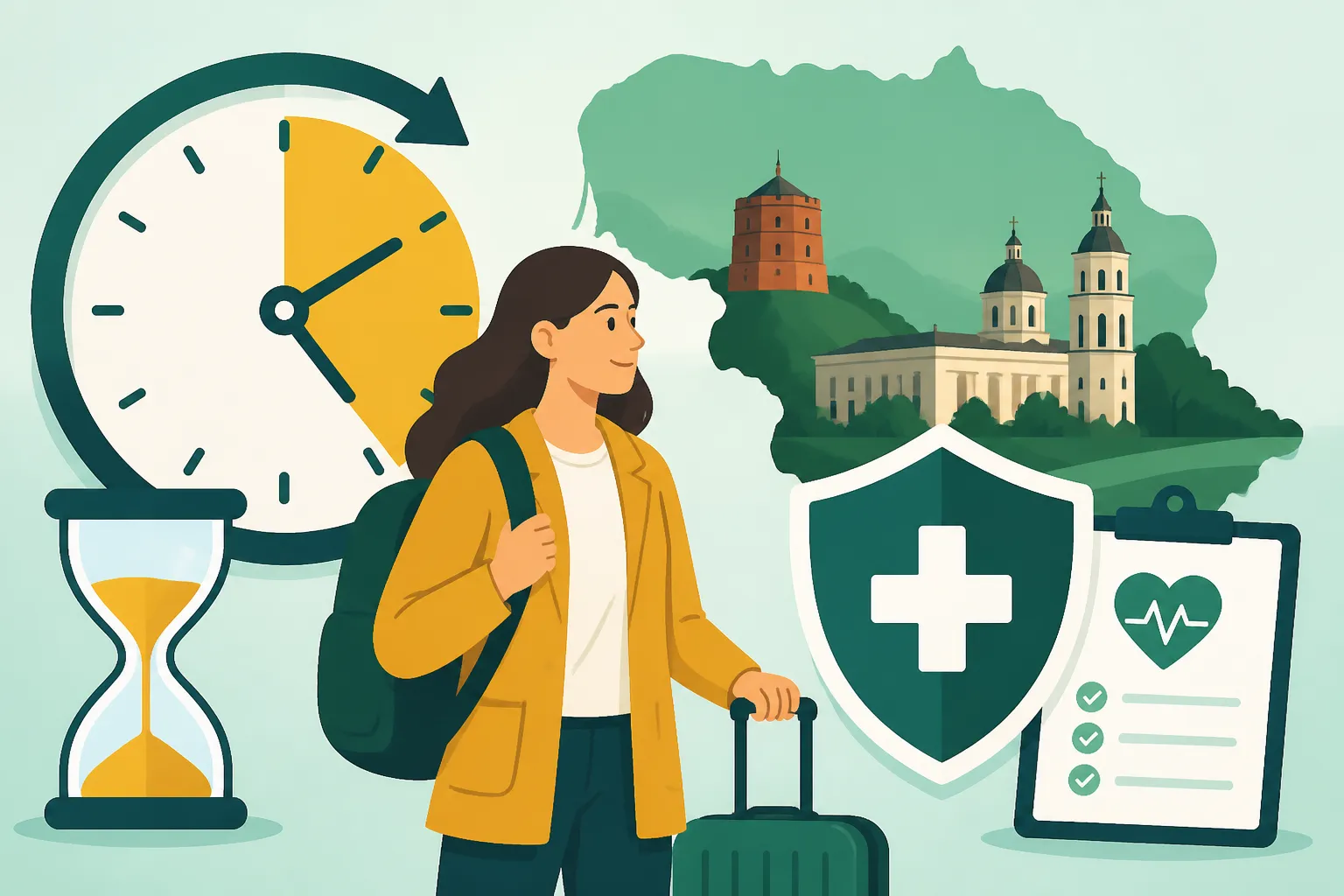
The "residency gap" is the period between your arrival and the moment your Temporary Residence Permit (TRP) is issued and your residence is declared. This process can take anywhere from two to four months depending on the backlog at the Migration Department (MIGRIS). During this time, you are effectively in a state of limbo. You are legally allowed to be here, but the public healthcare system doesn't "see" you yet. This is why Understanding Health Insurance Waiting Periods for New Residents in Lithuania is the first thing any newcomer should study before they even pack their bags.
Many expats try to "wing it" during these first few months. One friend of mine ended up with a nasty case of appendicitis while waiting for his TRP approval. Because his PSD wasn't active, he had to pay for the entire surgery and hospital stay out of pocket. It was a stressful, expensive lesson that could have been avoided with a bit of forward planning. You need to understand that the system is built on data synchronization between MIGRIS, the State Tax Inspectorate (VMI), and Sodra. If one link in that chain is missing, your insurance status will show as "uninsured" in the national database.
Steps to Obtaining Public Health Insurance PSD
The very first hurdle you will face is getting your personal identification code. You cannot interact with the healthcare system in any meaningful way without this number. It is the key that unlocks everything from banking to booking a doctor's appointment. If you are wondering how to start, you should check out How to Get Your Asmens Kodas (Personal Code) and Why It Matters for Healthcare to understand the weight this number carries. Generally, for non-EU citizens, this code is issued along with your residence permit. For EU citizens, it happens when you declare your place of residence.
Once you have your Asmens Kodas, the timeline depends heavily on your "basis" for insurance. If you are moving here for a job, your employer handles the heavy lifting. They must register you with Sodra (the Social Insurance Fund) on your very first day of work. Usually, your PSD status becomes "active" within 24 to 48 hours of that registration. However, if you are moving as a freelancer, the clock starts differently. You will need to know How to Register for PSD as a Self-Employed Person in Lithuania to ensure you aren't accidentally skip-paying and losing coverage. As a freelancer, you are responsible for making your own monthly contributions, and the system won't validate your coverage until the first payment is logged.
For those who are not working—perhaps you are here on a family reunification basis or as a student—the timeline can be even trickier. Students are often covered by the state if they are from the EU, but non-EU students usually need to provide proof of private insurance to get their visa in the first place. This is where a lot of people get caught in a loop: you need insurance to get the permit, but you need the permit to get the state insurance. This administrative "chicken and egg" scenario is a classic part of the Lithuanian expat experience. You have to navigate the bureaucracy with patience and a very thick folder of documents.
Bridging the Gap with Private Insurance
Because the public system has these inherent delays, having a bridge is not just a luxury; it is a necessity. Most immigration officers will actually require you to show proof of health insurance that covers at least 30,000 EUR for the entire duration of your visa or until your residence permit is issued. This is where many expats turn to flexible providers. For example, SafetyWing is a popular choice for digital nomads and new arrivals because it can be purchased on a month-to-month basis. Since you don't always know exactly which day your TRP will be approved, having a policy like SafetyWing that you can cancel once your PSD kicks in is a lifesaver.
Private insurance like SafetyWing acts as your shield during that 2-to-4-month waiting period. It covers emergencies and unexpected illnesses that the Lithuanian state won't touch until you are officially in their database. Newcomers are often advised to think of private insurance as their "landing gear." You wouldn't try to land a plane without it, and you shouldn't try to move to a new country without a health safety net. It gives you the peace of mind to focus on finding an apartment and learning how to say "Ačiū" without worrying that a trip to the ER will bankrupt you.
When choosing a bridge policy, make sure it meets the specific requirements of the Migration Department. They are quite strict about the wording of the policy and the coverage amounts. Using a reputable brand like SafetyWing ensures that the certificate you present at your MIGRIS appointment will be accepted without question. Once your TRP is in hand and you've visited the Seniūnija to declare your address, you can finally transition to the public system and stop your private premiums if you wish. However, some expats choose to keep a private policy active to avoid the long waiting lists often found in public polyclinics.
Insurance Activation Timelines by Category
To help you visualize how long this all takes, I've broken down the typical waiting periods based on your status in the country. Note that these are "best-case" scenarios assuming all your paperwork is in order.
| Expat Category | Trigger for Coverage | Estimated Time to Active PSD |
|---|---|---|
| Employee (Non-EU) | Signing contract & TRP issuance | 1 – 2 days after start date |
| EU Citizen (Job seeker) | Declaration of residence | 1 – 7 days after registration |
| Freelancer (Individual Activity) | Registration with VMI/Sodra | Immediate upon first payment |
| Student (Non-EU) | Enrollment & TRP issuance | Coverage usually remains private |
| Family Member (Non-EU) | TRP issuance & Address declaration | 2 – 5 days after registration |
As you can see from the table, the moment of "activation" is always tied to a specific bureaucratic event. For the employee, it’s the 1-SD form submitted by HR. For the freelancer, it's the 12-month advance payment or the start of monthly contributions. If you are curious about the specifics of these payments, Understanding PSD Contributions Through Sodra in Lithuania provides a deeper dive into the numbers. It is also worth noting that if you are an EU citizen and you have a valid European Health Insurance Card (EHIC), your timeline is much shorter, as you have immediate access to emergency care while your local residency is being processed.
However, even with the EHIC, you still need to register locally if you plan to stay long-term and access the full range of non-emergency services. The Lithuanian system is very digitalized. Once you are in, you will be using the Understanding the E-Sveikata (E-Health) system in Lithuania portal for everything from seeing your blood test results to getting prescriptions. But getting your name to appear in that digital portal for the first time is the finish line of a marathon that begins the moment you step off the plane.
Accessing Care Before Your Insurance is Active
What happens if the worst occurs and you need a doctor tomorrow, but your MIGRIS appointment isn't for another month? First, don't panic. Lithuania has an excellent network of private clinics like Grybo gatvė or Kardiolita that will see you without any local insurance. You will simply pay the full consultation fee at the reception. A typical visit to a specialist might cost between 60 EUR and 150 EUR. While this is expensive compared to the "free" public system, it is much faster and often more accessible for English speakers.
If it is a true life-or-death emergency, you should call the authorities immediately. You should memorize What Is the Emergency Phone Number in Lithuania? before you need it. In an emergency, hospitals are required to stabilize you regardless of your insurance status. However, once you are stable, the billing department will come knocking. This is why having that bridge insurance like SafetyWing is so critical. You can focus on recovery while the insurance companies handle the "how" and "when" of the payment.
For routine issues like a cold or a minor skin rash, many expats find it easier to just visit a private "šeimos gydytojas" (family doctor) and pay out of pocket. It saves the headache of trying to navigate the public polyclinic system before you have your Asmens Kodas. To prepare for this, make sure you know What Documents Do I Need to Get an Asmens Kodas in Lithuania? so you can speed up the process as much as possible. The faster you get your code, the faster you can How to Register for Compulsory Health Insurance (PSD) as a Foreigner in Lithuania and leave the world of out-of-pocket payments behind.
Factors That Can Delay Your Coverage
Despite your best efforts, things can go wrong. The most common delay is a "mismatch" in the databases. Perhaps your name is spelled with a special character in one system and not in another. Or maybe your employer forgot to hit "submit" on your Sodra registration. It is wise to check your status manually about a week after you think you should be covered. You can do this by logging into the Sodra portal or the VLK (State Health Insurance Fund) website using your bank link or e-signature.
Another major delay factor is the residency declaration. In Lithuania, you don't just "live" somewhere; you must "declare" it. This requires the consent of your landlord. If your landlord is hesitant to let you declare your residence at their property (a common issue in the rental market), your health insurance registration will stall. You cannot be fully integrated into the PSDF system without a declared address. Always clarify this with your landlord before signing a lease, as it directly impacts your ability to access healthcare.
Lastly, remember that the system doesn't backdate coverage. If you are uninsured for the month of March and you get sick on March 15th, but your insurance only activates on April 1st, you are on the hook for those March bills. There is no "grace period." This is why I advocate for overlapping coverage. Keep your SafetyWing policy active until you have physically logged into the E-Sveikata portal and seen your own name listed as "Apdraustas" (Insured). It is a small price to pay to avoid a massive financial headache in a country where you are still finding your feet.
Disclaimer
The information provided in this guide is for informational purposes only and does not constitute legal or medical advice. Healthcare regulations and immigration laws in Lithuania are subject to change. Always consult with the National Health Insurance Fund (vlk.lt), the Migration Department (migris.lt), or a qualified legal professional to confirm the most current requirements and procedures for your specific situation.