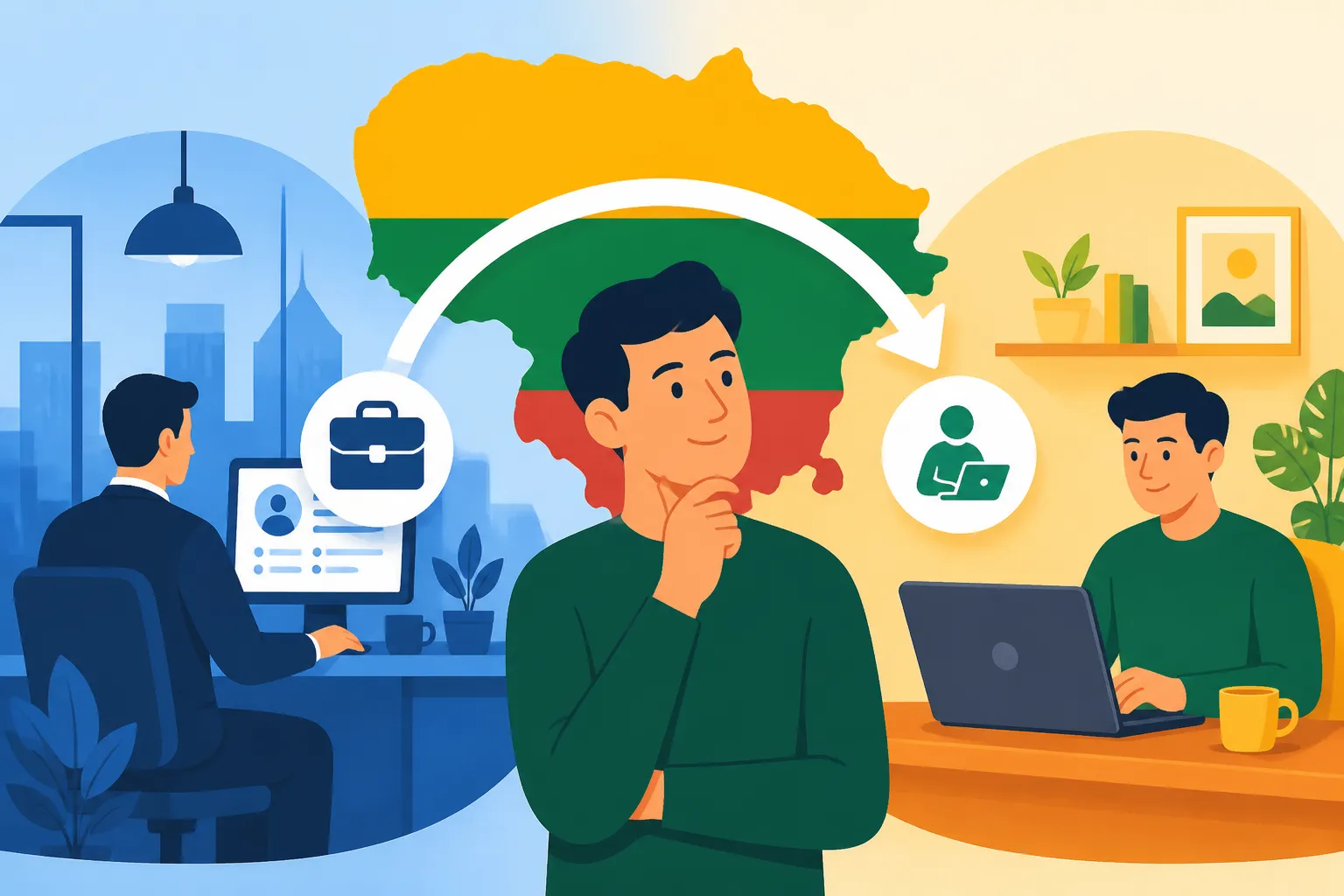
Can I Switch from Employment to Self-Employment in Lithuania?
Moving to Lithuania, many of us initially land secure, employed roles, navigating the corporate world in Vilnius, Kaunas, or Klaipėda. But after some time, a common thought begins to surface: what if I could be my own boss? What if I could take control of my work, set my own hours, and truly build something for myself here? The shift from traditional employment to self-employment in Lithuania is a significant one, riddled with administrative changes and new financial responsibilities, but it's absolutely achievable. This guide will walk you through the entire journey, from understanding the core differences to managing your finances, ensuring you're well-prepared for this exciting, albeit challenging, transition.
Understanding the Landscape: Employment vs. Self-Employment in Lithuania
When you first arrive, or even if you've been here for years, the stability of a traditional employment contract (darbo sutartis) is often reassuring. You have a clear salary, your employer handles all your taxes and social contributions, and you benefit from set working hours and annual leave. But for many, the allure of self-employment, with its promise of autonomy and flexibility, eventually becomes too strong to ignore. The systems are fundamentally different, and understanding these distinctions is the first crucial step before you even think about making the switch.
The Core Differences: Rights, Responsibilities, and Benefits
As an employee in Lithuania, you're protected by the Labour Code (Darbo Kodeksas). This means your employer is responsible for your social security (Sodra) contributions, ensuring you have health insurance (PSD), pension contributions, and coverage for sick leave, maternity leave, and unemployment benefits. Your income tax (GPM) is also deducted at source. You have defined working hours, usually 40 hours a week, and a guaranteed number of annual leave days. This structure provides a safety net and predictability.
However, as a self-employed individual, particularly if you choose the popular "individual activity" (individuali veikla) route, you become responsible for all these aspects yourself. There's no employer to deduct your taxes or manage your social contributions. You decide your working hours, but you also bear the full weight of finding clients, invoicing, marketing, and the administrative burden that comes with running your own show. The financial benefits of self-employment often hinge on the potential for higher earnings and greater deductions for business expenses, but this comes with increased risk and administrative tasks. You'll also find that benefits like sick pay or parental leave are calculated differently and often require proactive management of your own contributions to Sodra Social Insurance in Lithuania: The Full Guide.
Why Expats Consider the Switch
The reasons expats in Lithuania contemplate this switch are as diverse as the individuals themselves. For some, it's about pursuing a passion that doesn't fit neatly into a traditional job description. Perhaps you're a skilled designer, consultant, or content creator who sees a gap in the market here or wants to serve international clients from your Lithuanian base. The vibrant startup scene in Vilnius, particularly in tech and fintech, also inspires many to strike out on their own.
Others might be looking for more flexibility in their schedule, especially those with families or those who prefer to travel frequently. The idea of being able to choose your projects, decline work that doesn't align with your goals, and truly own your professional journey can be incredibly liberating. It's also an attractive option for those who feel constrained by corporate structures or believe they can earn more by directly charging for their expertise. Many see it as a natural progression once they've established a network and understand the local market dynamics.
The Practicalities of Making the Leap: Key Steps and Considerations
Deciding to go solo is just the beginning. The actual transition involves several crucial steps, from formally leaving your current employment to registering your new self-employed status and understanding the different legal forms available. It's not a decision to be taken lightly, as each step has its own set of requirements and implications.
Closing Your Employment Chapter: Notice Periods and Formalities
The first practical step is to formally end your current employment. This typically involves tendering your resignation in writing, adhering to the notice period stipulated in your employment contract (nuomos sutartis) and by Lithuanian law. The standard notice period for an employee is usually 14 calendar days, though this can vary depending on your contract, collective agreements, or specific circumstances like probation periods. It's vital to check your contract carefully.
During this period, ensure you wrap up all your responsibilities, transfer knowledge, and maintain a professional relationship with your employer. You might need reference letters for future endeavours, and burning bridges is never a good idea. Make sure to discuss any outstanding vacation pay, final salary, and the return of company property. Your employer will issue you a final statement, which will be important for your records, especially when it comes to understanding your past income for tax purposes. For a deeper dive into these rules, consult our guide on Understanding Notice Periods Under the Lithuanian Labour Code.
Choosing Your Self-Employment Path: Individual Activity vs. MB
In Lithuania, the most common forms of self-employment for individuals are "individual activity" (individuali veikla) and establishing a Small Partnership (Mažoji Bendrija, MB). Each has distinct legal, tax, and administrative implications.
-
Individual Activity (Individuali Veikla): This is the most straightforward and popular option for freelancers, consultants, and small business owners. You operate as a natural person, not a separate legal entity. This means you are personally liable for any debts or obligations of your business. The setup process is relatively simple, primarily involving registration with the State Tax Inspectorate (VMI). The taxation is generally simpler too, with lower rates for smaller incomes. This is often the preferred choice for those just starting out or providing services rather than selling physical products with significant overhead.
-
Small Partnership (Mažoji Bendrija, MB): An MB is a legal entity, similar to a limited liability company but designed for small businesses with up to 10 members. It provides limited liability, meaning your personal assets are separate from the business's debts. This offers greater protection if your business ventures into higher-risk areas or requires significant investment. Setting up an MB is more complex, involving registration with the Centre of Registers (Registrų Centras) and requiring a foundational document (like articles of association). The accounting and tax rules are also more intricate, often necessitating the help of an accountant. Many expats consider an MB once their individual activity grows substantially or they plan to hire employees. For detailed steps, check out How to Set Up a Small Partnership (Mažoji Bendrija, MB) in Lithuania.
Your choice should depend on your specific business activity, expected income, risk tolerance, and future plans. Many start with individual activity and transition to an MB later if needed.
Navigating the Bureaucracy: Registrations and Initial Setup
Once you've decided on your self-employment structure, it's time to tackle the bureaucracy.
-
Get Your Asmens Kodas (Personal Code): If you don't already have one, this is absolutely essential. It's your unique identification number in Lithuania and required for almost all administrative procedures. Our guide on How to Get Your Asmens Kodas Personal Code and Why It Matters for Healthcare provides all the details.
-
Register with the State Tax Inspectorate (VMI): This is where you declare your intention to engage in individual activity. You can do this online through the My VMI (Mano VMI) portal or in person at a VMI branch. You'll need to specify your type of activity (e.g., IT services, consulting, artistic creation) using specific codes. This is a critical step for How to Register Individual Activity (Individuali Veikla) in Lithuania.
-
Register with Sodra (Social Insurance Fund): As a self-employed person, you are responsible for your own compulsory health insurance (PSD) and social insurance contributions. Even if you're not working, you'll still need to pay PSD each month to ensure you have health coverage. If you are generating income, you'll also contribute to the state social insurance fund, which covers your pension, maternity/paternity, and sickness benefits. This is a major change from employment, where your employer handles this.
-
Open a Business Bank Account (Optional but Recommended): While not legally required for individual activity, it's highly recommended to open a separate bank account for your business income and expenses. This simplifies accounting, tax declarations, and generally keeps your personal and business finances clear. Banks like Swedbank, SEB, and Luminor offer business accounts, and often fintech solutions like Revolut Business or Wise are also popular among freelancers. For more on banking, refer to How to Open a Bank Account at a Lithuanian Bank as a Foreigner.
-
Consider an Accountant: Especially if you're not fluent in Lithuanian or are unfamiliar with local tax laws, hiring an accountant can save you a lot of headaches. They can help with monthly declarations, annual tax returns, and ensuring compliance, preventing costly mistakes.
Financial and Tax Implications: What Changes When You Go Solo
This is perhaps the most significant area of change. As an employee, your financial life is relatively simple regarding taxes and contributions. As a self-employed individual, you become your own finance department. Understanding these changes is paramount to avoiding unexpected tax bills and ensuring you're covered for essential services like healthcare.
Understanding Your New Tax Responsibilities
When you switch to self-employment, you're no longer receiving a net salary; you're receiving gross income. This means you need to put aside money for taxes yourself. For individual activity, the income tax (GPM) rate is progressive, starting at 5% and potentially increasing to 15% for higher incomes. These rates apply after deducting allowable expenses.
You'll also need to consider Value Added Tax (PVM or VAT). If your annual revenue from individual activity exceeds €45,000 within a calendar year, you are legally required to register for VAT. This means you'll add VAT to your invoices and periodically pay it to the VMI. However, for most starting out, staying below this threshold simplifies things. It's a good idea to seek advice from a professional or utilize resources like "Taxes for Expats" to understand your specific obligations. They can help clarify the nuances of the Lithuanian tax system for self-employed foreigners.
Let's look at the general tax rates for Individual Activity (with a business certificate, verslo liudijimas, being a simpler, often fixed-tax option for very specific activities, but individual activity is more common for most service-based freelancers):
| Tax Type | Calculation Basis | Rate (2024, approx.) | Notes |
|---|---|---|---|
| Income Tax (GPM) | (Income – Allowable Expenses) | 5-15% | 5% for profits up to approx. €20,000; then progressively increases to 15% for higher profits. |
| Compulsory Health Ins. (PSD) | 6.98% of 90% of your declared monthly income (from previous month) or 6.98% of the minimum monthly salary (MMA) if no income. | Fixed monthly amount if no income. | Paid monthly. This guarantees public healthcare access. See How Much Is the Monthly PSD Contribution Through Sodra? for current figures. |
| State Social Ins. (VSD) | 12.52% of 90% of your declared monthly income (from previous month) | 12.52% | Paid monthly, covering pension, sickness, maternity/paternity. Capped annually. |
| VAT (PVM) | Turnover exceeding €45,000/year (optional below this) | 21% (standard) | Only applicable if you register for VAT or exceed the threshold. |
Note: These rates are indicative and subject to change. Always consult official VMI and Sodra sources or a tax professional.
You will need to use the VMI Electronic Declaration System (EDS) to declare your income and pay your taxes annually. Keeping meticulous records of all your income and expenses is vital for your annual tax return. For a complete understanding of your obligations, a deep dive into The Complete Guide to Taxes in Lithuania for Expats (2027) is highly recommended.
Social Security and Healthcare Contributions
This is a point where many expats transitioning to self-employment get tripped up. As an employee, your employer took care of your PSD (compulsory health insurance) and VSD (state social insurance, including pension). Now, it's all on you.
-
Compulsory Health Insurance (PSD): Regardless of whether you're earning income, if you are a resident in Lithuania, you are generally required to pay PSD monthly. If you have no income for a given month, you'll still pay a fixed amount based on the current minimum monthly salary (MMA). This ensures your access to the public healthcare system. This is a crucial element of Registering for Compulsory Health Insurance (PSD) in Lithuania (2027).
-
State Social Insurance (VSD): If you are generating income from your individual activity, you will also pay VSD contributions. These contributions go towards your pension, sickness benefits, and maternity/paternity benefits. The amount is calculated as a percentage of your declared income, similar to GPM. These contributions are important for your future security, as they build up your entitlement to state benefits.
Missing these contributions can lead to penalties and, more importantly, loss of access to public healthcare services. You can often manage these payments through the Sodra portal, much like you would manage your How to Set Up Your Account on the Patient Portal in Lithuania.
Managing Your Income and Expenses
As a self-employed individual, the line between personal and business finances can blur, but it's crucial to keep them separate.
-
Invoicing: You'll need to create professional invoices for your clients. These should include your personal code, your client's details, a clear description of services, the amount, and payment terms. There are many online invoicing tools available.
-
Expense Tracking: This is where you can significantly reduce your tax burden. Many expenses directly related to your individual activity are deductible. This can include office supplies, internet, phone, certain software subscriptions, professional development courses, and sometimes even a portion of your home utilities if you work from home. Keep every receipt and record every expense meticulously.
-
Financial Planning: Since your income might fluctuate, it's wise to build up a financial cushion. Set aside a percentage of every payment you receive specifically for taxes and social contributions. Many self-employed individuals aim to save at least 25-30% of their gross income for this purpose. Also, consider setting up a buffer for slower months or unexpected expenses. This newfound financial responsibility means careful budgeting and forecasting become a regular part of your routine.
Life as a Self-Employed Expat: Challenges and Rewards
Making the switch isn't just about paperwork and taxes; it's a fundamental change in lifestyle and professional identity. It comes with its own unique set of challenges that expats often feel more acutely, but also incredible rewards that make the journey worthwhile.
Building a New Network and Client Base
When you're employed, clients and projects often come to you through your company. As a freelancer or small business owner, you are the face of your business, and finding work becomes your responsibility. This means actively networking, both online and offline. Join expat groups, professional associations, and local business meetups. Platforms like LinkedIn are invaluable for connecting with potential clients and collaborators. Don't underestimate the power of word-of-mouth referrals.
Language can sometimes be a barrier, especially if your services are primarily aimed at the local Lithuanian market. While many Lithuanians, especially in younger generations and in cities like Vilnius, speak excellent English, mastering some basic Lithuanian phrases can open doors and build trust. Consider using language learning platforms like iTalki to practice your Lithuanian skills. Even a little effort goes a long way in showing respect for the local culture and can enhance your professional interactions. For more on this, our guide on Learning Lithuanian: A Complete Guide to Language Courses and Levels can provide useful insights.
Maintaining Work-Life Balance and Well-being
One of the biggest promises of self-employment is flexibility, but it can also be its biggest challenge. The lines between work and personal life can easily blur, especially if you're working from home. It's tempting to constantly be "on" and respond to emails late into the night. However, burnout is a real risk.
It's crucial to establish routines, set clear working hours, and carve out dedicated time for yourself and your family. Learn to say no to projects that don't align with your goals or that stretch you too thin. Prioritize your mental and physical health. This is particularly important for expats, who might not have the same immediate support networks as locals. Make sure you understand how to access healthcare services, even as a self-employed individual, by reading The Complete Guide to Healthcare in Lithuania for Expats (2027).
The Freedom and Flexibility
Despite the challenges, the rewards of self-employment are often immense. The freedom to choose your projects, set your own rates, and manage your time can lead to a profound sense of job satisfaction and personal fulfillment. You're no longer just a cog in a machine; you're building something of your own, seeing the direct impact of your efforts.
For expats, it can also mean greater integration into the local economy and culture. You might find yourself collaborating with Lithuanian businesses, understanding market needs in a deeper way, and contributing directly to the vibrant entrepreneurial spirit of the country. The ability to work from anywhere, whether it's a cozy café in Vilnius Old Town or a quiet cabin by a lake, offers a lifestyle that many dream of. It's a journey of continuous learning, self-discovery, and building a professional life that truly reflects your aspirations in Lithuania.
Disclaimer
Please note that this guide provides general information and does not constitute legal, tax, or financial advice. Laws and regulations in Lithuania are subject to change. It is always recommended to consult with a qualified legal, tax, or financial professional in Lithuania for advice tailored to your specific situation.