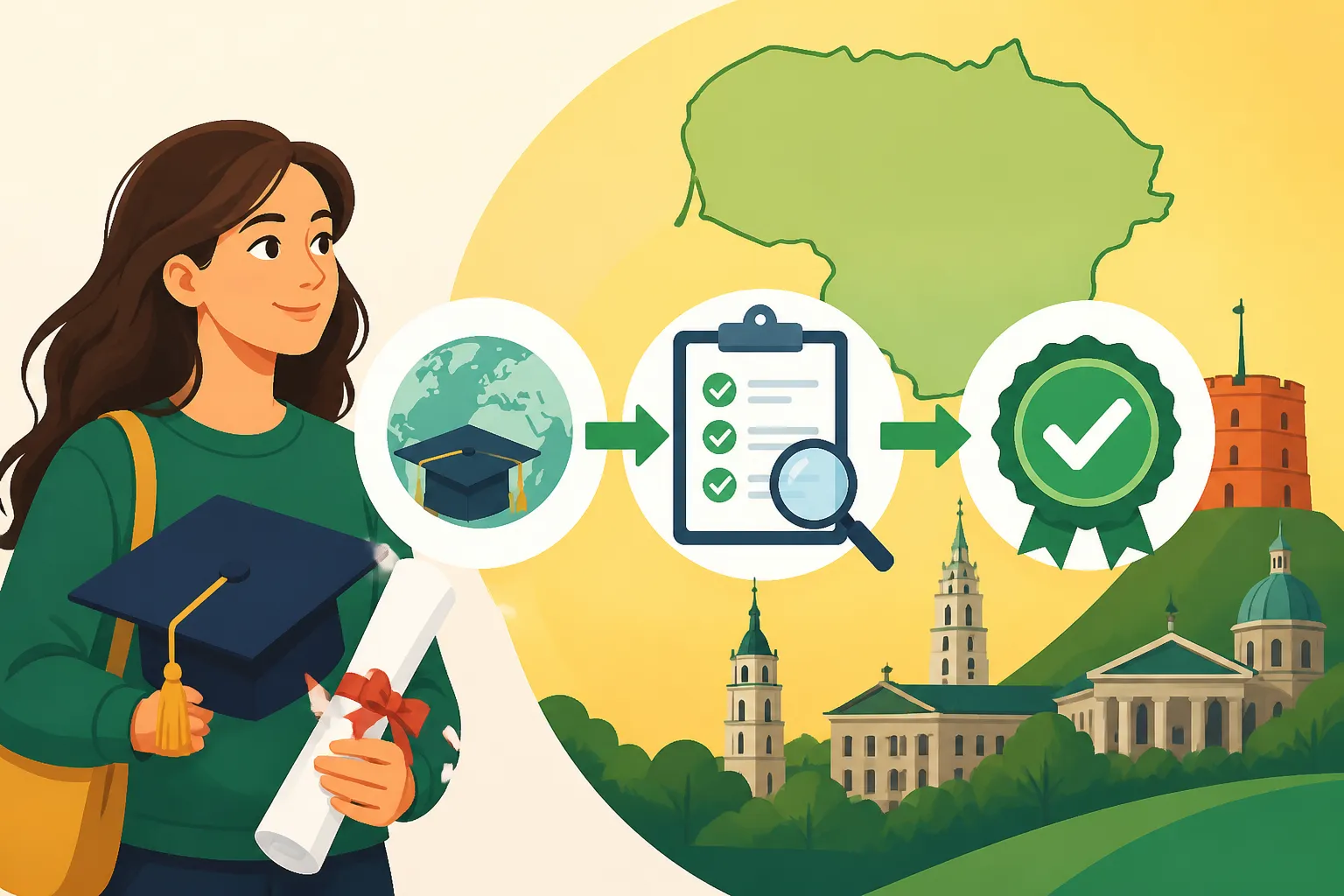
How to Get Your Foreign Degree Recognised (SKVC) in Lithuania
Oh, the joy of moving to a new country and realizing that the perfectly valid degree you earned back home might as well be written in invisible ink as far as local institutions are concerned! It's a common expat frustration, believe me, and Lithuania is no exception. That diploma you proudly hung on your wall? Here, it often needs to go through an official evaluation process to be fully understood and accepted. This comprehensive guide will walk you through the ins and outs of getting your foreign degree recognized by the Centre for Quality Assessment in Higher Education, better known as SKVC, demystifying a process that many find daunting.
Understanding Why Degree Recognition Matters in Lithuania
When you first arrive in Lithuania, brimming with your international experience and qualifications, it can be a bit of a shock to learn that your university degree, which was perfectly acceptable everywhere else, might not be immediately understood or accepted at face value. This isn't because Lithuania doesn't value foreign education; it's simply a function of differing educational systems and the need for standardized assessment. For many expats, this recognition process through the SKVC (Studijų kokybės vertinimo centras) becomes a necessary bureaucratic hurdle to clear, impacting everything from your job prospects to your ability to pursue further studies.
The 'Why' Behind the Bureaucracy: Employment and Further Study
Your initial reaction might be, "Why bother? My degree is from a reputable university!" And you're right to feel that way. However, Lithuania, like many countries, has specific requirements, especially for certain professions or for roles within public institutions. Imagine applying for a job in a large Lithuanian company or a governmental agency. While a private startup might be more flexible and just want to see your skills, a more traditional employer or any public sector job will almost certainly ask for proof that your foreign qualification is formally recognized as equivalent to a Lithuanian one. This recognition assures them that your education meets local standards and qualifications frameworks.
Beyond immediate employment, degree recognition becomes non-negotiable if you plan to continue your academic journey here. Dreaming of a Master's or a PhD at Vilnius University or Kaunas University of Technology? Then having your previous degree formally recognized by SKVC is usually a prerequisite for admission. Even certain vocational courses might require it to ensure you meet the foundational educational requirements. Without this formal stamp of approval, universities simply cannot assess your eligibility fairly against their local applicants. It’s about creating an equitable playing field and ensuring quality control across the board.
Ultimately, navigating the recognition process, while feeling like an extra step, is an investment in your long-term professional and academic integration into Lithuanian society. It removes ambiguity, provides legitimacy, and significantly smooths the path for your career and educational aspirations here. Think of it as translating your academic achievements into the local language of qualifications. This foundational step often goes hand-in-hand with securing your overall right to live and work here. For instance, successfully navigating this process can sometimes be as crucial as understanding How to Get a Work Permit and National (D) Visa in Lithuania or The Complete Guide to Working in Lithuania as a Foreigner (2027).
SKVC: Your Gateway to Lithuanian Professional Life
So, who is this mysterious SKVC? The Centre for Quality Assessment in Higher Education (Studijų kokybės vertinimo centras, SKVC) is the central authority in Lithuania responsible for evaluating foreign qualifications. It’s not just one of several options; for most academic and general professional recognition purposes, SKVC is your designated port of call. Their main role is to assess foreign higher education qualifications and provide information on the Lithuanian education system, ensuring that international degrees are properly understood and valued within the national framework.
The SKVC acts as a gatekeeper, of sorts, though their intention is to standardize, not just to complicate matters for newcomers. They compare your foreign degree's level, content, and quality against the Lithuanian education system. This ensures that a Master's degree from, say, Canada, is indeed equivalent to a Magistro laipsnis from a Lithuanian institution. They are designed to provide an objective, expert assessment, removing the burden from individual employers or universities to evaluate degrees from countless different global systems.
While SKVC primarily handles academic recognition, they are also a crucial first point of contact for those whose professions are regulated in Lithuania. Even if the final decision for a regulated profession rests with a different body, SKVC will often provide an initial academic assessment or guide you to the correct authority. Understanding the role of the SKVC is your first critical step. They are the official channel through which your foreign educational achievements gain formal currency in Lithuania, making your overall journey into the Lithuanian professional landscape much smoother.
Distinguishing Between Academic and Professional Recognition
It’s crucial to understand that not all degree recognition is the same. There are two main types you’ll encounter in Lithuania: academic recognition and professional recognition. While they both involve assessing your foreign qualification, their purpose, process, and the authorities involved can differ significantly. Misunderstanding this distinction can lead to wasted time and effort, so let’s break down what each means for you.
Academic Recognition for General Purposes
Academic recognition is what SKVC primarily focuses on, and it’s likely what most expats will need. This process determines the academic value of your degree in comparison to the Lithuanian higher education system. Essentially, SKVC assesses whether your Bachelor's degree from, for example, Australia, is equivalent to a Lithuanian bakalauras degree, or if your Master's aligns with a magistro laipsnis. They look at the level, the field of study, the learning outcomes, and the duration of your studies to make this determination.
You'll typically need academic recognition if you're planning to:
- Apply for general jobs where the profession isn't legally regulated (e.g., IT specialists, marketing managers, business analysts, project coordinators, many roles in the private sector). While some progressive private companies might not strictly require it, having this official document removes any doubt for HR departments, especially in larger or more established firms.
- Pursue further education in Lithuania, such as another Master's degree, a PhD, or even specific advanced vocational training. Lithuanian universities require academic recognition to evaluate your eligibility for their programs. You can find more details on this process in guides like The Complete Guide to Studying at a Lithuanian University (2027) or How to Apply to a Lithuanian University as an International Student.
- Gain an official, universally understood statement of your educational level within Lithuania. Even if you're self-employed, having this recognized status can bolster your credibility with clients or partners.
The process for academic recognition is generally handled entirely by the SKVC. They will issue you an official certificate stating the equivalence of your foreign qualification to a corresponding Lithuanian degree. This certificate is your golden ticket for proving your academic standing in Lithuania for most non-regulated fields.
Professional Recognition for Regulated Professions
Now, this is where things get a bit more complex. Professional recognition is required if your occupation falls under the category of a "regulated profession" in Lithuania. These are professions where specific qualifications, experience, and often licensing are legally mandated to protect public health, safety, or other public interests. Think of doctors, nurses, pharmacists, architects, lawyers, teachers, certain engineers, and social workers. These professions aren't just about having a degree; they often involve very specific curricula, practical training requirements, and professional ethics that need to align with national standards.
For regulated professions, the SKVC might perform an initial academic assessment to determine the level of your degree. However, the ultimate decision for professional recognition often rests with the specific professional body or ministry responsible for that field. For example:
- Doctors and nurses would typically apply to the Ministry of Health or its delegated agencies.
- Lawyers might go through the Ministry of Justice or the Lithuanian Bar Association.
- Teachers would deal with the Ministry of Education, Science and Sport.
The process for professional recognition is usually much more detailed and can involve comparing your entire curriculum course by course, assessing your practical experience, and sometimes requiring additional internships, adaptation periods, or supplementary examinations to cover any differences in training. It can be a longer, more intricate journey, and expats often find this path challenging due to the specific, sometimes unique, requirements of each professional body. It's vital to identify early on if your profession is regulated in Lithuania, as this will dictate your entire recognition strategy. You can usually find a list of regulated professions on the European Commission's database or through the relevant Lithuanian ministry websites. This pre-assessment is crucial to avoid delays and ensure you're knocking on the right door from the start.
The Documents You'll Need for Your SKVC Application
Gathering the correct documents is arguably the most critical and often the most frustrating part of the degree recognition process in Lithuania. It feels like a treasure hunt, doesn't it? One missing paper, one uncertified translation, and your application can come to a screeching halt. The SKVC is quite particular about what they require, and for good reason – they need solid proof to make an informed assessment of your qualifications. So, let’s go through the essential paperwork you'll need to prepare.
Core Application Documents
First and foremost, you’ll need to prove who you are and your right to be in Lithuania. This typically includes a copy of your passport or national ID card and, if you're a non-EU/EEA citizen, your Lithuanian residence permit. It's always wise to have both originals and certified copies ready, even if the initial application is online. For instance, obtaining your How to Get Your Asmens Kodas Personal Code and Why It Matters for Healthcare will be an important prerequisite, as this personal code is often used for identification in various official processes, including your SKVC application.
The absolute stars of the show are your academic documents:
- Your original degree certificate/diploma: This is the official document confirming you completed your studies and were awarded the degree.
- Academic transcripts or diploma supplement: This is often even more important than the diploma itself! It provides a detailed breakdown of all the courses you took, the credits awarded (often in ECTS if applicable), the grades you received, and the total duration of your study program. The SKVC uses this to compare the content and workload of your studies to Lithuanian standards. Make sure it's comprehensive.
- If your country is part of the 1961 Hague Apostille Convention, your original degree certificate and transcripts will likely need an Apostille stamp. This is an international certification that legalizes public documents for use in other countries that are also party to the convention. If your country is not part of this convention, you might need to go through a full legalization process, which typically involves obtaining certification from your country’s Ministry of Foreign Affairs, and then further legalization by the Lithuanian embassy or consulate in your home country. This can be a lengthy and costly process, so research this requirement for your specific country well in advance.
- Proof of name change: If the name on your academic documents differs from your current legal name (e.g., due to marriage), you'll need to provide official documentation like a marriage certificate or a court order confirming the name change. All documents must match your current identification.
Translation and Certification Requirements
This is where many expats hit their first major snag – the translation requirements. All documents that are not originally in Lithuanian, English, or Russian must be officially translated into Lithuanian. And no, Google Translate won't cut it, nor will your bilingual friend. These translations must be:
- Certified translations: This means the translation must be performed by a sworn translator (in Lithuania, often by a notary-certified translator) or by a translation agency whose signature is certified by a notary. The translator attests to the accuracy of the translation.
- Costly: Be prepared for these costs. Official translations can add a significant amount to your overall application expenses. Prices can vary, but expect to pay per page or per word. It's worth getting a few quotes from different certified translation bureaus in major cities like Vilnius or Kaunas.
The importance of accuracy in translation cannot be overstated. Even minor errors or ambiguities can lead to your application being returned or delayed, as SKVC will need clarification. It's often a good idea to double-check the translated documents against the originals if you have any proficiency in Lithuanian or ask a trusted local to review them. This meticulous approach to documentation and translation, while tedious, is absolutely essential for a smooth recognition process.
Here's a quick summary table of key documents:
| Document Category | Specific Document | Requirement/Notes |
|---|---|---|
| Identification | Passport or National ID Card | Copy of valid identification. |
| Lithuanian Residence Permit (if applicable) | Copy for non-EU/EEA citizens. | |
| Academic Proof | Original Degree Certificate/Diploma | Proof of awarded qualification. |
| Academic Transcripts / Diploma Supplement | Detailed list of courses, grades, credits, and study duration. Crucial for assessment. | |
| Legalization (if needed) | Apostille or Legalization Stamp | Required for documents from countries party to the Hague Apostille Convention or full consular legalization for others. Check your country's status! |
| Translations | Certified Translations into Lithuanian | For all documents not in Lithuanian, English, or Russian. Must be certified by a sworn translator or notary. Factor in cost and time. |
| Supporting Documents | Proof of Name Change (if applicable) | Marriage certificate, court order, etc., if name on academic docs differs from ID. |
| Proof of Payment of Application Fee | Receipt or confirmation of the SKVC application fee. | |
| Completed SKVC Application Form | Filled out online via the SKVC portal. |
Navigating the SKVC Application Process Step-by-Step
Once you've diligently gathered and prepared all your documents, it's time to actually submit your application to the SKVC. This part of the journey is largely digital, thanks to their online portal, but it still requires careful attention to detail to ensure everything goes smoothly. Don't be shy about seeking help if you hit a language barrier or find yourself stumped by a particular section, as the portal itself is primarily in Lithuanian.
Initial Application and Submission
The first step is to visit the official SKVC website and locate their online application portal. You’ll need to create an account if you don’t already have one. Think of it like any online government service you've used before – you register, confirm your email, and then you're granted access to the digital forms. As mentioned, the portal is predominantly in Lithuanian, so having a good web browser with translation features or a kind Lithuanian-speaking friend on standby can be a real lifesaver. This is a common expat reality when dealing with official processes, much like Learning Lithuanian A Complete Guide to Language Courses and Levels.
The online application form itself requires you to input personal details, information about your educational institution, the degree you obtained, and the purpose of your recognition (e.g., employment, further study). Be meticulous when filling this out; even small typos can cause confusion. After completing the form, you’ll be prompted to upload scanned copies of all your prepared documents. This includes your apostilled/legalized diploma, transcripts, certified translations, ID, and any name change documents. Ensure your scans are clear, legible, and in the correct file format (usually PDF is preferred) to avoid any issues. Make sure the file sizes are manageable but also high enough quality for readability.
Finally, you’ll need to pay the application fee. The fee amount can change, so always check the latest rates on the SKVC website. This payment is typically done online via bank transfer or credit/debit card. Make sure to keep a copy of your payment confirmation, as it's often required as part of your submission. Once all forms are filled, documents uploaded, and fees paid, you can hit that "submit" button. A confirmation email or message in the portal usually indicates successful submission.
The Assessment and Communication Phase
After you've submitted your application, the waiting game begins. The SKVC will review your application to ensure all required documents are present and correctly formatted. This initial check is crucial. If anything is missing or unclear, they won't proceed with the full assessment until it's rectified. Don't be surprised if you receive a request for additional information – this is actually quite common and doesn’t necessarily mean there’s a problem with your degree. They might ask for more details on specific courses, grading systems, or even course descriptions from your university's official catalogue to get a clearer picture of your studies.
It's vital to respond to any requests for information promptly and comprehensively. The quicker and clearer your response, the faster your application can move forward. Use the same online portal or designated email channels for communication. The typical processing time for academic recognition can vary, but generally, you can expect it to take anywhere from one to two months for straightforward cases. However, complex cases, especially those involving regulated professions or requiring extensive document comparisons, can take longer. Factors like high application volumes or the need for clarification from your former university can also extend these timelines. Patience, as with much of Lithuanian bureaucracy, is a virtue here.
Receiving Your Recognition Decision
The moment you've been waiting for! You will receive notification of SKVC's decision, typically through the online application portal and/or via postal mail to your declared address. If your application is successful, you'll be issued an official Certificate of Recognition (Pažyma apie užsienio kvalifikacijos pripažinimą). This certificate will officially state the equivalence of your foreign qualification to a corresponding Lithuanian degree, detailing the level (e.g., Bachelor's, Master's) and often the field of study. This is the document you've been working towards!
Once you have this certificate, treat it like gold. Keep the original safe, and make several certified copies. You'll need to provide these copies to potential employers, universities if you plan further studies, or any other institution that requires proof of your recognized degree. This official document removes any doubt about the validity and level of your education in Lithuania.
What if the decision isn't what you hoped for? In some cases, SKVC might issue a negative decision or a partial recognition (e.g., your Master's is recognized as a Bachelor's with additional conditions). If you disagree with the decision, you usually have the right to appeal within a specified timeframe. This would involve submitting additional arguments or documents to support your case. It’s also possible to accept a partial recognition if it still meets your immediate needs. Regardless of the outcome, understanding the SKVC's decision and your options is crucial for planning your next steps in Lithuania.
Common Challenges and Tips for Expats
Navigating the degree recognition process can feel like a labyrinth, especially when you're dealing with a new country's administrative system. As an expat, you're not just dealing with paperwork; you're also often battling language barriers, cultural differences, and the sheer unpredictability of bureaucratic timelines. But don't despair! Many have walked this path before you, and there are ways to mitigate these common challenges.
Language Barriers and Cultural Nuances
Let's be honest, the biggest hurdle for many non-Lithuanian speakers is, well, the language itself. While you might find some information in English on the SKVC website, the online portal for applications and much of the official correspondence will likely be in Lithuanian. This can be incredibly frustrating when you're trying to fill out detailed forms or understand specific requests for additional information. It’s during these times that having a local Lithuanian friend, a colleague, or even a professional assistant can be invaluable. They can help translate specific terms, understand the nuances of the questions, and ensure you're providing accurate information.
Beyond just the language, there are cultural nuances in educational systems. What might be standard practice in your home country regarding transcripts or course descriptions might be unfamiliar to SKVC assessors. For example, the way ECTS credits are applied or how practical training is documented can differ significantly. Be prepared to clearly explain the specifics of your degree program if asked. This openness to clarification and willingness to provide detailed context can make a huge difference in the assessment process. For expats looking to improve their Lithuanian skills, even just enough for daily interactions or navigating basic bureaucracy, platforms like iTalki can be a great resource for finding tutors. Learning key phrases related to administrative processes can empower you to engage more directly.
Managing Expectations and Dealing with Delays
One universal truth about bureaucracy, regardless of the country, is that it rarely moves at lightning speed. In Lithuania, you might encounter what expats affectionately (or exasperatedly) refer to as "Lithuanian time." This means things often take longer than initially stated or expected. Patience, truly, is not just a virtue but a necessity. The official SKVC website usually states processing times, but these are often estimates. Factors like high volumes of applications, the complexity of your specific case, or simply administrative backlogs can cause unforeseen delays.
To manage this, the best advice is simple: don't wait until the last minute. If you know you'll need degree recognition for a job application or university admission, start the process as far in advance as possible. Ideally, begin gathering documents and submitting your application months before you actually need the certificate. If you haven't heard back within the expected timeframe, a polite follow-up email through the online portal or to their official contact address is acceptable. However, avoid excessive pestering; a weekly email won't speed things up and might even have the opposite effect. A respectful, infrequent check-in is usually sufficient. Remember that setting up your entire life in a new country involves several bureaucratic steps, from getting your How to Get a Temporary Residence Permit (TRP) in Lithuania (2027) to declaring your residence, and all of them require a certain level of foresight and patience.
Financial Considerations
Let's talk money, because bureaucracy often comes with a price tag. The SKVC application itself has a fee, which you’ll need to pay upfront. However, the application fee is often just one piece of the financial puzzle. The biggest cost factor for many expats is the certified translations. Depending on the length of your diploma and transcripts, and the rates of certified translators, these costs can quickly add up to a significant sum. For instance, a detailed 10-page transcript could cost hundreds of euros to translate officially.
Additionally, if your documents require an Apostille or full legalization, there will be fees associated with that process in your home country. These could include notary fees, government administrative fees, and potentially courier costs if you're sending documents back and forth. It's crucial to budget for these unexpected expenses when planning your move or job search in Lithuania. Think of them as an investment in your future professional life here. While these costs are typically out-of-pocket expenses for individuals, understanding your overall financial obligations, including taxes, is always important. For comprehensive financial planning, you might want to look into resources like The Complete Guide to Taxes in Lithuania for Expats (2027), although direct tax deductions for these specific recognition costs are generally not applicable.
What to Do After Recognition: Leveraging Your Credentials
Congratulations! You’ve navigated the maze, endured the waiting, and now hold that precious SKVC Certificate of Recognition in your hands. This isn't just a piece of paper; it's a powerful tool that validates your hard-earned qualifications within the Lithuanian system. Now comes the exciting part: leveraging your newly recognized credentials to advance your career or education in your new home. This official document removes a significant barrier, allowing you to fully integrate into the professional and academic landscape.
Job Hunting with Your Recognized Degree
Having your foreign degree formally recognized by SKVC provides a significant boost to your job applications in Lithuania. It instantly tells potential employers that your qualifications have been assessed and deemed equivalent to local standards, removing any ambiguity they might have had. This is especially beneficial when applying to:
- Public sector jobs: Any role within state institutions, municipalities, or public services will almost certainly require recognized qualifications. Your SKVC certificate is essential here.
- Larger, more traditional Lithuanian companies: While agile startups might prioritize skills over formal recognition, more established firms or those with rigid HR policies will appreciate the official validation. It streamlines their internal compliance and hiring processes.
- International companies with local branches: Even if they are global entities, their Lithuanian operations often adhere to local employment laws and qualification standards, making your recognized degree a valuable asset.
When you apply for jobs, make sure to explicitly mention that your degree has been recognized by SKVC and be ready to provide a copy of the certificate alongside your original diploma. This proactive approach not only demonstrates your preparedness but also signals your commitment to living and working long-term in Lithuania. It transforms your foreign degree from a potential question mark into a clear, understandable asset on your CV. If you're looking for more general advice, articles like The Expat Guide to Finding a Job in Lithuania (2027) or Understanding the Lithuanian Employment Service (Užimtumo Tarnyba) can offer broader strategies for job searching.
Further Education and Career Advancement
Beyond immediate employment, your SKVC recognition unlocks a world of academic and professional development opportunities in Lithuania. If you harbored dreams of pursuing another Master's degree, a PhD, or even specific professional development courses at a Lithuanian university, your recognized degree is the key. Universities will accept this certificate as proof of your previous academic level, making your application for advanced studies much smoother. This is a crucial step if you wish to deepen your expertise or pivot your career trajectory through further education here.
For those in regulated professions, the academic recognition provided by SKVC is often just the initial, albeit critical, step towards full professional recognition. While SKVC assesses the academic level, professional bodies will then evaluate your practical experience and specific curriculum against local licensing requirements. The SKVC certificate acts as a strong foundation, streamlining the subsequent professional recognition process by confirming the academic equivalence of your core qualification. It serves as a strong endorsement that eases the path to obtaining a professional license. In the long run, having your qualifications properly assessed and recognized not only aids in immediate job placement or academic pursuits but also significantly enhances your long-term career prospects and professional integration into Lithuanian society, allowing you to build a robust professional identity in your new home.
Important Nuances and Updates
While the general framework for degree recognition in Lithuania remains consistent, there are always nuances and potential updates that expats need to be aware of. Understanding the distinctions between EU/EEA and non-EU/EEA qualifications, and staying informed about any changes to the process, can save you a lot of headaches down the road. The administrative landscape can shift, so continuous vigilance is key to a smooth experience.
EU/EEA vs. Non-EU/EEA Qualifications
One of the most significant distinctions in the recognition process is based on where your qualification was obtained. If your degree is from an EU/EEA member state, you generally benefit from a more streamlined and often less burdensome process. This is due to various EU directives and agreements aimed at facilitating the free movement of professionals and students within the Union. While some assessment might still be required, especially for regulated professions, the underlying principle of mutual recognition often simplifies the process considerably. You might find that fewer documents are needed, or the assessment focuses more on any substantial differences in your training.
On the other hand, if your qualification is from a non-EU/EEA country, the assessment tends to be more rigorous and detailed. This is because there isn't the same framework of automatic or streamlined mutual recognition agreements in place. SKVC will delve deeper into comparing your curriculum, grading systems, and institutional accreditation against Lithuanian standards. This is precisely why obtaining an Apostille or undergoing full legalization for your documents is so critical for non-EU/EEA qualifications, and why detailed academic transcripts are essential for a thorough content comparison. While this might feel like an unfair disparity, it's rooted in the varying educational standards and lack of universal bilateral agreements between numerous countries and Lithuania.
Keeping Up with Changes
The world of regulations and administrative processes is rarely static. SKVC, like any public institution, may update its procedures, fees, document requirements, or processing times. What was true last year might have subtly changed this year. Therefore, it is absolutely paramount that you always check the official SKVC website (skvc.lt) for the most current and accurate information before you begin or during your application process. Relying on outdated information from forums or older guides, however well-intentioned, could lead to unnecessary delays or even outright rejection.
The SKVC website is your primary source of truth. They typically publish news, updates, and detailed guides in both Lithuanian and English. If you have specific questions or encounter a situation not clearly covered, don't hesitate to reach out to SKVC directly. They usually provide contact details for inquiries, often via email or phone. Be persistent but polite in your communications, and try to formulate your questions clearly and concisely. Additionally, keeping your own immigration status up-to-date, such as ensuring your The Complete Guide to Lithuanian Residence Permits for Expats (2027) is current, is important as it underpins your eligibility for various processes, including degree recognition. Being proactive and informed is your best defense against bureaucratic surprises in Lithuania.
Disclaimer
Please note that while every effort has been made to provide accurate and up-to-date information in this guide, regulations and procedures in Lithuania can change. This content is intended for informational purposes only and does not constitute legal or official advice. Always consult the official websites of the relevant Lithuanian authorities, such as the Centre for Quality Assessment in Higher Education (SKVC), and consider seeking professional legal or immigration advice for your specific situation.