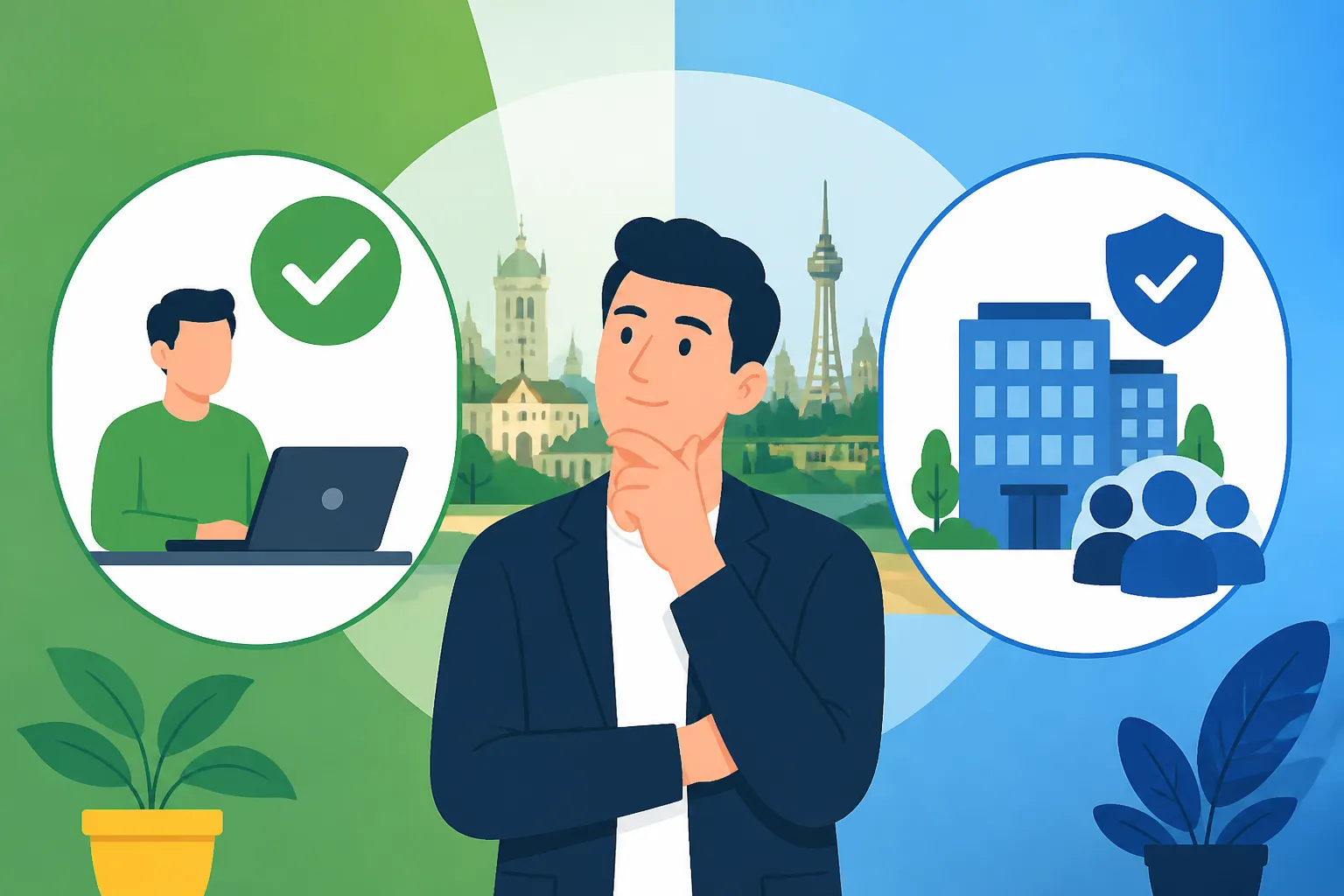
Is It Better to Use Individual Activity or a Business Certificate in Lithuania?
When you first consider venturing into self-employment in Lithuania, whether you're a freelancer, consultant, or small business owner, it’s easy to get tangled in the administrative web. One of the most common head-scratchers for expats is figuring out the difference between an Individual Activity (Individuali Veikla) and a Business Certificate (Verslo Liudijimas) – and more importantly, which one makes the most sense for your unique situation. This guide will meticulously break down both options, helping you understand their nuances, tax implications, and administrative burdens so you can make an informed decision and avoid future headaches.
Navigating Self-Employment Options for Expats in Lithuania: The Initial Conundrum
Moving to Lithuania often opens up exciting opportunities for personal growth and career changes. Many expats find themselves exploring self-employment, whether it's consulting for a foreign company, teaching a language online, or launching a small local venture. It's a fantastic way to integrate into the local economy and build something of your own. However, the initial steps, particularly choosing the right legal structure for your solo enterprise, can feel like trying to solve a Rubik's Cube blindfolded.
The Common Confusion: Individual Activity vs. Business Certificate
The Lithuanian system, while generally clear once you understand it, doesn't always translate perfectly into expat-familiar terms. The two most common forms of individual self-employment, Individual Activity (IA) and Business Certificate (BC), often get mixed up. Both allow you to work independently and generate income, but they cater to very different types of activities, income levels, and administrative preferences. It’s not about one being inherently "better" than the other, but rather about which one aligns best with what you plan to do and how much you expect to earn. Many foreigners initially assume they're interchangeable, only to find out later that they've chosen a structure that either overcomplicates their life or restricts their earning potential.
Why This Choice Matters for Your Expat Journey
Making the right choice between Individual Activity and a Business Certificate from the outset is crucial for several reasons. Firstly, it directly impacts your tax obligations and the amount of money you actually get to keep. Secondly, it dictates the administrative load you'll face – how often you interact with the tax authority (VMI), what kind of accounting you need to do, and how you manage your health and social insurance contributions through Sodra. Get it wrong, and you could end up paying more tax than necessary, dealing with unexpected fines, or struggling with complex paperwork that could have been simpler. It also affects your perceived legitimacy in the market, your ability to issue invoices, and even your peace of mind knowing you're fully compliant with Lithuanian law.
Decoding Individual Activity (Individuali Veikla)
Individual Activity, often abbreviated as IA (or IV in Lithuanian), is perhaps the most versatile and widely used form of self-employment for professionals and freelancers in Lithuania. Think of it as a relatively simple way to run a business as a natural person, without establishing a separate legal entity like a company.
What Individual Activity Entails for Foreigners
Essentially, Individual Activity allows you to operate as a sole trader. You are personally responsible for the business, and there's no legal distinction between you and your business. This means your personal assets could potentially be at risk, though for most small-scale service providers, this isn't a major day-to-day concern. To start, you typically need to register your activity with the State Tax Inspectorate (VMI). You'll need your Asmens Kodas (Personal Code) and Why It Matters for Healthcare to do this. The registration process itself is fairly straightforward and can often be done online through the VMI's Electronic Declaration System (EDS), which can be a relief. It's suitable for a broad range of activities – from IT consulting and graphic design to tutoring on platforms like iTalki, translation, or even opening a small boutique online. The key is that your activity isn't just a one-off gig; it's an ongoing, profit-seeking endeavor.
The Advantages and Disadvantages of Individual Activity
Like any option, IA comes with its own set of pros and cons that expats should carefully weigh.
Pros:
- Broad Scope of Activities: You're not limited to a specific list of trades. If you're a freelance writer, a software developer, or a yoga instructor, IA covers you.
- Flexible Taxation: Taxes are typically paid on your actual profit (income minus expenses), which can be very beneficial if you have significant business-related costs. This allows for various tax deductions.
- No Income Cap: Unlike a Business Certificate, there's no strict limit on how much you can earn under Individual Activity. This makes it ideal for growing businesses or those with high earning potential.
- Relatively Simple Setup: Registering is generally not complicated, especially if you're comfortable with online forms.
- Professional Perception: It's a recognized and respected structure for professionals, allowing you to issue proper invoices to clients, both local and international.
Cons:
- More Complex Accounting: While not full-blown company accounting, you need to meticulously track your income and expenses. This means keeping receipts and maintaining an income/expense journal. It's not rocket science, but it requires discipline.
- Higher Potential Tax Rates at Higher Incomes: While flexible, the Personal Income Tax (GPM) rate for IA starts at 5% but can rise to 15% once your annual taxable income (profit) exceeds a certain threshold (currently around €35,000 for service activities, adjusted annually). This is in addition to social security contributions.
- Social and Health Insurance (Sodra & PSD) Contributions: You're responsible for paying your own social insurance (Sodra) and compulsory health insurance (PSD) contributions. These are calculated based on your profit and can be a significant monthly outflow. Understanding Sodra Social Insurance Contributions in Lithuania is vital.
- Personal Liability: As a sole trader, your personal assets are technically linked to your business. While unlikely for small online businesses, it's a point to consider.
Unpacking the Tax Structure for Individual Activity
This is where things can get a bit detailed, but understanding it is key. Under Individual Activity, you'll primarily be dealing with three types of contributions:
- Personal Income Tax (GPM): This is applied to your taxable profit (income minus allowed expenses). For most service activities, the rate is 5% on annual profit up to a certain threshold (e.g., ~€35,000 in 2024, but check current VMI regulations as it changes), and then 15% on profit exceeding that threshold. If your activity is "liberal profession" (e.g., lawyer, artist) or you employ more than three people, the rates might be different. You can choose to deduct actual expenses or claim a standard 30% expense deduction without keeping receipts (though this still means income is recorded). This is a big one, so make sure you read up on How Much Tax Does Individual Activity Pay in Lithuania in 2026?.
- Compulsory Health Insurance (PSD): As a self-employed individual, you must pay PSD. This ensures you have access to public healthcare. The monthly contribution is a fixed percentage (currently 6.98%) of the minimum monthly salary (MMA), regardless of your actual income, if you have no other employment or covered status. If you are also employed, your employer pays PSD, and you generally don't pay it additionally for your IA. Otherwise, you contribute about €60-70 per month (this also changes with MMA). This ensures you're covered by the public healthcare system.
- State Social Insurance (Sodra): This covers your pension, maternity/paternity benefits, and sickness benefits. You pay 12.52% of 90% of your taxable profit up to a certain annual ceiling (which is quite high). It's crucial to understand these contributions for your long-term financial security. If you're consulting with a firm like Taxes for Expats, they'll often guide you through these calculations to ensure you're compliant.
All these contributions are typically declared and paid annually via the VMI's EDS system, though PSD is paid monthly.
Understanding the Business Certificate (Verslo Liudijimas) in Lithuania
Now, let's switch gears and look at the Business Certificate (Verslo Liudijimas, or BC). This is a much more simplified system, designed for specific, often small-scale or seasonal activities with predictable, lower incomes. It's often favored by those running very local, cash-based businesses or offering manual services.
What Exactly Is a Business Certificate?
A Business Certificate is a simplified tax scheme that allows individuals to engage in a very specific list of activities for a fixed period (from a few days up to a year) by paying a predetermined, fixed income tax amount upfront. Instead of calculating profit and declaring it annually, you pay a set fee to the municipality, and that's usually your main tax burden for GPM. However, there are still PSD and Sodra contributions to consider. The list of eligible activities for a BC is much narrower than for IA and is determined by municipalities. Common examples include hairdressing, minor construction work, driving a taxi, certain crafts, or selling goods at a local market. If you're thinking of becoming a high-level IT consultant for an international firm, a BC simply isn't an option.
Exploring the Benefits and Limitations of a Business Certificate
The simplicity of the Business Certificate is its biggest draw, but that simplicity also comes with significant limitations.
Benefits:
- Utter Simplicity: This is the ultimate "set it and forget it" option for GPM. You pay your tax fee upfront, and you don't need to track expenses for GPM purposes, nor do you file an annual GPM declaration for income earned under the BC.
- Predictable Tax Costs: You know exactly what your GPM liability is going to be from day one.
- Lower Initial Tax Burden (potentially): For activities with very low expected income, the fixed tax fee can be significantly lower than what you'd pay under IA's GPM percentage.
- Easy to Start and Stop: You can obtain a BC for just a few days or weeks, making it ideal for seasonal work or testing a new idea without a long-term commitment.
Limitations:
- Strict Activity List: Your activity must be on the municipal list of approved activities for a BC. If it's not, you can't use this option. This list varies slightly by municipality (e.g., Vilnius vs. Kaunas).
- Income Cap: This is a crucial one. There's an annual income ceiling for income earned under a BC (e.g., around €45,000 for some activities in 2024, but it can vary by activity and municipality). If you exceed this, you'll need to re-register as Individual Activity or face a significant tax adjustment.
- Limited Client Base: If you're providing services to legal entities (companies) or VAT payers, there are often restrictions or higher tax rates applied to that income under a BC. It's generally geared towards providing services directly to the public (natural persons).
- No Expense Deduction for GPM: You cannot deduct business expenses from your income under a BC to reduce your GPM. The fixed fee is fixed.
- Less Professional for Certain Fields: While perfectly fine for many trades, for service-oriented professionals dealing with corporate clients, it can appear less professional than IA.
Calculating Your Tax Load with a Business Certificate
The tax structure for a Business Certificate is quite different:
- Fixed Income Tax (GPM): This is the core of the BC. You pay a specific amount set by your municipality for your chosen activity and period. These fees can vary significantly. For example, a hairdresser in Vilnius might pay a different monthly fee than a taxi driver in Klaipėda. This payment covers your GPM, and usually, you don't file an annual GPM declaration for this income.
- Compulsory Health Insurance (PSD): Similar to IA, you still need to pay PSD. The calculation is the same: 6.98% of the monthly minimum wage (MMA) if you are not otherwise employed or covered.
- State Social Insurance (Sodra): Again, similar to IA, you pay 12.52% of 90% of your projected income, up to the annual ceiling. Since your GPM is fixed, your Sodra base is often a fixed amount determined by regulations or your chosen contribution level, rather than actual profit.
It’s important to remember that even with a BC, you still have these ongoing PSD and Sodra obligations, which can sometimes be overlooked due to the "fixed tax" allure.
Making Your Choice: Individual Activity vs. Business Certificate
Deciding between Individual Activity and a Business Certificate is a pivotal moment for any expat venturing into self-employment in Lithuania. It's not a one-size-fits-all answer; what works for a freelance graphic designer in Vilnius might be completely unsuitable for a seasonal tour guide in Kaunas.
Key Factors to Consider for Your Situation
When you're trying to make this choice, you need to put on your realistic hat and ask yourself some hard questions about your business, your income, and your comfort with administration.
- Nature of Your Activity: What exactly will you be doing? Is it a "liberal profession" (e.g., IT consultant, lawyer, artist, lecturer) or a manual trade/service (e.g., plumber, cleaner, crafter, masseuse)? IA is broad, BC is specific. If you’re offering services online, perhaps even through a platform like iTalki, and it's an ongoing professional endeavor, IA is almost certainly your route.
- Expected Income Level: How much do you anticipate earning annually from this activity?
- Low and Predictable Income (under BC cap): A Business Certificate might be more tax-efficient and simpler if your income is modest and falls comfortably below the BC's income cap, especially if you have minimal expenses.
- Higher or Unpredictable Income (above BC cap): Individual Activity is the clear winner here, as it has no income ceiling and adapts to fluctuating profits.
- Client Type: Who are your clients?
- Mainly Natural Persons (the public): A Business Certificate is designed for this.
- Legal Entities (companies), VAT payers, or international clients: Individual Activity is almost always required due to invoicing requirements and BC limitations.
- Business Expenses: Do you anticipate having significant, deductible business expenses (e.g., software licenses, equipment, professional training, office rent)?
- Many Expenses: IA allows you to deduct these from your income, reducing your GPM.
- Few to No Expenses: A BC's fixed tax can be attractive, as there's no need to track expenses for GPM.
- Administrative Comfort: How much paperwork and accounting are you willing to do?
- Minimal Effort: A Business Certificate with its upfront GPM payment is very low-maintenance.
- Willing to Track Expenses and File Annually: Individual Activity offers more flexibility and potential tax savings, but requires diligent record-keeping. Remember, understanding How to Register as a Freelancer with the Lithuanian Tax Authority (VMI) is paramount for IA.
- Need for Professional Representation/Invoicing: Do you need to issue formal invoices (sąskaita faktūra) that are widely accepted by companies? IA is better suited for this.
Real-World Scenarios for Each Self-Employment Path
Let's look at some examples to bring this to life:
Scenario 1: The Freelance Software Developer
Maria, an expat in Vilnius, works as a freelance software developer for clients across Europe. Her income is high and variable, and she has expenses for software, a powerful laptop, and online courses.
- Choice: Individual Activity.
- Why: Her income will likely exceed the BC cap, her clients are legal entities, and she has significant expenses she'll want to deduct to reduce her taxable profit. IA allows her to issue professional invoices and operate internationally.
Scenario 2: The Seasonal Tour Guide
Jonas, a retiree living in Klaipėda, wants to offer walking tours for tourists during the summer months. His income will be modest and primarily from individual tourists.
- Choice: Business Certificate.
- Why: His activity (tour guiding) is often eligible for a BC, his income is seasonal and likely below the cap, and his clients are natural persons. The simplicity of paying a fixed upfront tax is very appealing.
Scenario 3: The Online English Tutor
Sarah, an American expat, teaches English online via platforms like iTalki. She has a steady stream of students and a modest but consistent income.
- Choice: Individual Activity.
- Why: While her income might initially fall within a BC range, her activity is a professional service, and her clients are often considered 'legal entities' by the platform itself for payment processing. More importantly, IA allows for growth without hitting a strict income ceiling, and she can deduct expenses like internet, a good webcam, and teaching materials.
Scenario 4: The Handcrafts Artisan
Lina makes and sells handmade jewelry at local markets and online. Her income is variable, but she keeps it small as a passion project. She has some expenses for materials.
- Choice: Could be either, depending on specifics.
- If she primarily sells at local markets directly to the public and her income is low, a Business Certificate (if 'handcrafts' is on the municipal list) could be very simple.
- If she sells mainly online to customers abroad through a proper e-shop, or her income grows, Individual Activity would be more appropriate for its broader scope and professional invoicing capabilities, allowing her to deduct material costs.
Navigating the Registration Process and Ongoing Compliance
Regardless of your choice, the journey often begins with the State Tax Inspectorate (VMI). You'll usually need to register your intent to conduct self-employment there. For Individual Activity, you register the specific type of activity. For a Business Certificate, you apply for the certificate for a defined period and activity.
- VMI EDS System: The Electronic Declaration System (EDS) is your best friend. It’s where you’ll manage your IA declarations, review your PSD/Sodra status, and for IA, file your annual tax return. Learning Understanding the VMI Electronic Declaration System (EDS) in Lithuania is crucial early on.
- Registrų Centras: While not directly for self-employment registration, the Centre of Registers (
Registrų Centras) is where your personal data and registered address are kept, which is fundamental for any official dealings in Lithuania. - Sodra: You'll need to understand your obligations here too. For self-employed individuals, ensuring your PSD is active and paid monthly, and that your Sodra contributions are correctly calculated and paid, is paramount. If you lose your job and rely solely on IA, you'll need to ensure your PSD remains active. Remember, How to Register for Compulsory Health Insurance (PSD) as a Foreigner in Lithuania is a separate, but critical, step for all residents.
Here's a quick comparison table to summarize the key differences:
| Feature | Individual Activity (Individuali Veikla) | Business Certificate (Verslo Liudijimas) |
|---|---|---|
| Activity Scope | Broad, suitable for most professional services, IT, consulting, creative | Specific, limited list of trades/services, usually manual or local retail |
| Income Tax (GPM) | 5% or 15% on taxable profit (income – expenses) | Fixed amount paid upfront (varies by activity & municipality) |
| Income Cap | No cap | Has an annual income ceiling (e.g., ~€45,000, varies by activity) |
| Expense Deduction | Yes, for GPM (actual or 30% flat deduction) | No, GPM is fixed regardless of expenses |
| Accounting Complexity | Requires tracking income/expenses for GPM | Minimal, no need to track expenses for GPM purposes |
| PSD Contribution | 6.98% of MMA (if not otherwise insured), paid monthly | 6.98% of MMA (if not otherwise insured), paid monthly |
| Sodra Contribution | 12.52% of 90% of taxable profit (up to ceiling) | 12.52% of 90% of a projected/fixed income base (up to ceiling) |
| Client Type Suitability | Natural persons, legal entities (companies), international clients | Primarily natural persons; restrictions/higher tax for legal entities |
| Liability | Personal liability | Personal liability |
| Duration | Ongoing, until cancelled | Specific period (days, weeks, months, up to a year) |
Final Thoughts on Your Lithuanian Entrepreneurial Path
Choosing between Individual Activity and a Business Certificate isn't just a technicality; it's a decision that sets the stage for your entrepreneurial journey in Lithuania. It affects your financial well-being, your peace of mind, and the amount of time you spend on administrative tasks versus actually building your business. Don't let the initial jargon deter you. Many expats have successfully navigated this, and you can too.
Seeking Professional Advice and Continuous Learning
While this guide aims to provide a comprehensive overview, tax laws and regulations in Lithuania can change. It's always a good idea to consult with a local accountant or a tax advisor, especially if your situation is complex or involves international income streams. Firms specializing in Taxes for Expats are invaluable resources for ensuring full compliance. They can offer tailored advice based on your specific activity and projected income, helping you optimize your tax situation from day one. Additionally, keep yourself informed by regularly checking the VMI website and other official sources. The learning never truly stops, but armed with the right knowledge, you'll feel much more confident in your choices. Understanding The Complete Guide to Taxes in Lithuania for Expats (2027) is a great foundational step.
Disclaimer
The information provided in this article is for general informational purposes only and does not constitute professional tax, legal, or financial advice. While we strive to provide accurate and up-to-date information, regulations in Lithuania can change. It is highly recommended to consult with a qualified Lithuanian tax advisor or legal professional for advice tailored to your specific situation before making any decisions related to self-employment or business registration.