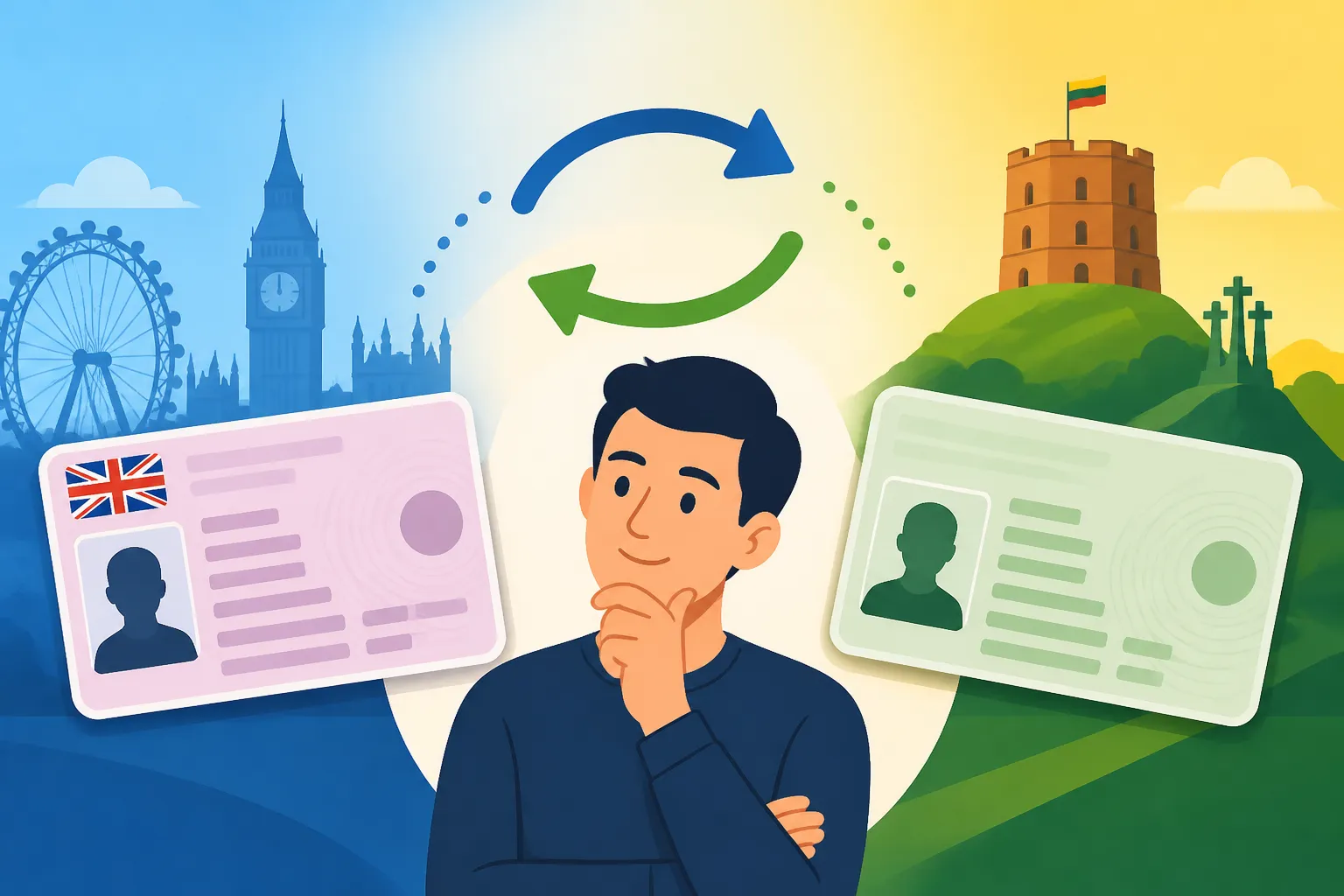
How Do I Exchange My UK Driving Licence in Lithuania?
Oh, the joys of moving to a new country! Just when you think you’ve got a handle on residence permits, bank accounts, and finding a decent apartment, another administrative challenge rears its head: your driving licence. For us UK expats in Lithuania, this particular hurdle comes with its own unique post-Brexit flavour, adding an extra layer of "wait, what now?" to an already complex process. Forget trying to decipher vague online government guides; this is your comprehensive, expat-to-expat roadmap to understanding and completing the UK driving licence exchange in Lithuania.
The UK Licence and Lithuanian Roads: Do You Need to Exchange?
First things first, let's address the burning question: can you even drive with your UK licence in Lithuania? And if so, for how long? This is where many of us get confused, and the rules have definitely shifted since the UK left the EU. Before Brexit, it was simple: your UK licence was an EU licence, valid indefinitely in Lithuania, no exchange needed unless you wanted to for convenience. Ah, those were the days!
Initial Driving Rights for UK Licence Holders
Post-Brexit, the landscape changed significantly. Your UK licence is now considered a foreign licence from a non-EU/EEA country. This means there are limitations on its long-term validity here in Lithuania. When you first arrive and establish your residency, you can typically drive using your valid UK licence for a period of up to one year from the date your residence permit was issued. This one-year window is a grace period, allowing you to settle in and get your affairs in order. It's a lifesaver when you're still navigating things like getting your Asmens Kodas (Personal Code) or figuring out where the closest Maxima is.
However, once that year is up, your UK licence is no longer legally valid for driving in Lithuania. Driving without a valid licence is a serious offense, and trust me, you do not want to deal with Lithuanian bureaucracy from that angle. So, if you plan on living here long-term and driving, exchanging your licence is not just an option, it's a necessity. This applies whether you're working, studying, or simply enjoying the tranquil Lithuanian countryside. Make sure you've also properly declared your place of residence in Lithuania, as this is a fundamental step for pretty much all administrative processes.
When the Exchange Becomes Mandatory
The mandatory exchange kicks in once you've been a resident for one year. This isn't counted from when you first stepped foot in Lithuania, but specifically from the date your Lithuanian Temporary Residence Permit (TRP) was issued. If you're an EU citizen, it's usually from the date you registered your right of residence. It’s crucial to mark this date on your calendar because time flies when you're busy with all the expat adventures.
The process of exchanging your licence is handled by Regitra, Lithuania's state enterprise responsible for vehicle registration and driver licensing. It's not a direct swap; they'll take your UK licence, and you'll receive a new Lithuanian one. This means you won't be able to hold both simultaneously. Given that you're probably busy getting your new life sorted, perhaps even coordinating shipping your belongings with services like Sirelo, it’s easy to let this deadline creep up on you. Don't! It’s far better to start the process a few months before your one-year grace period expires to avoid any stressful last-minute scrambling or, worse, being unable to drive legally.
Eligibility and the Nitty-Gritty Paperwork for Your Exchange
Okay, so you know you need to exchange it. Now, let’s get into the slightly less glamorous but absolutely critical details: what you need to be eligible and what documents you'll need to gather. This is where patience becomes your best friend, and attention to detail is paramount.
Core Eligibility Requirements
To exchange your UK driving licence, you must first and foremost be a legal resident of Lithuania. This means you hold a valid Lithuanian residence permit, whether it's a temporary one (TRP) or a permanent one. Without this, Regitra won't even look at your application. If you’re still navigating the initial stages of getting your permits, our guide on The Complete Guide to Lithuanian Residence Permits for Expats (2027) can offer some valuable insights.
Secondly, your UK driving licence must be valid and unexpired. They won't exchange a revoked, suspended, or expired licence. It should also be a full driving licence, not a provisional one. And yes, it needs to be in English, which for a UK licence, is always the case!
Thirdly, you'll need a valid medical certificate from a Lithuanian doctor, confirming you are fit to drive. This is a standard requirement for all driving licence applicants in Lithuania, not just expats. It’s a good excuse to get a general check-up anyway! This medical assessment is generally quite straightforward, often covering eyesight, hearing, and a basic health review. You’ll need to visit a local clinic or polyclinic for this, and it’s wise to call ahead to see if they have English-speaking staff or if you need to bring a translator.
The Essential Document Checklist
Gathering the right documents is half the battle. Missing even one tiny piece of paper can send you back to square one, costing you time and another trip to Regitra. Here’s a detailed breakdown of what you'll typically need:
- Your Valid UK Driving Licence: The physical card itself. They will take this from you.
- Your Valid Lithuanian Residence Permit Card: This proves your legal residency in Lithuania.
- Your Passport or National ID Card: For identity verification.
- Your Asmens Kodas (Personal Identification Code): This is essential for all official transactions in Lithuania. If you don't have one yet, it's usually issued as part of your residence permit process, but make sure you know it.
- Medical Certificate (Vairuotojo Sveikatos Pažymėjimas): As mentioned, obtained from a Lithuanian medical institution. This certificate is valid for a certain period, usually 10 years for regular drivers, but it's important to get it before your Regitra appointment. The cost for this typically ranges from €20-€40, depending on the clinic. It's part of the complete guide to healthcare in Lithuania for expats (2027), so you might find more info there on how to obtain it.
- Proof of Address: While your residence permit usually covers this, sometimes an additional document like a utility bill might be requested, though it's less common for licence exchange. However, it's always good practice to have recent proof of address ready.
- Application Form: You'll fill this out at the Regitra office or sometimes online beforehand.
Table: Documents Required for UK Driving Licence Exchange in Lithuania
| Document | Description | Important Notes |
|---|---|---|
| Valid UK Driving Licence | Original physical card | Must be full, unexpired, and not provisional. Will be surrendered. |
| Lithuanian Residence Permit | Original biometric card (TRP or PR) | Essential proof of legal residency in Lithuania. |
| Passport/National ID | Original document | For identity verification. |
| Asmens Kodas | Lithuanian Personal Identification Code | Crucial for all administrative procedures; usually on your residence permit. |
| Medical Certificate | Vairuotojo Sveikatos Pažymėjimas | Obtained from a Lithuanian doctor/clinic. Ensure it's current. Costs apply. |
| Application Form | Provided at Regitra office or sometimes downloadable | Will be completed with your details. |
Before heading to Regitra, I always recommend double-checking their official website or even calling them. Requirements can sometimes change, and there’s nothing worse than showing up unprepared after already dealing with the labyrinth that is Lithuanian administration.
Navigating Regitra: Your Step-by-Step Exchange Process
Once you've gathered all your documents and taken a deep breath, it's time for the actual exchange process at Regitra. This is usually the part that causes the most anxiety, but with a clear plan, it's totally manageable.
Booking Your Appointment
The first crucial step is to book an appointment at a Regitra office. You cannot just walk in and expect to be served, especially not for complex expat matters. Booking online through the Regitra website is generally the easiest and most recommended way. You'll choose your preferred service (licence exchange), location (e.g., Vilnius, Kaunas, Klaipėda), and a convenient date and time. Keep an eye on the booking slots; popular locations, especially in Vilnius, can fill up quickly.
When you're trying to book, it might feel a bit like a scavenger hunt, but persistence pays off. Ensure you select the correct service for "vairuotojo pažymėjimo keitimas" (driving licence exchange) and specify it's for a foreign licence. It is advisable to book a few weeks in advance to give yourself ample time. Don't forget that before your appointment, you'll need to have secured your medical certificate. Consider it another pre-requisite, just like making sure your phone is charged so you can quickly look up something or use an eSIM from Airalo to stay connected if you're still on your travel plan.
What to Expect at the Regitra Office
On the day of your appointment, arrive a little early. Regitra offices, while generally modern and efficient, can still have queues or unexpected delays. You'll typically check in using a self-service terminal with your appointment number.
Here's a general flow of what will happen:
- Waiting Area: You'll be assigned a number and wait for it to be called to a specific service window.
- Document Submission: At the window, you’ll present all your meticulously prepared documents. The Regitra employee will review them, cross-referencing your passport, residence permit, and UK licence. This is where your medical certificate also comes into play. They might ask a few clarifying questions, usually about your residency or the validity of your UK licence. If you have any concerns about language, consider bringing a Lithuanian-speaking friend or using a translation app.
- Photo and Signature: If everything is in order, they'll take your photograph (no smiling with teeth, usually!) and capture your digital signature for your new Lithuanian driving licence.
- Payment: You’ll pay the state fee for the licence exchange. The fee for a new driving licence in Lithuania is currently around €15. This can usually be paid by card directly at the counter.
- Surrender of UK Licence: This is a key moment. You will hand over your physical UK driving licence. It's often sent back to the DVLA in the UK or destroyed, as you cannot legally hold two EU/EEA-compatible licences simultaneously. For those who feel a pang of nostalgia, take a photo of it before you go!
- Temporary Document (Optional): In some cases, if there's a processing delay, you might be issued a temporary document allowing you to drive while your new licence is being prepared. However, it's not always guaranteed, and often, you just have to wait.
The entire process at the counter, assuming all your documents are correct, usually takes about 15-30 minutes. Once you're done, you'll be given information on when and how to collect your new Lithuanian driving licence.
Timelines, Costs, and What Happens Next
You've done the hard part – navigating the paperwork and the appointment. Now, let's talk about the practicalities of getting your new licence in hand and what it means for your driving life in Lithuania.
Processing Times and Collection
Typically, your new Lithuanian driving licence will be ready within 5 to 10 working days. Sometimes, if you opt for expedited service (which costs extra), it can be ready faster, even within 1-3 working days. The standard fee of €15 typically covers the normal processing time.
Regitra will inform you when your licence is ready for collection. You can often check the status online using your application number. When it’s time to pick it up, you’ll return to the same Regitra office where you applied, typically requiring another appointment for collection (though sometimes this is less strict). You'll need to bring your ID and the receipt you received during your application.
Once you have that shiny new Lithuanian licence in your hand, congratulations! You're officially a fully licensed driver in Lithuania, recognised throughout the EU/EEA. You can now confidently explore the beautiful Baltic landscapes, from the bustling streets of Vilnius to the stunning Curonian Spit. And if you're also registering a car, remember that our guide on How to Register a Vehicle with Regitra in Lithuania might be your next port of call.
Implications for Your Driving Life
Your new Lithuanian driving licence will have the same categories as your UK licence (e.g., B for cars, A for motorcycles), ensuring you retain the driving privileges you had. It's valid for 10 years, after which you'll need to renew it (which is a much simpler process than the initial exchange).
It's also worth noting that your Lithuanian licence is now your primary driving document. If you travel outside of Lithuania, especially within the EU/EEA, this is the licence you will use. If you ever decide to move back to the UK or another country, you would then follow their rules for exchanging a foreign (Lithuanian) licence.
What if You're Still Within the One-Year Grace Period?
If you're still within your first year of residency and using your UK licence, you might be wondering if you can just keep driving on it. Legally, yes, you can. However, many expats choose to exchange it sooner rather than later to avoid the last-minute rush. There’s no penalty for exchanging early. Plus, having a Lithuanian licence can sometimes simplify other administrative tasks, as it’s a locally issued ID document. It integrates seamlessly with systems like the E-Government Gateway (Elektroniniai Valdžios Vartai) in Lithuania, making online interactions with state institutions much smoother.
It’s just one of those things that, once done, feels like a huge weight lifted. You’ve successfully navigated another piece of the Lithuanian administrative puzzle. Now you can focus on more exciting things, like exploring public transport in Lithuania for times when you don't want to drive, or simply enjoying your new home!
Disclaimer
Please remember that I am an expat blogger, not a legal or government authority. The information provided here is based on my personal experience, general knowledge, and publicly available information at the time of writing. Regulations and procedures in Lithuania can change, so always double-check the latest requirements with official sources like Regitra and the Lithuanian Migration Department before undertaking any official process.