Understanding the 90/180 Schengen Rule for Lithuania
The bewildering 90/180 Schengen Rule is one of those bureaucratic hurdles that sends shivers down the spine of even the most seasoned expat, and many newcomers to Lithuania are caught off guard by its complexities. It’s not just a technicality; it’s a critical piece of information that can make or break your travel plans, your residency dreams, or even lead to unexpected trouble at the border. This guide is here to untangle the knots, clarify what it means for your time in Lithuania, and help you navigate this often-confusing system.
What Exactly is the 90/180 Schengen Rule?
Let's cut right to the chase because this rule causes more head-scratching than a poorly translated government document. Many hopeful visitors or future residents arrive in Lithuania (or any Schengen country, for that matter) with a vague understanding, often leading to stressful situations down the line. The 90/180 Schengen Rule isn't some arbitrary guideline; it's the fundamental principle governing short-term stays for non-EU/EEA/Swiss citizens within the vast Schengen Area. Getting this wrong can have serious consequences, from fines to outright bans, so understanding its nuances is paramount.
The Core Principle of Short Stays
At its heart, the 90/180 Schengen Rule states that non-EU/EEA/Swiss citizens are permitted to stay in the Schengen Area for a maximum of 90 days within any 180-day period. It sounds simple enough, doesn't it? But here’s where the confusion really kicks in: it's not 90 days per calendar year, nor does leaving the Schengen Area for a quick trip to a non-Schengen country automatically "reset" your clock. No, it’s a rolling 180-day period. This means that on any given day, you must count back 180 days from that day, and within that backward-looking window, your total cumulative stay in the Schengen Area cannot exceed 90 days.
This "rolling" aspect is what trips most people up. Imagine you’re standing at the Lithuanian border, or you’re simply trying to plan your next visit; you need to consider all your entries and exits over the past six months. Every single day spent within any Schengen country during that window adds to your 90-day tally. It requires a bit of mental gymnastics, or better yet, a dedicated tracking method, to stay on the right side of the law. This isn't just a Lithuanian thing; it's a rule applied uniformly across all Schengen member states, meaning your days spent vacationing in Spain or visiting friends in Germany all count towards that same 90-day limit.
Who Does the Rule Apply To?
This rule specifically targets citizens from non-EU, non-EEA, and non-Swiss countries who do not hold a long-stay national visa (Type D) or a valid residence permit issued by a Schengen member state. If you hail from countries like the United States, Canada, the United Kingdom, Australia, New Zealand, or many nations in Latin America and Asia, this rule is directly applicable to you when you enter Lithuania or any other Schengen country without a specific long-stay immigration document.
For example, if you’re a British citizen who moved to Lithuania after Brexit, you now fall under these short-stay rules for tourist visits, just like an American or an Australian would. Your previous freedom of movement as an EU citizen no longer applies for purely short-term stays. However, if you are an EU, EEA, or Swiss citizen, you have the right to free movement and establishment within the Schengen Area, meaning the 90/180 rule does not apply to you. You can come and go as you please, and stay for as long as you wish, though you may need to Declare Your Right of Residence as an EU Citizen in Lithuania if you plan to stay longer than three months. Understanding this distinction is crucial to avoid any awkward conversations with border officials who are, after all, simply doing their job to uphold these rules.
The Schengen Area Defined
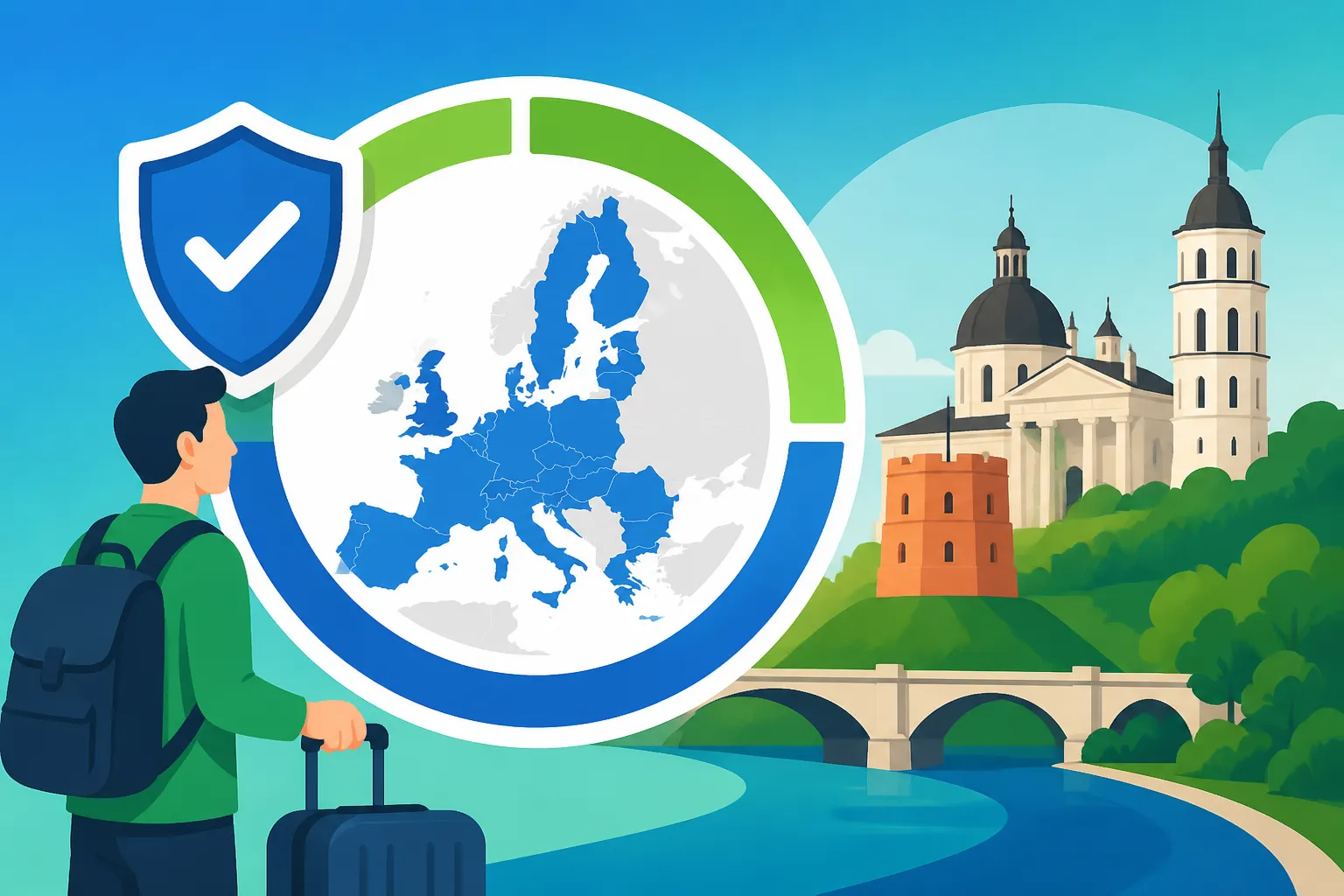
Lithuania is proudly part of the Schengen Area, which is essentially a zone comprising 27 European countries that have abolished passport and all other types of border control at their mutual borders. Think of it as one big, border-free territory for travelers. When you enter one Schengen country, you're effectively entering the entire zone.
The current list of Schengen countries includes: Austria, Belgium, Bulgaria, Croatia, Czechia, Denmark, Estonia, Finland, France, Germany, Greece, Hungary, Iceland (non-EU), Italy, Latvia, Liechtenstein (non-EU), Lithuania, Luxembourg, Malta, Netherlands, Norway (non-EU), Poland, Portugal, Romania, Slovakia, Slovenia, Spain, Sweden, and Switzerland (non-EU). This means if you fly into Vilnius, Lithuania, and then take a bus to Warsaw, Poland, and then a train to Berlin, Germany, all of that travel is considered within the single Schengen space, and your days are continuously accumulating towards that 90-day limit. There are no internal border checks, but your time in each country is still part of your overall Schengen allowance. It's essential to remember that while Bulgaria and Romania have recently joined the Schengen Area for air and sea borders, land border controls remain in place, so their status might still be nuanced for some types of overland travel depending on the latest updates.
Calculating Your Days: It's Trickier Than You Think
The greatest pitfall for many non-EU visitors to Lithuania and the wider Schengen zone isn't necessarily ignorance of the rule, but rather the sheer complexity of calculating their permitted stay. The "rolling" nature of the 180-day period is not intuitive and can easily lead to miscalculations. It's not like simply counting 90 days from your arrival; it requires a constant awareness of your past movements. Many expats have shared stories of anxiety when planning trips or even just leaving the country, worried they might have miscounted and face an unexpected interrogation.
The "Rolling" 180-Day Period Explained
Let's dive deeper into this "rolling" concept, because it's absolutely fundamental. The rule doesn't say "you can stay for 90 days, then you have to leave for 90 days." Instead, it means that on any day you are in the Schengen Area, you must be able to look back exactly 180 days from that day, and your total stay within that specific 180-day window cannot exceed 90 days. This means the 180-day reference period is not fixed. It constantly shifts.
Let's use a hypothetical example:
- You arrive in Lithuania on January 1st and stay for 60 days, leaving on March 1st.
- You then re-enter on June 1st. On June 1st, you need to look back 180 days (which would take you back to early December of the previous year). Within that window, you have only used 60 days. You have 30 days remaining.
- You stay for another 30 days, leaving on July 1st. You've now used your full 90 days.
- If you wanted to re-enter on August 1st, you would count back 180 days from August 1st. Any days you spent from February onwards would still count. Days you spent in December and January might start to "fall off" the 180-day window. This is where it gets really complicated and why manual tracking can become a headache.
This constant recalculation is why it’s imperative to keep meticulous records. It's not a set allowance that renews annually or after a fixed absence; it's a dynamic limit based on your real-time presence. This continuous assessment is designed to prevent non-EU citizens from essentially living in the Schengen Area long-term without the appropriate long-stay visas or residence permits, which are subject to much stricter requirements.
Days Counted vs. Days Not Counted
To complicate things further, certain days count towards your 90-day limit, while others do not. Generally, both your day of entry and your day of exit are counted as full days of presence within the Schengen Area. So, a trip that starts on Monday and ends on Friday counts as five full days, even if you arrive late on Monday and leave early on Friday. This seemingly minor detail can quickly add up, especially for frequent travelers.
Crucially, any days you spend in Lithuania (or any other Schengen country) under a national long-stay visa (Type D) or a valid Temporary Residence Permit (TRP) do not count towards your 90-day short-stay limit. This is a vital distinction! If you’ve successfully obtained a How to Get a Temporary Residence Permit (TRP) in Lithuania (2027) for work or study, for example, your presence in Lithuania under that permit is entirely separate from your short-stay allowance. You are no longer considered a "visitor" subject to the 90/180 rule within the country that issued your permit. However, if you then travel as a tourist to another Schengen country while holding a Lithuanian TRP, those days will count towards your 90/180 short-stay allowance for visiting other Schengen states outside of Lithuania. Yes, it’s a bit of a maze, but an important one to understand!
Practical Tools and Apps for Tracking
Given the complexity, relying solely on your memory or a quickly scribbled note can be a recipe for disaster. Thankfully, there are tools available to help you keep track. The European Commission provides an official Schengen calculator on its website, which many expats find invaluable. You simply input your entry and exit dates, and it calculates your remaining days and flags potential overstays. It’s highly recommended to use this tool before planning any trips or if you’re unsure about your current status.
Beyond official tools, many people swear by personal tracking methods. A simple spreadsheet logging all your entry and exit dates can be incredibly effective. Some expats even use dedicated smartphone apps designed specifically for Schengen short-stay calculations. Whatever method you choose, the key is consistency and accuracy. Don't wait until the last minute to try and figure it out. Regular checks will prevent panic and ensure you're always in compliance, especially if you're frequently in and out of the Schengen zone, perhaps visiting family or combining a short holiday with scouting for longer-term relocation options through a service like Sirelo, which can help with the complexities of moving.
Consequences of Overstaying in Lithuania
Let me tell you, there are few things more daunting than facing a stern Lithuanian border official when you've accidentally overstayed your welcome. This isn't just about a slap on the wrist; the consequences of exceeding the 90/180 Schengen rule can be severe, impacting not only your immediate travel plans but also your long-term prospects for visiting or living in Lithuania or any other Schengen country. There are many accounts of good people making honest mistakes that led to serious trouble, so it's critical to understand the gravity of an overstay.
Immediate and Long-Term Repercussions
The moment an overstay is detected, whether at the airport upon departure or during a routine check, you can expect immediate repercussions. The most common immediate consequence is a fine. While the exact amount can vary and depends on the duration of the overstay and the discretion of the border authorities, fines in Lithuania can range from a few hundred euros to over a thousand. It's an unexpected and unwelcome expense that can quickly sour your travel memories.
Beyond financial penalties, overstaying can also lead to deportation. This is a far more serious matter, involving being escorted out of the country, often at your own expense, and having a black mark on your immigration record. But perhaps the most enduring and damaging consequence is a Schengen-wide entry ban. Depending on the length of your overstay, you could be banned from entering any Schengen country for a period ranging from one year to five years, or even longer for egregious violations. This means no future holidays, no business trips, and certainly no easy path to a The Complete Guide to Lithuanian Residence Permits for Expats (2027). Such a ban is entered into the Schengen Information System (SIS II), making it visible to border guards across all member states, effectively closing off a large chunk of Europe to you.
Impact on Future Visa Applications
An overstay, even a minor one, will significantly complicate any future attempts to secure a visa or residence permit for Lithuania or any other Schengen country. When you apply for a new visa, immigration authorities will review your travel history. A previous overstay indicates a failure to comply with immigration regulations, which is a major red flag. It tells them you're a high-risk applicant.
This could mean:
- Automatic visa refusal: Many countries have strict policies against issuing visas to individuals with a history of overstaying.
- Increased scrutiny: Even if your application isn't immediately refused, you'll face intense scrutiny, requiring more documentation, longer processing times, and potentially multiple interviews to convince them you won't repeat the mistake.
- Damage to long-term residency goals: If you had dreams of eventually securing Permanent Residence in Lithuania: The Complete Pathway (2027) or even citizenship, an overstay will make that journey exponentially harder, if not impossible. The trust in your compliance with local laws will have been broken. This isn't just about losing a holiday; it's about potentially derailing your entire expat dream in Lithuania.
How Lithuanian Authorities Enforce the Rule
Lithuanian authorities, like those in other Schengen countries, have robust systems in place to enforce the 90/180 rule. When you enter and exit the Schengen Area, your passport is stamped or your details are electronically recorded. This data feeds into centralized databases, allowing border control officers to easily track your cumulative days. They aren't just looking at your stamps; they have access to a comprehensive record of your movements within the entire zone.
At airports, train stations, and land borders, officers perform routine checks. When you present your passport for departure, their systems will immediately flag any overstay. Don't assume that because there are no internal border checks within Schengen, your movements go unnoticed. Every entry and exit from the external borders is logged. Even a short overstay of a day or two will be detected and recorded. Attempting to hide an overstay or entering under false pretenses will only compound the problem, leading to even more severe penalties. It's far better to be fully aware of your status and proactively address any issues with the Migration Department (MIGRIS) before it becomes a problem at the border.
Strategies for Longer Stays Beyond the 90/180 Rule
For those who dream of more than a short visit to Lithuania, the 90/180 Schengen Rule can feel incredibly restrictive. But don't despair! It's designed to differentiate between short-term tourists and individuals genuinely seeking to live, work, or study in a Schengen country. There are legitimate pathways to extend your stay beyond that 90-day limit, and they all involve applying for the correct long-stay visa or residence permit. This is where your true expat journey in Lithuania begins, moving from a visitor to a recognized resident.
National Visas Type D for Lithuania
A crucial first step for many seeking a longer stay in Lithuania is obtaining a National Visa, often referred to as a Type D visa. Unlike the short-stay Schengen (Type C) visa, which is what the 90/180 rule governs, a Type D visa is a long-stay visa issued by a specific Schengen country (in this case, Lithuania) for stays exceeding 90 days. It's your ticket to staying longer than three months, usually while you await or apply for a Temporary Residence Permit.
This type of visa is typically granted for specific purposes, such as:
- Study: If you've been accepted into a Lithuanian university, you'll need a Type D visa to enter and then apply for your student residence permit.
- Work: If you have an employment contract with a Lithuanian company, a Type D visa is often the initial requirement before getting your work-based residence permit.
- Family Reunification: If you're joining a family member who is already a resident in Lithuania.
- Business: For entrepreneurs or those setting up a business in Lithuania.
Holding a National (Type D) visa for Lithuania allows you to legally stay in the country for its validity period, typically up to one year. During this time, you can also travel to other Schengen countries for up to 90 days within any 180-day period, as a tourist, without impacting your stay in Lithuania. It's a powerful document that signals your legitimate intent to reside in Lithuania long-term. You can find more detailed information in our guide, Understanding the National (Type D) Visa for Lithuania.
Applying for a Temporary Residence Permit (TRP)
For anyone serious about making Lithuania their home for an extended period, the ultimate goal after a national visa (or sometimes directly, depending on your nationality and grounds) is to secure a Temporary Residence Permit (TRP). This permit officially grants you the right to reside in Lithuania for a specified duration, usually one to three years, and is renewable. With a TRP, you are no longer considered a "visitor" but a legitimate resident of Lithuania, and your days spent in the country do not count towards the 90/180 Schengen short-stay limit.
The grounds for obtaining a TRP are varied and mirror those for a Type D visa, but with more stringent requirements and documentation. Common grounds include:
- Employment: Having a valid work contract with a Lithuanian employer. You'll need to understand How to Access Healthcare on a Work Visa in Lithuania once you have your permit.
- Study: Being enrolled in a recognized educational institution.
- Business: Establishing and operating a legitimate business in Lithuania.
- Family Reunification: Joining a spouse, parent, or child who is a Lithuanian citizen or legal resident.
- Scientific Research: For researchers coming to work in academic or research institutions.
The application process for a TRP happens through the Migration Department (MIGRIS) and involves submitting extensive documentation, proving your financial stability, health insurance (like Cigna Global, which offers comprehensive expat plans), and accommodation. It can be a lengthy process, often requiring patience and meticulous preparation. Our comprehensive guide, The Complete Guide to Lithuanian Residence Permits for Expats (2027), will walk you through every step. Remember, once you have your TRP, you're not just allowed to stay in Lithuania; you also gain the right to travel visa-free within the entire Schengen Area for up to 90 days in any 180-day period for tourist purposes.
Understanding Different Visa Categories
Navigating the various visa and permit categories can feel like learning a new language, but understanding them is key to your successful relocation. Beyond the general Type D visa and TRP, there are specialized categories designed to attract specific skill sets or investments. For instance, the EU Blue Card is a residence permit for highly skilled non-EU/EEA workers, offering a streamlined process and enhanced rights. If you qualify as a highly skilled professional, exploring the Understanding the EU Blue Card for Skilled Workers in Lithuania pathway could be advantageous.
Similarly, Lithuania has schemes for entrepreneurs and startups, allowing founders to gain residence if their business ideas are deemed innovative and beneficial to the economy. Each category has its own set of requirements, income thresholds, and application procedures. It's vital to identify the category that best fits your personal circumstances and professional background. Don't try to fit a square peg into a round hole; choose the correct visa or permit from the outset to avoid complications and ensure a smooth transition to your new life in Lithuania. Consulting official MIGRIS guidelines and potentially even a legal professional specializing in immigration can provide invaluable clarity.
Specific Scenarios and Common Misconceptions
The 90/180 Schengen Rule is rife with potential misunderstandings, and many expats (and even seasoned travelers) often stumble when applying it to specific, real-world travel scenarios. It's not a one-size-fits-all rule, and knowing how it applies (or doesn't apply) in different contexts can save you a lot of grief. Let's tackle some of the most common misconceptions and scenarios that often cause confusion for those planning their stays in Lithuania.
Multi-Country Schengen Travel vs. Single-Country Stays
This is perhaps the biggest misconception: many people mistakenly believe they get 90 days per Schengen country. Let me be absolutely clear: the 90/180 rule applies to the entire Schengen Area as a single entity, not per country. This means your 90-day allowance is cumulative across all 27 Schengen member states.
For example, if you spend 30 days vacationing in France, then fly to Lithuania and spend another 30 days exploring Vilnius and Kaunas, and then pop over to Germany for another 30 days for a business trip, you have just used your full 90-day allowance within a 90-day period. You would then need to exit the Schengen Area and remain outside for at least 90 days before you could re-enter. You cannot, for instance, spend 90 days in Lithuania, then simply cross the border into Poland and start a new 90-day period. This is a common and dangerous misunderstanding that often leads to overstays. Each day spent in any Schengen country contributes to that single 90-day total.
Visiting Non-Schengen EU Countries (e.g., Ireland, Bulgaria, Croatia, Romania, Cyprus)
Here's a clever bit of information for non-EU citizens who want to extend their time in Europe without breaking the Schengen rule: not all EU countries are part of the Schengen Area. Countries like Ireland are members of the EU but not Schengen. Other countries like Bulgaria, Croatia, Romania, and Cyprus are in various stages of Schengen integration, but their land borders (and for some, all borders) might still function as external borders for the purpose of the 90/180 rule.
What this means is that time spent in these non-Schengen EU countries does not count towards your 90-day Schengen limit. For example, if you spend 80 days in Lithuania, you could then theoretically fly to Ireland (assuming you have a valid visa or are visa-exempt for Ireland) and stay there for a period, and those days wouldn't count against your Schengen tally. After your time in Ireland, you could re-enter the Schengen Area, and the 180-day look-back period would have continued to roll, potentially freeing up more days for you. This strategy offers a way to "reset" your Schengen clock passively by being outside the zone. However, always check the specific visa requirements for each non-Schengen country you plan to visit, as their own immigration rules will apply independently. It's not a free pass for indefinite stay, merely a way to manage your Schengen days more flexibly.
Dealing with Emergency Situations
Life happens, and sometimes, despite your best efforts, unforeseen circumstances can lead to an accidental overstay. What if you're hospitalized in Lithuania, your flight is canceled due to a natural disaster, or a family emergency prevents you from leaving on time? This is a stressful situation, and the worst thing you can do is bury your head in the sand.
If you find yourself in an emergency situation that makes it impossible to leave the Schengen Area within your permitted 90 days, you must immediately contact the Lithuanian Migration Department (MIGRIS). Explain your situation, provide all available documentation (e.g., hospital records, doctor's notes, police reports, airline cancellation notices), and formally request an extension of your stay or an exemption. While there's no guarantee, immigration authorities can, in exceptional humanitarian or force majeure circumstances, grant a temporary extension or waive the overstay penalty. Ignoring the situation and hoping for the best is a sure way to incur fines and an entry ban. Always prioritize communicating with the authorities and providing proof of your unavoidable circumstances. This is also where having robust travel or expat health insurance, like Cigna Global, becomes invaluable, as they can often assist with documentation or provide support during medical emergencies that impact travel plans.
| Feature | Short-Stay (Schengen Visa / Visa-Free) | Long-Stay (National Visa / Residence Permit) |
|---|---|---|
| Duration of Stay | Max 90 days within any 180-day period | Over 90 days, typically 1-5 years, renewable |
| Primary Purpose | Tourism, short business, transit, family visits | Work, study, family reunification, business establishment |
| Governing Rule | 90/180 Schengen Rule | National immigration laws of Lithuania (and EU directives) |
| Application Location | Embassy/Consulate in home country (for visa), or no application needed (visa-free) | Embassy/Consulate (for national visa), then Migration Department (MIGRIS) in Lithuania (for residence permit) |
| Days Counted Towards 90/180 | ALL days spent in any Schengen country | Days spent in Lithuania under the permit do NOT count; days visiting other Schengen countries as tourist DO count. |
| Required Documents | Passport, proof of funds, travel insurance | Passport, proof of purpose (work contract, university acceptance), health insurance, accommodation, financial stability |
| Right to Work | Generally NO | YES (if permit is work-based) |
| Right to Reside | NO, temporary visitor status | YES, established legal resident |
| Travel within Schengen | Restricted by 90/180 rule | Free movement within Schengen for up to 90/180 days for tourism, while residing legally in Lithuania |
Disclaimer
Please remember that I am an expat blogger sharing general advice based on my experience and publicly available information. Immigration laws and regulations in Lithuania and the broader Schengen Area are complex and can change. This guide is for informational purposes only and does not constitute legal advice. Always consult with official government sources, such as the Lithuanian Migration Department (MIGRIS), or seek professional legal counsel for personalized advice regarding your specific situation before making any decisions related to your visa or residency status.