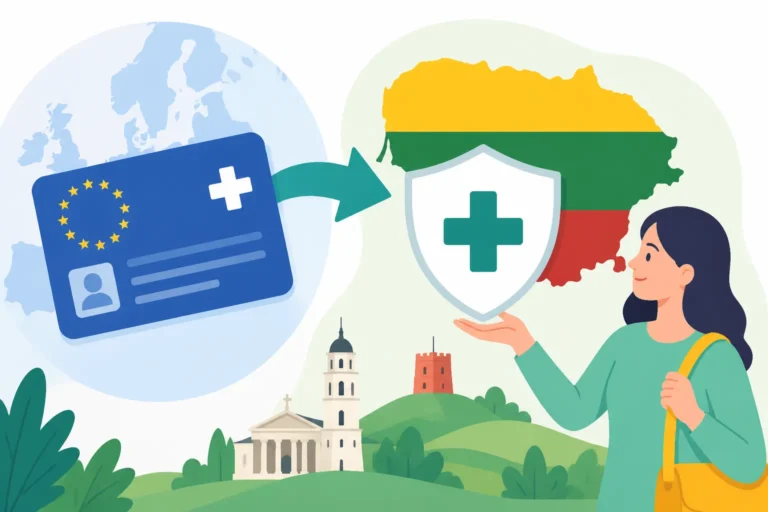
How Much Is the Monthly PSD Contribution Through Sodra?
One of the biggest shocks for new arrivals in Lithuania is realizing that health insurance isn't just a suggestion—it's a strict legal requirement managed by the state social insurance fund, Sodra. If you’ve ever found yourself staring at a mysterious debt notification on your bank app, this guide will clarify exactly how much you need to pay, who is responsible for the transfer, and how the monthly PSD rate is calculated for 2024 and beyond.
Decoding the PSD: Why Lithuania’s System Can Be Confusing for Expats
When you first move to Vilnius, Kaunas, or Klaipėda, the acronym "PSD" will quickly become part of your daily vocabulary. It stands for Privalomasis Sveikatos Draudimas, or Compulsory Health Insurance. Unlike some countries where you only pay into a system if you choose to use public services, Lithuania operates on a universal contribution model. This means that if you are a permanent resident or a temporary resident with certain work rights, you are likely required to pay into the system every single month, regardless of whether you ever visit a doctor.
The confusion usually starts with the dual nature of the bureaucracy. While the National Health Insurance Fund (VLK) handles the actual healthcare services and hospital budgets, Sodra is the entity responsible for collecting the money. I remember the first time I received a letter from Sodra; I thought it was a scam because I hadn't even visited a hospital yet. In reality, it was just the system reminding me that my "subscription" to the Lithuanian state was due. For a deeper dive into the administrative side, you might want to look at How Lithuania's Health Insurance Fund (VLK/PSDF) Works: A Full Overview to see where your money actually goes.
What Exactly is the PSD?
In its simplest terms, the PSD is a solidarity-based insurance tax. By paying your monthly contribution, you gain access to the full suite of public medical services, from routine check-ups at your local poliklinika to emergency surgeries at major hospitals. The system is designed so that those who are employed have their contributions deducted automatically from their gross salary. However, for many expats, the situation is rarely that straightforward.
If you are a freelancer, a digital nomad on a specific visa, or someone currently between jobs, the responsibility for these payments shifts entirely to you. Failure to pay doesn't just result in a debt to the state; it results in your insurance status being marked as "inactive." This means that if you suddenly need an emergency appendectomy, you could be billed thousands of euros as an uninsured patient. This is why Understanding PSD Contributions Through Sodra in Lithuania is one of the most critical administrative tasks you’ll tackle in your first month.
Why Sodra is Your New Best Friend or Most Persistent Bill
Sodra functions as the gatekeeper of your social security. They track your employment history, your pension points, and your health insurance status. The reason they feel persistent is that the PSD is calculated on a monthly basis. Even if you leave Lithuania for a month but remain a registered resident, the clock keeps ticking.
The system is highly digitized, which is a blessing and a curse. While you can check everything online, the automated debt collection system is unforgiving. If you are a few euros short on your payment because the rate changed at the start of the year, Sodra might notify the tax authorities, and in extreme cases, your bank account could be partially frozen for the amount owed. To avoid this, it is essential to stay updated on Registering for Compulsory Health Insurance (PSD) in Lithuania (2027) as regulations evolve.
The Calculation: How Much You Will Actually Pay in 2024 and 2025
The most common question I get from fellow expats is: "Why does the price keep changing?" The answer lies in the Minimum Monthly Wage (MMA). In Lithuania, the monthly PSD contribution for those paying independently is fixed at 6.48% of the current MMA. As the government increases the minimum wage to keep up with inflation and economic growth, your health insurance bill goes up alongside it.
In 2024, the MMA was set at €924. If you do the math—€924 multiplied by 6.48%—you get the magic number of €59.87. This is the amount that thousands of self-employed expats and unemployed residents have been transferring to Sodra every month. However, looking ahead to 2025 and 2026, the MMA is projected to rise significantly, which means your healthcare costs will also see a bump. For instance, with the 2025 MMA set at €1,038, the monthly PSD contribution will increase to €67.26.
Current Monthly Rates and Future Projections
To help you budget for the coming years, here is a breakdown of how these costs are structured. It is vital to remember that these are the rates for people paying "manually." If you are employed under a standard contract, your employer pays a different percentage as part of your total social security package, and you don't need to worry about the specific math.
| Year | Minimum Monthly Wage (MMA) | PSD Rate (%) | Monthly Contribution |
|---|---|---|---|
| 2024 | €924 | 6.48% | €59.87 |
| 2025 | €1,038 | 6.48% | €67.26 |
| 2026 (Est.) | €1,100+ | 6.48% | €71.28+ |
As you can see, the trend is upward. While it’s only a few extra euros a month, it adds up over a year. If you are moving from a country with a purely private system, these costs might seem high, but remember that this covers almost everything with no deductibles or co-pays for standard services. For a full comparison of these costs against the private sector, check out The Cost of Healthcare in Lithuania: A Complete Breakdown for Foreigners (2026).
The Relationship Between PSD and the Minimum Wage
The logic behind linking the PSD to the MMA is that it ensures the healthcare fund grows in proportion to the general economy. For those of us living here, it means we must be diligent every January. Sodra usually updates their website, but they don't always send a personalized email saying, "Hey, your bill just went up by five euros."
If you continue to pay the previous year's rate, you will accumulate a tiny debt of a few euros each month. Eventually, your status will flip to "uninsured" because the full amount wasn't covered. Expats can be turned away at the doctor's office for a €10 debt they didn't know they had. If you find yourself in this situation, you’ll need to quickly figure out What Should I Do If My PSD Status Is Inactive in Lithuania? to restore your coverage.
Who Needs to Pay PSD Manually?
Not everyone in Lithuania has to log into their bank once a month to pay Sodra. The system is designed to catch people in different "baskets" of residency and employment. Understanding which basket you fall into is the difference between a smooth experience and a headache involving the migration department.
If you are working a 9-to-5 job with a Lithuanian company, you can breathe a sigh of relief. Your accountant handles everything. Your "gross" salary already includes these deductions. You can verify this by looking at your payslip; you'll see a line for social insurance. If you want to see how this fits into your overall health journey, read Navigating the Lithuanian Healthcare System: An Expat's Roadmap (2027).
Self-Employed and Freelance Expats
This is the group that most often runs into trouble. If you operate under an "Individual Activity" (Individuali veikla) certificate or a business license (Verslo liudijimas), you are responsible for your own PSD. Even if you haven't made a single euro in sales this month, the state expects its €59.87 (for 2024).
There is one exception: if you are already employed elsewhere in Lithuania and paying PSD through that job, you don't necessarily have to pay the fixed monthly amount for your side-hustle, though you will settle the percentage-based difference during your annual tax declaration. For many digital nomads, having a backup plan like SafetyWing can be useful during the months when they are setting up their local business and waiting for their official Asmens Kodas to be processed.
Non-Working Residents and Dependents
If you are a non-EU citizen on a temporary residence permit and you are not working, you are still required to pay the PSD to keep your permit valid and your health covered. This also applies to spouses who are not yet employed. Lithuania is quite strict about "gaps" in insurance. If you have a gap, you might be asked to pay for the missing months retroactively when you go to renew your residence permit.
For EU citizens, the process is slightly different if you have an EHIC card from your home country, but once you declare residency in Lithuania, the local system usually takes precedence. You should look into How to Use Your EHIC (ESDK) Card in Lithuania as an EU Citizen to see if you can avoid double-paying during your first few months.
Step-by-Step: Managing Your PSD Payments Through Sodra
Managing your payments is actually quite simple once you get past the Lithuanian-only interface of the older portals. The modern Sodra "Resident Portal" (Gyventojo portalas) is relatively intuitive and can be accessed via your e-banking credentials or an e-signature (Mobile-ID).
Once logged in, you can see your current insurance status and any outstanding debts. To pay, you simply use the standard payment codes provided by Sodra. The code for "Current PSD contributions for self-paying individuals" is usually 448, but always double-check this on the official website as codes can vary based on your specific social category.
How to Set Up an Automatic Payment
I highly recommend setting up a standing order with your Lithuanian bank (like Swedbank, SEB, or Revolut). Since the amount only changes once a year, you can set it and forget it for 12 months. This prevents the "inactive status" nightmare. When you set up the transfer, ensure the recipient is "SoDra" and that your Asmens Kodas (personal code) is clearly mentioned in the reference or "Unique ID" field. Without that code, Sodra won't know the money came from you.
If you are still waiting for your residence permit and don't have a personal code yet, you might face a catch-22. In these instances, private insurance like SafetyWing is an absolute lifesaver. It provides the coverage you need to satisfy visa requirements before you are eligible to enter the public PSD system. Many expats also wonder Is Private Health Insurance Worth It for Expats in Lithuania? as a supplement to the public system to avoid waiting lists.
Checking Your Insurance Status on E-Sveikata
Once you've paid, it usually takes 2–3 business days for the system to update. You can verify that you are "green-lit" by logging into E-Sveikata. This is the national e-health portal where all your prescriptions and medical history are stored. If your status there shows as insured, any doctor in the public system will be able to see you for free (or the subsidized rate).
If you are a student or a researcher, your university might handle your registration, but you should still check your status manually. For those with children, remember that How to Register Family Members for Health Insurance in Lithuania is a separate process that ensures your dependents are also covered under your umbrella or the state's budget.
Bridging the Coverage Gap: When PSD Isn't Enough
While the PSD is fantastic for major medical issues, the public system in Lithuania can be slow. Waiting times for specialists like dermatologists or cardiologists can sometimes stretch into months. This is why a significant portion of the expat community chooses to use a hybrid approach.
They pay the mandatory PSD because it’s the law and it covers catastrophic emergencies, but they also maintain a private policy. This allows them to visit fancy private clinics in Vilnius for same-day appointments while knowing that if something truly serious happens, the public hospitals—which are actually very well-equipped—will take care of them.
The Dangers of Inactive Insurance Status
I cannot stress this enough: do not let your PSD lapse. If you are found to be uninsured, the Migration Department may view this as a violation of your residency conditions. Furthermore, the debt to Sodra accrues interest. It’s a small percentage, but it’s an unnecessary headache. If you are traveling outside of Lithuania but still registered as a resident, you are still liable for these payments. If you plan to be away for a long time, you must officially "depart" via the E-Government Gateway to stop the PSD clock.
Private Alternatives and Supplemental Coverage
For those who are just arriving or who move frequently, SafetyWing offers a flexible "Nomad Insurance" that can fill the gaps when the Lithuanian bureaucracy moves too slowly. While it doesn't replace the legal requirement of the PSD for residents, it provides a crucial safety net for travel, accidents, and those awkward weeks between arriving in the country and getting your official Asmens Kodas.
When you do finally settle in, you might find that the public system's dental coverage is quite limited. In those cases, looking at Understanding Private Health Insurance Plans in Lithuania can help you find a plan that covers the extras like high-end dental work or private hospital rooms that the PSD doesn't fully fund. Many people ask How Much Does Private Health Insurance Cost in Lithuania in 2026? and find that adding a private layer is surprisingly affordable compared to Western European prices.
Disclaimer
This guide is for informational purposes only and does not constitute legal or professional medical advice. Lithuanian laws regarding social insurance and healthcare (PSD/Sodra) are subject to change. Always verify current rates and payment codes directly with the official Sodra website or a qualified legal professional before making financial decisions. The author is an expat sharing personal experiences and research, not a government representative.