How to Use Your EHIC (ESDK) Card in Lithuania as an EU Citizen
Navigating the medical landscape in a new country is often the most stressful part of the expat experience, especially when you are feeling unwell and vulnerable. Many EU citizens arrive in Vilnius or Kaunas assuming their European Health Insurance Card (EHIC) is a magic key to every clinic door. This guide clarifies exactly how to use your card, known locally as the ESDK, and bridges the gap between public requirements and the practical reality of Lithuanian healthcare.
Understanding the EHIC and ESDK in the Lithuanian Context
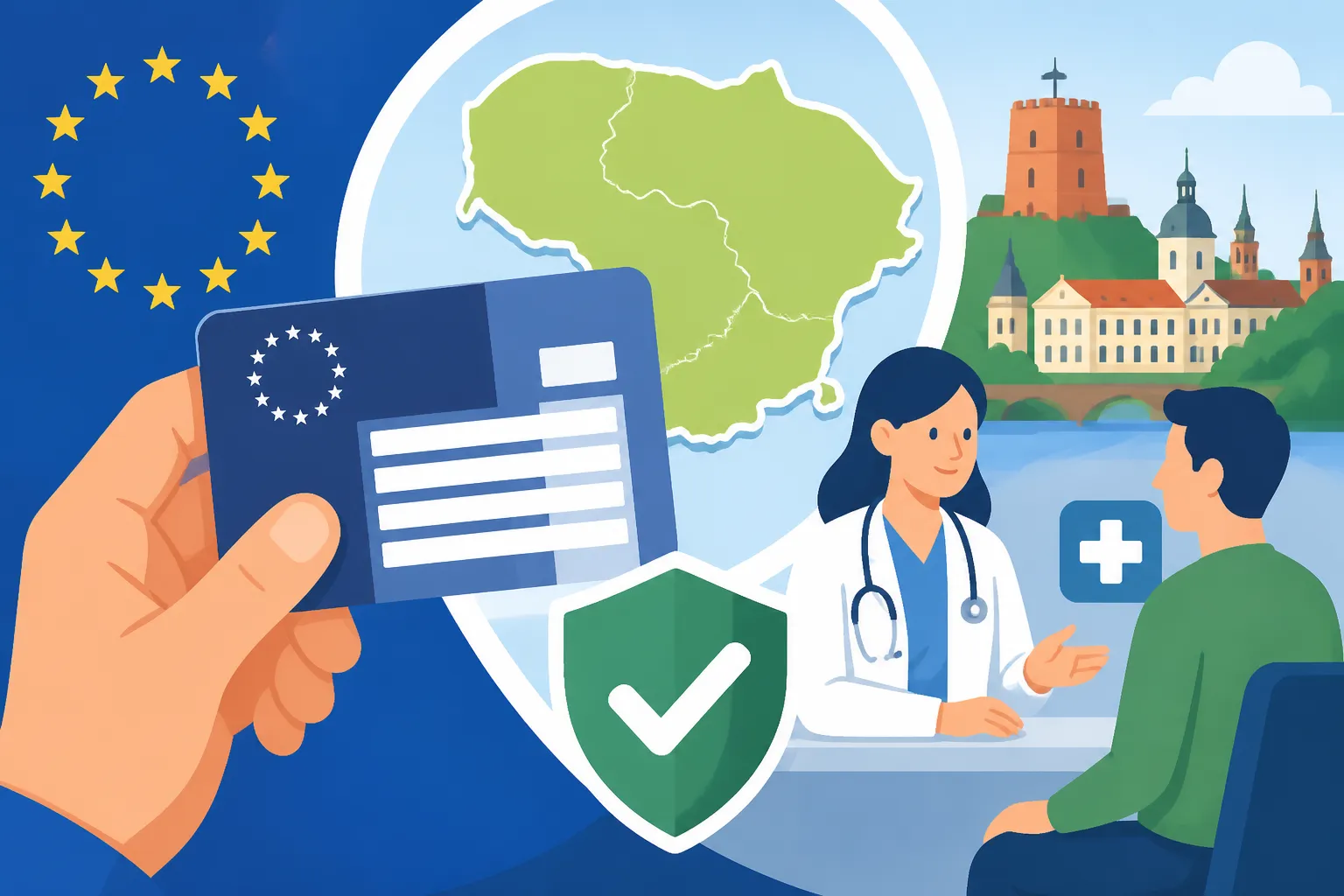
When you first land in Lithuania, you might hear locals or administrative staff refer to your card as the ESDK. This stands for Europos sveikatos draudimo kortelė. While the name is different, the function remains the same: it proves that you are covered by the social security system of another EU/EEA member state or Switzerland. However, a common mistake many expats make is assuming the ESDK covers every type of medical visit. In reality, the card is designed for "necessary care."
The Definition of Necessary Care
In the eyes of the Lithuanian State Patient Fund (VLK), necessary care is medical assistance that cannot be postponed until you return home. This is a deliberately broad definition that allows doctors to exercise professional judgment. If you have a sudden high fever, a broken limb, or an acute infection, the ESDK is your primary tool. It ensures you are treated under the same conditions and at the same cost as a Lithuanian insured person.
However, "necessary care" does not typically include elective surgeries, routine check-ups that could wait six months, or specialized treatments for chronic conditions that were already stable before your trip. Many newcomers are frustrated when they try to use an ESDK for a standard dental cleaning or a non-essential dermatologist visit, only to be told they must pay the full private rate. Understanding this boundary is the first step toward avoiding unexpected bills.
Who Is Eligible to Use the Card
The ESDK is strictly for EU citizens who are in Lithuania temporarily. This includes tourists, students on Erasmus programs, and workers on short-term assignments. If you have officially declared your residence and started working for a local company, the rules change. At that point, you transition into the local system. You can read more about this transition in our guide on How to Register for Compulsory Health Insurance (PSD) as a Foreigner in Lithuania.
For those who are just visiting or are in their first few weeks of relocation, the ESDK remains valid as long as your insurance in your home country is active. If your card expires while you are in Klaipėda or Šiauliai, you generally cannot renew it locally; you must contact the health authorities in your home nation to send a temporary replacement certificate, which is usually a PDF document that carries the same legal weight as the plastic card.
Navigating the Lithuanian Poliklinika System
The backbone of public healthcare in Lithuania is the Poliklinika. These are large, multi-functional community health centers that house family doctors, specialists, and diagnostic laboratories. If you need non-emergency care and want to use your ESDK, the Poliklinika is where you must go. Private clinics often do not accept the ESDK, meaning you would have to pay out of pocket and seek reimbursement later from your home country, which is a notorious bureaucratic headache.
Finding a Public Healthcare Provider
To use your card successfully, you must ensure the facility has an agreement with the Territorial Patient Fund (TLK). Most large, Soviet-era buildings with the word "Poliklinika" in the title are public. In the center of Vilnius, for example, the Centro Poliklinika is a common choice for foreigners. When you walk in, look for the registration desk (Registratūra).
It is a good idea to check The Complete Guide to Healthcare in Lithuania for Expats (2027) to understand which facilities are most likely to have English-speaking staff. While many younger doctors speak excellent English, the administrative staff at the registration desk might only speak Lithuanian or Russian. Having your ESDK card and a form of ID ready is essential to smooth over any language barriers.
The Registration and Triage Process
When you present your ESDK at a Poliklinika, the staff will verify its validity against the EU database. You won't be "registered" in the same way a local resident is—you won't be assigned a permanent family doctor—but you will be entered into the system for that specific visit. They will often ask for your "Asmens kodas," but as a visitor, you likely won't have one. In these cases, they use your date of birth and passport number.
Once registered, you will typically see a family doctor (Šeimos gydytojas) first. They act as the gatekeeper. If your issue requires a specialist, the doctor will issue a referral. This is a critical step because, without a referral, the ESDK might not cover the specialist visit. For more on how this works, see our article on How E-Referrals (Siuntimas) Work for Specialists in Lithuania.
What the ESDK Covers and What It Doesn't
One of the most frequent complaints I hear from fellow expats is the discovery that the ESDK isn't "free" healthcare, but rather "equal" healthcare. This means if a Lithuanian citizen pays a subsidized fee for a specific service or medication, you will pay that same fee. While many basic services are free, there are nuances, especially regarding diagnostic tests and materials used in treatments.
Emergency Care vs. Routine Visits
In a true emergency, you should head to the nearest Ligoninė (Hospital) emergency room or call 112. For life-threatening situations, the ESDK is almost always accepted without question. You can find more detail on this in Emergency Medical Care in Lithuania: What Every Expat Needs to Know. The hospital will provide the necessary stabilization and immediate treatment at no cost to you.
The gray area appears when you need follow-up care. If you were treated for an injury at the emergency room and need to come back a week later for a check-up or to have stitches removed, the hospital might direct you to a Poliklinika. At the Poliklinika, the visit might be covered, but you may be asked to pay a small fee for materials like high-quality bandages or specific diagnostic kits that aren't on the "base" covered list.
Prescription Medications and Pharmacies
Lithuania uses a sophisticated electronic system called E-Sveikata. If a doctor at a public clinic writes you a prescription using your ESDK details, it should appear in the national database. When you go to a Vaistinė (Pharmacy), you simply show your ID and your ESDK. For more on this, check out Understanding the Electronic Prescription (E-Receptas) System in Lithuania.
However, the ESDK only covers the reimbursable portion of the medicine. In Lithuania, medications are categorized. Some are 100% covered, while others are only 50% or 80% covered. You will be responsible for paying the "patient's share" at the pharmacy counter. Furthermore, not all medicines are on the reimbursement list. If the doctor prescribes a brand-name drug that isn't covered by the state fund, you will have to pay the full price.
| Service Type | ESDK Coverage Level | Potential Out-of-Pocket Costs |
|---|---|---|
| Emergency Ambulance | 100% Covered | None in genuine emergencies |
| Family Doctor Visit | 100% Covered | None at public poliklinikas |
| Specialist Visit | Covered with Referral | Small administrative fees |
| Hospital Stay | 100% Covered | Extra for private rooms |
| Prescription Drugs | Variable (50-100%) | Patient "co-payment" share |
| Dental Care | Limited | Fillings and materials often extra |
| Private Clinic Visit | Not Covered | Full private rates apply |
Handling Language Barriers and Administrative Hurdles
The reality of using the public system in Lithuania can be daunting. Unlike the sleek private centers that cater specifically to the international community, public poliklinikas are designed for the local population. This means that while the medical technology is modern, the "customer service" experience can feel a bit retro.
Practical Tips for Communication
If you do not speak Lithuanian, I highly recommend bringing a local friend or at least having a translation app ready on your phone. Medical terms are often similar to Latin or English, but the instructions for where to go next (e.g., "Go to the third floor, room 302, and wait for the green light") can be confusing.
If you find yourself in a situation where the staff refuses to accept your card, do not panic. Sometimes, newer staff members aren't fully trained on the ESDK protocol for non-residents. Ask for the "VLK" or "Ligonių kasos" representative at the facility. Every major public clinic has someone responsible for insurance coordination who will understand the legal requirements of the EU health card. For further help finding someone who understands you, see How to Find an English-Speaking Doctor in Lithuania.
What to Do If You Are Charged Upfront
In some rare instances, a facility might insist on an upfront payment, especially if their system is down or if they are a "semi-private" entity. If this happens, always ask for a detailed invoice (Sąskaita faktūra) and a receipt. Ensure the document explicitly states the medical reason for the visit and the treatments provided.
When you return to your home country, you can submit these documents to your national health provider for reimbursement. Note that they will only reimburse you up to the amount the treatment would have cost the Lithuanian state, which might be lower than what you paid. To avoid this, it is always better to double-check that the facility is part of the How Lithuania's Health Insurance Fund (VLK/PSDF) Works: A Full Overview network before agreeing to treatment.
When the ESDK Is Not Enough: Supplemental Protection
While the ESDK is a fantastic safety net, it has significant holes that can leave you financially exposed in certain scenarios. It is essentially a "bare minimum" coverage plan. For example, the ESDK never covers the cost of medical repatriation—if you are seriously ill and need a specially equipped flight back to your home country, the cost (which can be tens of thousands of euros) is entirely yours to bear.
The Role of Private Clinics and SafetyWing
In Lithuania, private healthcare is highly regarded for its efficiency, English-speaking staff, and lack of waiting lists. However, these clinics rarely accept the ESDK. If you prefer the comfort and speed of a private facility, you will need supplemental insurance. SafetyWing is a popular choice for many expats and digital nomads in Lithuania because it acts as a bridge.
If you have SafetyWing, you can visit the top-tier private clinics in Vilnius or Kaunas and know that you have coverage for those higher costs that the public system doesn't touch. I often suggest to friends that they treat the ESDK as their "emergency/hospital" backup and use SafetyWing for everything else. This allows you to bypass the long queues at the Poliklinika while still having the legal protection of the state system for major surgeries.
Non-Medical Emergencies and Travel Hazards
Another limitation of the ESDK is that it only covers health. It doesn't help you if your luggage is stolen in the Old Town or if you need to cancel your trip due to an emergency at home. Supplemental providers like SafetyWing provide a more holistic safety net that includes travel-related mishaps.
Even for health issues, the "necessary care" clause can be restrictive. If you develop a persistent but non-emergency back pain, the public system might put you on a months-long waiting list for an MRI. With SafetyWing, you have the flexibility to seek private diagnostics much sooner. This is a common strategy for people exploring Public vs Private Healthcare in Lithuania: Which Should Expats Choose? during their first year in the country.
Moving Beyond the ESDK: Long-Term Residency
If you decide to make Lithuania your permanent home, your reliance on the ESDK must end. Once you receive your residence permit and an Asmens Kodas, you are expected to contribute to the local Social Insurance (Sodra) system. This gives you full access to the Lithuanian healthcare system as a resident, which is actually quite comprehensive.
Transitioning to PSD (Compulsory Health Insurance)
The transition happens automatically for most employees, as your employer deducts the PSD contributions from your salary. However, for freelancers or those on a startup visa, the process requires manual registration. It is vital to ensure there is no gap between your ESDK coverage and your PSD activation. You can read about the nuances of this in Health Insurance in Lithuania: Compulsory, Private and Travel Options Explained.
During this transition period, many expats keep their SafetyWing policy active. It provides peace of mind while you wait for the Lithuanian bureaucracy to process your residency and activate your status in the VLK database. Nothing is more stressful than being "between" insurance systems when an unexpected flu or injury hits.
Final Thoughts for EU Citizens
Using your EHIC (ESDK) in Lithuania is a straightforward process as long as you play by the rules: stick to the public Poliklinika system, ensure you have a referral for specialists, and keep your expectations realistic regarding co-payments. Lithuania's medical staff are highly trained and the facilities in major cities are excellent. By understanding the system's structure, you can focus on your recovery rather than your paperwork.
Always remember that the ESDK is a tool for emergencies and urgent needs, not a replacement for a comprehensive health plan. Whether you choose to rely solely on the public system or supplement it with a flexible option like SafetyWing, being prepared is the key to a smooth and healthy stay in the Baltics. Don't wait until you're sick to figure out where your local Poliklinika is—take a walk, find the building, and familiarize yourself with the registration desk today.
Disclaimer
This guide is for informational purposes only and does not constitute legal or professional medical advice. Healthcare regulations in Lithuania and the European Union are subject to change. Always verify current requirements with the Lithuanian State Patient Fund (VLK) or your home country's health authorities before seeking treatment. We are not responsible for any costs incurred or medical decisions made based on this information.