Can I Use My EU Driving Licence Permanently in Lithuania?
Ah, the classic expat question! You've packed your bags, maybe even driven your car across half a continent, and now you're here in Lithuania, ready to embrace the Baltic life. But then that little voice in your head pops up: "What about my driving licence? Can I really just keep using my old EU one indefinitely?" It's a question I've heard countless times, and believe me, the rules, while seemingly straightforward on paper, always seem to throw a few curveballs in practice. This guide is here to untangle the official jargon and give you the real-world lowdown on using your EU driving licence in Lithuania.
The Immediate Relief: Yes, You Can Use It, Initially!
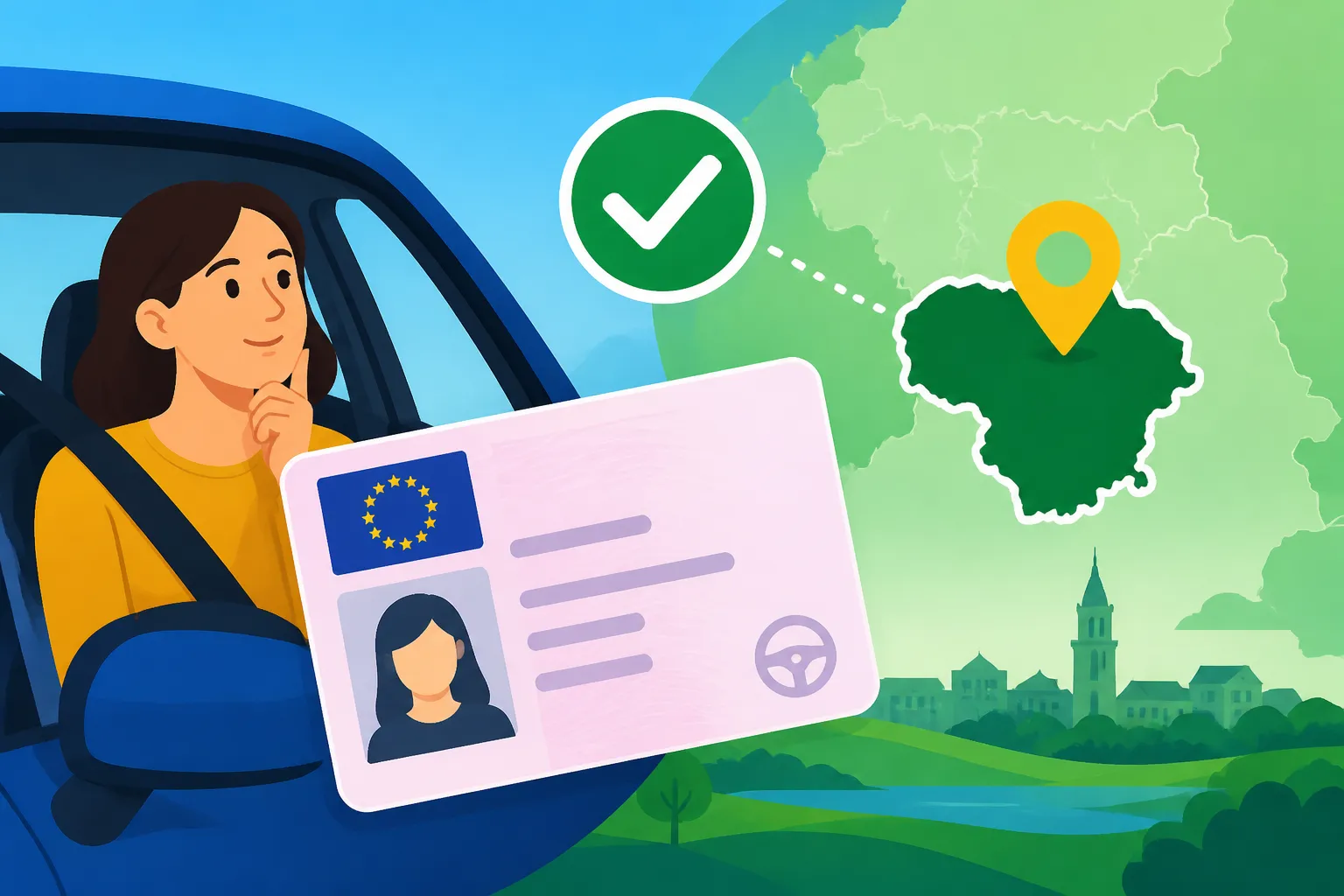
Let's get the good news out of the way first, because we all need a little win when navigating a new country's bureaucracy, don't we? If you're an EU/EEA citizen and you've just arrived in Lithuania, you absolutely can use your existing EU driving licence here. There's no immediate panic to rush to the infamous Regitra (the Lithuanian Road Transport Directorate) the moment you cross the border. The beauty of the European Union means that driving licences issued in one member state are generally recognised in all others. This applies to citizens from the 27 EU member states, as well as Iceland, Liechtenstein, and Norway.
Think of it as a grace period, or rather, the standard operating procedure for short-term stays and initial settlement. You can breathe a sigh of relief knowing you won't be immediately pulled over for having "foreign plates" and a non-Lithuanian licence. Whether you're in Vilnius, Kaunas, or exploring the beautiful Curonian Spit, your EU licence is valid. This recognition covers everything from renting a car for a weekend trip to simply driving your own vehicle around for daily errands.
The immediate convenience is immense. You've got enough on your plate when you first move: finding an apartment, setting up utilities, maybe even trying to figure out which Lithuanian mobile provider to go with (though I've heard good things about Airalo for quick connectivity when you land!). The last thing you need is another urgent administrative task. So, for the vast majority of expats who are just getting settled, driving on their existing EU licence is perfectly fine.
When "Permanent" Becomes a Bit… Flexible: The Residency Conundrum
Now, this is where the "permanently" part of your question gets a bit nuanced. While your EU licence is valid, the concept of "permanently" is tied directly to your legal residency status in Lithuania. The key rule to remember, which isn't unique to Lithuania but applies across the EU, is the 185-day rule.
The 185-Day Rule and Its Implications
The 185-day rule basically states that if you become a resident in a new EU country, your primary residence for driving licence purposes shifts after 185 days. This isn't about when your existing licence becomes invalid; it's about where your primary driving licence should theoretically be registered. For most EU citizens living long-term in Lithuania, this means that while your original EU licence remains valid, after you've officially established residency here, it is highly recommended, and in some cases implicitly expected, that you exchange it for a Lithuanian one.
Why the fuss? Well, it ties into a few things. First, it simplifies administrative processes. If your licence is issued in, say, Portugal, and you've been living in Lithuania for five years, it just makes more sense for your primary documentation to reflect your current country of residence. Second, it can impact things like insurance claims or even interactions with law enforcement. While a Lithuanian officer must recognise your valid EU licence, having a local one can smooth things over. And let's be honest, any expat who's dealt with bureaucracy knows that "smooth things over" is often the name of the game.
Another critical point here is your official declaration of residency. If you've gone through the process of Declaring Your Place of Residence in Lithuania: The Complete Guide and obtained your temporary or permanent residence permit, you are clearly establishing Lithuania as your primary home. This act, more than anything, triggers the expectation that you'll eventually get a Lithuanian driving licence. You're no longer just a visitor; you're part of the system.
The "When" of Exchanging Your Licence
So, when do you have to exchange it? Strictly speaking, for EU/EEA citizens, your existing licence remains valid until its expiry date. Unlike non-EU licences, which generally have a stricter 185-day limit before exchange is mandatory, EU licences enjoy this continuous validity. This means if your German licence expires in five years, you could technically continue using it for those five years while living in Lithuania.
However, many expats choose to exchange their licence sooner than the expiry date. Why?
- Lost or Stolen Licence: If your licence gets lost or stolen while you're living in Lithuania, you'll have to apply for a replacement in Lithuania through Regitra, rather than going back to your home country. At that point, you'll be issued a Lithuanian licence anyway.
- Convenience: For many, it's simply easier to have all their official documents from their country of residence. It can simplify dealings with local institutions.
- Renewal: When your current EU licence expires, you must renew it in the country where you are legally resident. So, if your French licence expires and you're living in Vilnius, you'll be renewing it at Regitra, and getting a Lithuanian one.
The threshold isn't as rigid as for non-EU citizens, but the spirit of the law, and practical sense, leans towards exchanging it once you've settled in long-term. Think of it as a logical step in The Complete Guide to Lithuanian Residence Permits for Expats (2027).
Navigating the Exchange Process at Regitra
Alright, so you've decided to bite the bullet and exchange your EU licence for a Lithuanian one, or perhaps your old one is about to expire. The process itself isn't too complicated for EU citizens, but it still involves a trip to Regitra, and like any administrative body, it requires preparation.
Step-by-Step for Exchanging Your EU Licence
-
Gather Your Documents: This is the golden rule for any official business in Lithuania. For a driving licence exchange, you'll typically need:
- Your existing valid EU/EEA driving licence.
- Your Lithuanian identity document (residence permit or ID card, if you're an EU citizen who has registered your Right of Residence as an EU Citizen in Lithuania).
- Your Asmens Kodas (Personal Code). This is fundamental for nearly everything here, and if you haven't got it yet, you'll need to know How to Get Your Asmens Kodas (Personal Code) and Why It Matters for Healthcare.
- A valid medical certificate confirming you're fit to drive. This means a visit to a doctor or medical commission in Lithuania. They'll check your eyesight, hearing, and general health. It's usually a standard medical check-up, nothing too arduous, but factor in the time and cost.
- Proof of address. Sometimes your residence permit is enough, but it's good to have a document from Registrų Centras or a utility bill if asked.
- Payment for the licence issuance fee.
-
Get Your Medical Certificate: This needs to be done before you go to Regitra. Many private clinics offer this service, and it's generally quick and straightforward. Just make sure the certificate is issued by a Lithuanian medical institution.
-
Book an Appointment at Regitra: While walk-ins might be possible in some smaller branches, it's always, always advisable to book an appointment online via the Regitra website. This saves you from potentially hours of waiting and ensures you're seen. Choose the service for "Vairuotojo pažymėjimo keitimas" (Driving licence exchange).
-
Visit Regitra: On your appointment day, arrive on time with all your documents. You'll hand over your old licence, submit your medical certificate, and they'll process your application. They'll take your photo and fingerprints (for the biometric card).
-
Pay the Fee: The fee for issuing a new driving licence varies depending on how quickly you want it. Standard issuance usually takes about 10 working days, but you can pay extra for express service (e.g., within 3 or 1 working day).
-
Collect Your New Lithuanian Licence: Once ready, you can pick it up from the same Regitra branch. Congratulations, you're officially a Lithuanian-licenced driver!
The costs for a standard driving licence exchange are fairly reasonable. As of my last check, a standard licence (issued within 10 working days) costs around €14.48, while an urgent one (3 working days) is €24.10, and a super urgent (1 working day) is €34.77. The medical certificate will be an additional cost, usually around €20-€40 depending on the clinic.
Beyond the Licence: Other Driving Considerations for Expats
Exchanging your driving licence is one thing, but if you've brought your car with you or plan to buy one here, there are other important aspects to consider for driving in Lithuania. It's all part of the big move, and companies like Sirelo can help with the logistics of getting your belongings (and even your car) across borders, but the local paperwork is always up to you!
Vehicle Registration and Roadworthiness
If you bring your car from another EU country and become a resident in Lithuania, you must register it here. There's no escaping this one after a certain period, typically 6-12 months, depending on specific circumstances. This involves:
- Regitra Registration: You'll need to take your car to Regitra to register it and get Lithuanian licence plates. This will require original documents from your previous registration. You can find a full rundown on How to Register a Vehicle with Regitra in Lithuania.
- Technical Inspection (Techninė Apžiūra): Your vehicle will need to pass a roadworthiness test, even if it just passed one in another EU country. This is done at designated technical inspection centres. This is known as the Understanding the Vehicle Roadworthiness Test (Techninė Apžiūra) in Lithuania. Don't worry, it's a routine check to ensure your car meets Lithuanian safety and environmental standards.
- Vehicle Registration Tax: Lithuania introduced a vehicle registration tax based on CO2 emissions. This is a one-off payment when you register a vehicle for the first time in Lithuania or when ownership changes.
Car Insurance
Mandatory third-party liability insurance (TPVCA or "Civilinės atsakomybės draudimas") is a must for any vehicle driven on Lithuanian roads. While your foreign insurance might cover you for a short transitional period, once your car is registered in Lithuania, you'll need local insurance. You can get quotes from various providers like ERGO, Gjensidige, BTA, and Lietuvos draudimas. It's wise to shop around, as prices can vary significantly. Some insurers might even offer better rates if you've built up a no-claims bonus in another EU country, so bring proof if you have it!
Road Rules and Culture
Lithuania drives on the right, and road signs are generally in line with European standards. Speed limits are 50 km/h in urban areas, 90 km/h outside urban areas, and 110-130 km/h on motorways, depending on the season and road type. Headlights are mandatory even during the day, year-round. And be prepared for winter conditions; winter tyres are compulsory from November 10th to April 1st. While the driving itself is familiar, it's always good to refresh your knowledge of local specificities, especially regarding right-of-way at intersections and pedestrian crossings.
The Bottom Line for EU Licence Holders
So, to answer your original question directly: Yes, you can use your EU driving licence permanently in Lithuania in the sense that it remains legally valid until its expiry date. However, once you become a legal resident, it is expected and strongly advisable to eventually exchange it for a Lithuanian one, especially when your current licence is due for renewal or if it gets lost or stolen.
Think of it as integrating fully into your new home. While the EU offers incredible flexibility, embracing the local system for crucial documents like your driving licence just makes life a little smoother in the long run. It's one less thing to worry about when you're busy enjoying all that expat life in Lithuania has to offer!
Disclaimer
The information provided in this guide is for general informational purposes only and does not constitute legal or professional advice. While we strive to provide accurate and up-to-date information, rules and regulations in Lithuania can change. It is always recommended to consult with the official Lithuanian Road Transport Directorate (Regitra) or a legal professional for the most current and specific advice regarding your individual situation.