How Do I Get a Lithuanian Language Certificate for Residence?
Navigating the labyrinthine world of Lithuanian administration can feel like trying to solve a Rubik's Cube blindfolded, and when it comes to long-term residence or citizenship, the Lithuanian language certificate often emerges as one of the trickiest sides to align. Many expats, myself included, have stood scratching their heads, wondering exactly what this certificate is, why it's needed, and how on earth to get one. This guide is here to demystify the process, walking you through the requirements, preparation, and examination steps so you can confidently secure your language certificate and solidify your life here in Lithuania.
Why You Might Need a Lithuanian Language Certificate for Residence
It's easy to dismiss learning Lithuanian when you can get by with English, especially in Vilnius or Kaunas's bustling tech and expat communities. But for those looking to plant deeper roots, the language requirement becomes an unavoidable reality. This isn't just about bureaucracy; it's about integration and genuinely participating in your adopted home.
The Legal Requirement for Permanent Residence and Citizenship
Let's be blunt: if you're eyeing long-term stability here, whether that's permanent residence or, eventually, Lithuanian citizenship, a language certificate isn't optional – it's mandatory. The Migration Department (MIGRIS) is quite clear on this. For a How to Apply for Permanent Residence in Lithuania application, you'll generally need to demonstrate proficiency at the A2 level. This isn't fluent, mind you, but it’s enough to handle basic, everyday situations. It proves you've made an effort to understand and communicate in your new home.
If your ambition stretches to becoming a full-fledged Lithuanian citizen through naturalisation, the bar is raised a bit higher. You'll need to pass a B1 level exam, along with a separate Understanding the Lithuanian Language and Constitution Exams for Citizenship test. This means you need to be able to communicate more fluently, express opinions, and understand more complex texts. For many, this is the biggest hurdle, especially if your daily life primarily involves English. It requires a sustained commitment, often over several years, to move from basic survival phrases to genuine conversational ability. Without this piece of paper, your path to deeper integration, sadly, hits a dead end, regardless of how many years you've contributed to the local economy or how well you manage your The Complete Guide to Taxes in Lithuania for Expats (2027).
Beyond the Law: Practical Benefits of Language Proficiency
While the legal requirement might be the immediate impetus, let's talk about the real benefits. Seriously, stepping out of the expat bubble and into conversations in Lithuanian is a game-changer. Imagine walking into a smaller, local shop, a 'vaistinė' (pharmacy), or a 'poliklinika' (polyclinic), and being able to express yourself without relying on frantic hand gestures or a translation app. It reduces stress, speeds up transactions, and frankly, makes life a lot more pleasant.
From a social perspective, speaking the local language opens doors. You can connect with neighbours, understand local humour, and genuinely participate in community events. Lithuanians, like people everywhere, appreciate when you make an effort. It fosters a sense of belonging that no amount of perfectly translated documents can provide. Plus, for those working in more local environments or looking to expand their career beyond international companies, language skills can be a significant advantage. Even if your job is in English, showing initiative in learning Lithuanian reflects well on your commitment to living here. It signals that you’re not just passing through, but truly investing in your new home.
Understanding the Official Language Proficiency Levels
Before you dive headfirst into flashcards and grammar books, it’s crucial to understand what the different proficiency levels actually mean in the context of the Lithuanian language certificate. These aren’t arbitrary classifications; they align with internationally recognised standards and dictate what you’ll be expected to understand and produce during the exam.
A2 for Permanent Residence: What It Means
The A2 level, often referred to as "Basic User" or "Waystage," is the minimum required for obtaining permanent residence. What does this truly entail? Think of it as functional survival language. You should be able to:
- Understand common phrases and frequently used expressions: This includes basic personal and family information, shopping, local geography, and employment. For example, understanding directions to the nearest supermarket, asking about the price of an item, or telling a doctor where it hurts.
- Communicate in simple and routine tasks: You should be able to exchange information on familiar topics and activities. This means you can hold a very basic conversation about your day, your hobbies, or your family, even if it's slow and requires some repetition.
- Describe in simple terms aspects of your background, immediate environment, and matters in areas of immediate need: You can introduce yourself, talk about where you live, what you do, and express basic needs. For instance, explaining to a landlord a problem with your heating or asking for specific items at a grocery store.
In essence, A2 means you can navigate daily life without being completely lost. You won't be discussing quantum physics, but you can order food, ask for help, and manage simple administrative tasks. It's about getting by, not thriving linguistically, but it's a solid foundation.
B1 for Citizenship: Stepping Up Your Game
For citizenship, you're looking at the B1 level, known as "Independent User" or "Threshold." This is a significant leap from A2 and requires more comprehensive language skills. At B1, you should be able to:
- Understand the main points of clear standard input on familiar matters: This covers work, school, leisure, etc. You can follow the gist of a news report, understand announcements at a train station, or comprehend the main points of a conversation at work, even if some details elude you.
- Deal with most situations likely to arise whilst travelling in an area where the language is spoken: You can handle travel arrangements, unexpected situations (like a cancelled bus), and interact with locals confidently.
- Produce simple connected text on topics that are familiar or of personal interest: This means you can write short emails, simple letters, or basic reports, expressing your thoughts on familiar subjects with reasonable coherence.
- Describe experiences and events, dreams, hopes and ambitions and briefly give reasons and explanations for opinions and plans: This is where it gets more nuanced. You can articulate more complex ideas, explain why you think something, and narrate past events or future plans with a degree of detail.
The B1 level isn't about perfection; it’s about functional independence. You can participate in more extended conversations, understand more nuanced information, and express yourself more spontaneously. It truly marks a transition from just surviving to actively engaging with Lithuanian society.
Common European Framework of Reference for Languages CEFR Explained
These A2 and B1 levels aren't unique to Lithuania; they are part of the Common European Framework of Reference for Languages (CEFR). The CEFR is an international standard for describing language ability. It's used across Europe and increasingly worldwide to evaluate language proficiency in six levels: A1, A2, B1, B2, C1, and C2.
- A Levels (Basic User):
- A1 (Beginner): Can understand and use very basic everyday expressions and simple phrases.
- A2 (Elementary): Can understand sentences and frequently used expressions related to areas of most immediate relevance (personal and family information, shopping, local geography, employment).
- B Levels (Independent User):
- B1 (Intermediate): Can understand the main points of clear standard input on familiar matters regularly encountered in work, school, leisure, etc. Can deal with most situations likely to arise whilst travelling.
- B2 (Upper Intermediate): Can understand the main ideas of complex text on both concrete and abstract topics, including technical discussions in their field of specialisation. Can interact with a degree of fluency and spontaneity.
- C Levels (Proficient User):
- C1 (Advanced): Can understand a wide range of demanding, longer texts, and recognise implicit meaning. Can express him/herself fluently and spontaneously without much obvious searching for expressions.
- C2 (Mastery): Can understand with ease virtually everything heard or read. Can summarise information from different spoken and written sources, reconstructing arguments and accounts in a coherent presentation.
Understanding these benchmarks is vital because it gives you a clear target. You're not just aiming to "speak Lithuanian," but to achieve a specific, measurable level of competence. When you enrol in courses or choose study materials, look for those that explicitly align with CEFR levels.
How to Prepare for Your Lithuanian Language Exam
Preparing for any language exam can be daunting, especially when the language is as unique and complex as Lithuanian. It demands consistent effort and a structured approach. You'll need to hit all four language skills: reading, writing, listening, and speaking.
Formal Courses and Institutions
For many expats, especially those who prefer a structured learning environment, formal language courses are the way to go. They offer several advantages:
- Experienced Teachers: You get instructors who understand common pitfalls for foreign learners and can guide you through tricky grammar.
- Curriculum: A well-designed course will systematically cover all the necessary grammar, vocabulary, and skills required for the A2 or B1 exam.
- Peer Support: Learning with others creates a supportive community where you can practice, ask questions, and motivate each other.
- Direct Practice: Classroom settings provide opportunities for speaking practice, role-playing, and receiving immediate feedback on your pronunciation and grammar.
In major cities like Vilnius and Kaunas, you'll find several reputable institutions offering Lithuanian language courses. Universities such as Vilnius University often have language centres with courses tailored for foreigners. Private language schools also abound. A quick search for "Lithuanian language courses for foreigners Vilnius" will yield many options. When choosing, make sure the course content is specifically geared towards preparing for the A2 or B1 CEFR level exams. Ask about their pass rates and whether they offer mock exams.
Self-Study Resources and Online Tools
Perhaps formal classes don't fit your schedule or budget. Fear not, the digital age offers a wealth of self-study resources. This path requires more discipline, but it’s entirely doable.
- Textbooks and Workbooks: Invest in good quality textbooks designed for A2 or B1 learners. Look for those with accompanying audio materials. These will provide a structured pathway through grammar and vocabulary.
- Language Learning Apps: Duolingo, Memrise, and similar apps can be fantastic for vocabulary building and basic sentence structure. However, they usually won't get you to B1 alone; consider them supplementary tools.
- Online Platforms: Websites like LingQ offer a vast library of Lithuanian content at various levels, allowing you to read, listen, and learn new words in context. YouTube channels dedicated to Lithuanian language learning are also becoming more popular.
- Podcasts and Music: Immerse yourself! Listen to Lithuanian podcasts or radio shows. Start with simpler content and gradually move to more complex ones. Lithuanian music can also be a fun way to pick up vocabulary and pronunciation, even if you don't understand every lyric at first.
- News in Simple Lithuanian: Some news outlets occasionally publish simplified versions of articles, which can be great for reading comprehension.
Remember, the key to self-study is consistency. Set a daily schedule and stick to it, even if it’s just 30 minutes a day.
Finding Tutors and Language Exchange Partners
Regardless of whether you choose formal courses or self-study, supplementing your learning with a tutor or language exchange partner is invaluable, especially for improving your speaking and listening skills.
- Professional Tutors: A good tutor can identify your weaknesses, provide tailored lessons, and give you focused practice on areas you struggle with. They can also conduct mock exams and give specific feedback. Platforms like iTalki are excellent for finding Lithuanian tutors, often at very reasonable rates. You can choose tutors based on their experience, reviews, and hourly rates, fitting it into your schedule.
- Language Exchange Partners: This is a free and often fun way to practice. Find a Lithuanian native speaker who wants to learn your language, and agree to meet (in person or online) to practice each other’s languages. This provides authentic conversational practice and cultural insights. Check local expat groups on social media or dedicated language exchange apps.
Combining formal learning with self-study and conversational practice is often the most effective approach. It addresses all aspects of language acquisition, giving you the best chance of success on exam day.
The Lithuanian Language Exam: What to Expect
The thought of an official language exam can send shivers down anyone's spine, particularly when it's in a language you're still mastering. But knowing what to expect can significantly reduce anxiety and help you perform your best.
Where to Take the Exam
The official Lithuanian language proficiency exams (for A1, A2, B1, B2 levels) are administered by accredited institutions. The most prominent one is the Centre for Assessment of Foreign Language Proficiency (Užsienio kalbos mokėjimo lygio vertinimo centras), usually at Vilnius University's Institute of International Relations and Political Science. However, other universities or language centres might also be authorised to conduct these exams.
It's crucial to check their official website for the latest schedule, registration deadlines, and specific locations. Exams are typically held a few times a year, so plan well in advance. Don't wait until the last minute before your residence permit or citizenship application deadline is looming – that's a recipe for stress and potential delays.
Exam Structure: Reading, Writing, Listening, Speaking
The exam will test all four core language skills, mirroring the CEFR framework. Here’s a general breakdown of what to expect for A2 and B1 levels:
- Reading (Skaitymas): You'll be given texts (e.g., short articles, advertisements, public notices for A2; more complex newspaper articles, simple literary texts for B1) and asked comprehension questions, often multiple-choice, true/false, or matching exercises. The goal is to assess your ability to extract main ideas and specific information.
- Writing (Rašymas): For A2, this might involve filling out a simple form, writing a short message, or composing a basic email (e.g., asking for information, describing a simple event). For B1, you'll need to write more coherent texts, such as an informal letter, an email expressing an opinion, or a short report, demonstrating your ability to organise thoughts and use appropriate vocabulary and grammar.
- Listening (Klausymas): You'll hear audio recordings (e.g., simple dialogues, announcements, short news items for A2; longer conversations, interviews, radio programmes for B1) and answer questions based on what you heard. This tests your ability to understand spoken Lithuanian, including accents and different speeds of speech. Don't worry, the recordings are usually clear, but they won't slow down for you!
- Speaking (Kalba): This is often the most nerve-wracking part. You'll typically have an individual or paired interview with examiners. For A2, expect simple self-introductions, answering basic personal questions, and perhaps a role-play of a simple everyday situation. For B1, you'll be expected to participate in a more extended conversation, express opinions, describe experiences, and respond to prompts on familiar topics. The examiners are usually professional and understand you're a learner, but they won't spoon-feed you. They're looking for your ability to communicate effectively, even with errors.
| Exam Component | A2 Level (Permanent Residence) | B1 Level (Citizenship) |
|---|---|---|
| Reading | Understand short, simple texts (e.g., ads, signs, simple messages). Identify key information. | Understand main points of clear standard texts (e.g., news, personal letters). Extract relevant details. |
| Writing | Fill out forms, write short notes/emails (e.g., asking for directions, simple thank-you). | Write coherent texts (e.g., informal letters, emails expressing opinions, short reports). Use basic connectors. |
| Listening | Understand simple phrases and common vocabulary in clear, slow speech (e.g., short announcements, basic conversations). | Understand main points of standard speech on familiar topics (e.g., interviews, radio programmes). Follow longer discussions. |
| Speaking | Participate in simple, direct exchanges (e.g., self-introduction, asking/giving personal information, simple transactions). | Maintain conversations on familiar topics, express opinions, describe experiences, give reasons for plans. |
| Grammar & Vocab | Basic grammar structures, common vocabulary for everyday situations. | Broader range of grammar structures, more extensive vocabulary for various topics. |
Registration, Fees, and Results
Registration: You'll need to register for the exam well in advance, usually through the institution's website. This often involves filling out an online form and submitting a copy of your passport or ID.
Fees: Be prepared to pay an exam fee. The cost can vary, but typically ranges from €40 to €70 per level. Always check the current fees on the official website. This fee is non-refundable if you miss the exam or decide not to take it.
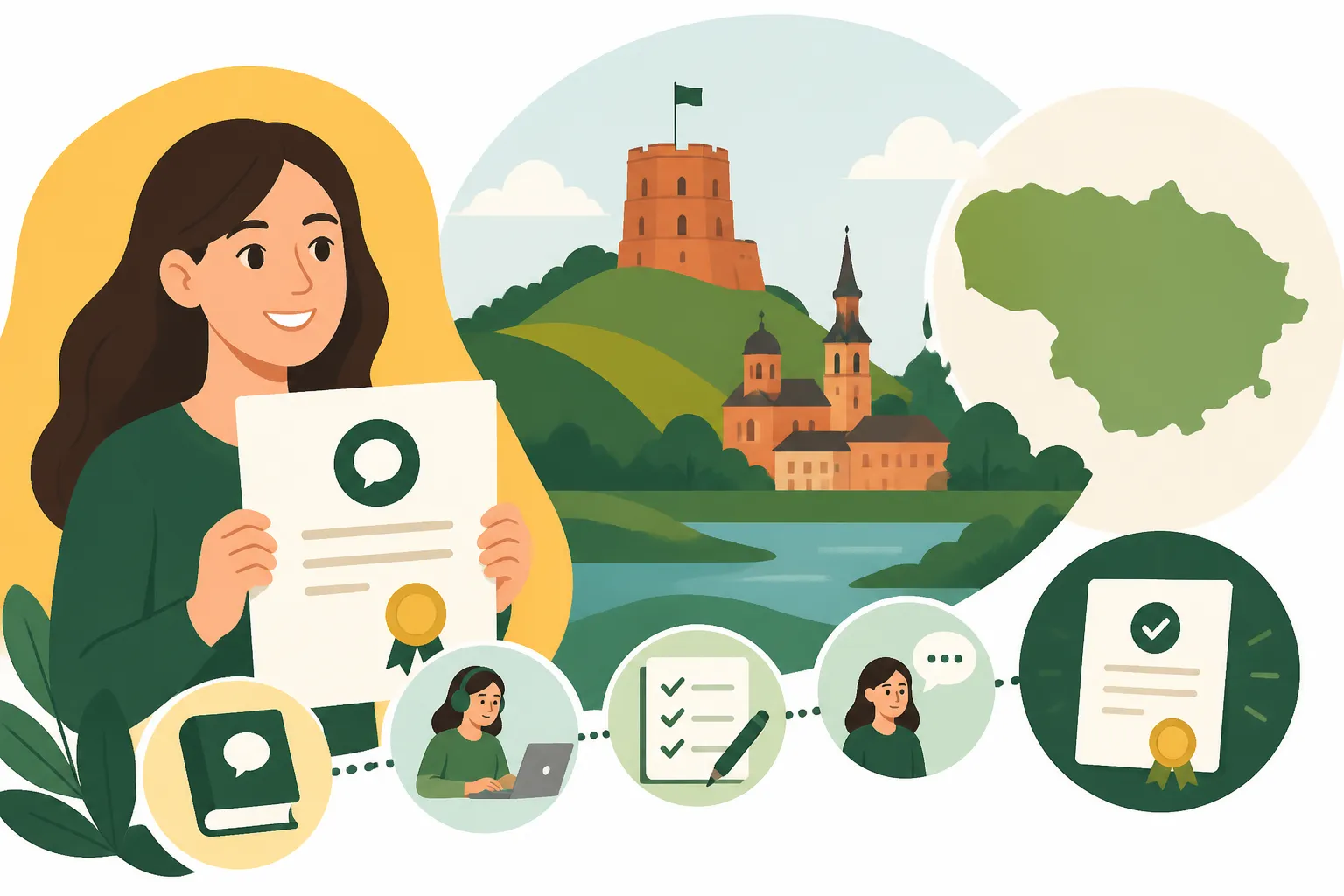
Results: Results are usually published online within a few weeks after the exam. If you pass, you'll receive an official certificate, which is the golden ticket you need for your residence or citizenship application. If you don't pass, don't despair! Many people need multiple attempts. Use the experience to identify your weaknesses and focus your future studies.
When you're submitting your residence permit application through the MIGRIS portal, make sure you have the original certificate or a certified copy, as they will require it. Details on How to Apply for a Temporary Residence Permit (TRP) in Lithuania or How to Apply for Permanent Residence in Lithuania will always list this as a key document.
What to Do After You Get Your Certificate
Congratulations! Getting that Lithuanian language certificate is a huge accomplishment, and you should absolutely take a moment to pat yourself on the back. But the administrative journey, as many of us expats know, rarely ends with just one step.
Submitting Your Certificate to MIGRIS or Other Authorities
Once you have your official certificate in hand, the next critical step is to submit it to the relevant authority, typically the Migration Department (MIGRIS). This document is a vital component of your application for either permanent residence or Lithuanian citizenship.
- For Permanent Residence: If you're applying for or renewing your permanent residence permit, you'll need to upload a clear scan of your A2 language certificate to the MIGRIS electronic services system (E-MIGRIS) along with your other documents. It’s always a good idea to bring the original with you to any in-person appointments, just in case they need to verify it. This is usually part of the application for Long-Term Resident (EU) Status in Lithuania.
- For Citizenship: If you're pursuing Lithuanian citizenship through naturalisation, your B1 language certificate, along with your Understanding the Lithuanian Language and Constitution Exams for Citizenship certificate, will be a central piece of your application package. The application process for citizenship is more rigorous and often involves multiple stages, so ensure all your documents, including this certificate, are perfectly in order. The authorities will scrutinise everything, including your contributions to society, your tax record (which is why staying on top of your The Complete Guide to Taxes in Lithuania for Expats (2027) is also crucial), and of course, your language proficiency.
Always double-check the specific requirements and submission methods on the official MIGRIS website, as procedures can sometimes change. Keep multiple copies, both digital and physical, for your records. It’s not uncommon for government agencies to ask for documents more than once, so being prepared saves a lot of headaches.
Keeping Your Language Skills Sharp
Getting the certificate is a milestone, but it's really just the beginning. The goal isn't just to pass an exam; it's to integrate into life here. Language is a living thing, and if you don't use it, you will lose it. This is a common pitfall for many expats who pass their A2 or B1 exam and then revert to primarily English-speaking environments.
- Continuous Exposure: Don't stop listening to Lithuanian radio, watching Lithuanian TV shows (even with subtitles at first), or reading local news portals. Make it a part of your daily routine.
- Active Practice: Seek out opportunities to speak. Engage with your neighbours, colleagues, or shopkeepers. Even a simple "Ačiū" (thank you) or "Labas rytas" (good morning) goes a long way. The more you use the language in real-life situations, the more natural it will become.
- Join Local Groups: Consider joining a local book club, a hiking group, or a sports team. These are excellent environments for natural language practice and cultural immersion. You’ll be surprised how quickly your conversational skills improve when you’re genuinely interested in the activity.
- Revisit Learning Resources: Don't be afraid to occasionally revisit your textbooks, apps, or even your old tutor on iTalki for a refresher. Learning a language is a marathon, not a sprint.
- Embrace Imperfection: You will make mistakes. Oh, believe me, you will. But that's part of the journey. Don't let the fear of sounding silly stop you from speaking. Lithuanians generally appreciate the effort and are often eager to help you learn.
Think of your language certificate not as an ending, but as a stepping stone. It unlocks new possibilities and signifies your commitment to this beautiful, complex country. The ongoing journey of language learning will deepen your connection to Lithuania, making your expat experience richer and more fulfilling.
Disclaimer
The information provided in this guide is for general informational purposes only and does not constitute legal or professional advice. While we strive to keep the information up-to-date and accurate, regulations and procedures in Lithuania can change frequently. It is always recommended to consult with the official Lithuanian Migration Department (MIGRIS) or a qualified legal professional for the most current and specific advice regarding your individual situation.