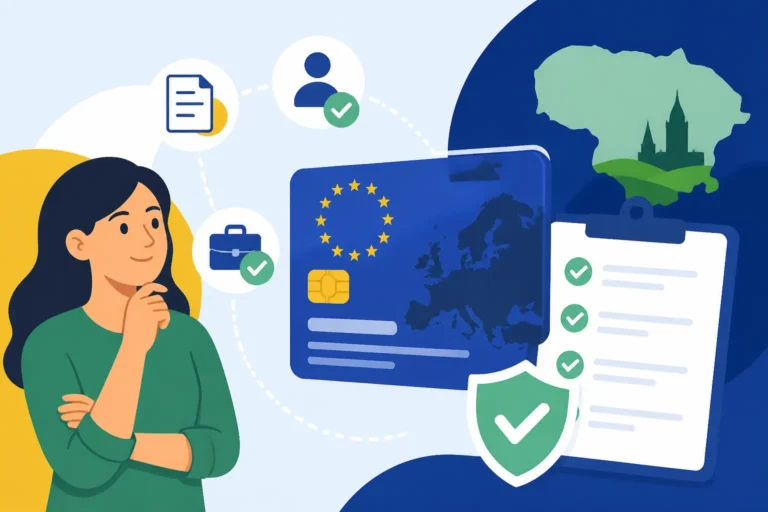
Understanding Long-Term Resident (EU) Status in Lithuania
Oh, the journey to feeling truly settled in Lithuania, isn't it something? Many of us arrive with dreams of new beginnings, perhaps on a work visa or a student permit, and somewhere down the line, the idea of "long-term" starts to truly sink in. But navigating the nuances between simply having a temporary residence permit and achieving a more robust status, like the fabled Long-Term Resident (EU) status, can feel like deciphering an ancient scroll written in a language you're still learning. This guide is for you if you're feeling a bit lost in the bureaucratic labyrinth, trying to understand what this status means, how it's different from national permanent residence, and what it truly takes to get there in Lithuania.
What Exactly is Long-Term Resident EU Status?
When we talk about long-term residence in Lithuania, it's easy to get tangled up in the terminology. There's the national "permanent residence permit" and then there's the "EU Long-Term Resident Status." While both signify a high level of stability and a strong connection to Lithuania, the EU variant carries an extra layer of portability and rights across a wider European stage. It’s like earning a master key, not just to your new Lithuanian home, but to several other doors across the continent. This isn't just about staying in Lithuania indefinitely; it's about gaining enhanced mobility and flexibility within the vast majority of the European Union.
More Than Just Permanent Residence: The EU Dimension
Let's clear up a common misconception: a national permanent residence permit in Lithuania (which you can learn more about in our guide on Permanent Residence in Lithuania: The Complete Pathway (2027)) grants you the right to live, work, and study in Lithuania indefinitely. It's a fantastic achievement, a testament to your commitment to this country. However, the EU Long-Term Resident Status, granted under EU Directive 2003/109/EC, goes a step further. It essentially allows you, once you've obtained it in one EU member state (in this case, Lithuania), to apply for residence in most other EU member states (excluding Denmark, Ireland, and the United Kingdom, which is no longer in the EU) under more favourable conditions than a non-EU citizen applying from scratch.
Imagine you've built a life in Vilnius, you've spent years contributing to the economy, and now an incredible job opportunity arises in Berlin or Paris. With just a national permanent residence permit, you'd likely have to start a new immigration process in Germany or France as if you were a new arrival from a non-EU country. But with EU Long-Term Resident Status from Lithuania, you'd find the path significantly smoother. You'd still need to apply for a residence permit in that new country, but the process is streamlined, and your status here in Lithuania gives you a considerable advantage, often exempting you from certain market tests or quotas. It's truly a valuable asset for those who envision a dynamic future within the European Union.
Key Benefits of Holding This Status
So, what exactly are these "favourable conditions" and "enhanced mobility"? Let's break down the tangible benefits that make pursuing EU Long-Term Resident Status worth the effort. First and foremost is the increased mobility. As mentioned, it facilitates easier relocation to other EU member states. You can move, work, or study in another participating EU country without having to go through the entire immigration procedure again as a non-EU citizen. This is a game-changer for career opportunities, personal growth, or even simply for those who might want a change of scenery within the EU without losing their hard-earned status.
Beyond geographical mobility, this status typically grants you rights comparable to citizens of the host country in many respects. This includes access to employment, education, social security, and other social benefits. While there might be some specific national variations, the general principle is one of equal treatment. For example, your children would have easier access to education in another EU country, and you yourself could pursue higher education or vocational training with fewer bureaucratic hurdles. It also generally simplifies Family Reunification in Lithuania: A Complete Guide for Expats, allowing you to bring close family members to live with you under more straightforward conditions, both in Lithuania and potentially in other EU states where you might eventually relocate. It's about securing a comprehensive legal standing that acknowledges your significant contribution and integration into the European fabric, not just the Lithuanian one.
Eligibility Requirements: The Marathon, Not a Sprint
Getting the EU Long-Term Resident Status isn't a quick dash; it's definitely a marathon. Lithuania, like all EU member states, has stringent criteria you need to meet, proving your deep connection and self-sufficiency. This isn't just a matter of checking boxes; it’s about demonstrating a sustained, legitimate presence and commitment to the country. Many expats, after years here, might assume it's just a formality, but trust me, MIGRIS (the Migration Department) looks at every detail with a fine-tooth comb. Don't underestimate the preparations.
The Five-Year Rule: Continuous and Legal Residence
At the heart of eligibility lies the crucial requirement of having resided legally and continuously in Lithuania for at least five years immediately prior to your application. "Legally" means you've held valid temporary residence permits (TRPs) or national visas (Type D) throughout this period. "Continuously" doesn't mean you can never leave the country – that would be practically impossible for anyone with family abroad or work travel! However, there are strict limits. You cannot have been absent from Lithuania for more than six consecutive months at any one time, and the total period of absences over the entire five years cannot exceed ten months.
It's vital that your previous permits, whether it was a How to Get a Temporary Residence Permit (TRP) in Lithuania (2027) based on work or study, were always valid and renewed on time. Any gaps in your legal residence can reset the clock, which is a heart-wrenching discovery for many. Keep every single residence permit card, every visa stamp, and every decision letter. I've seen friends who, after four and a half years, had a tiny gap of a few weeks due to a delayed renewal, and it completely derailed their application, forcing them to start counting from zero again. This is why it's so important to diligently track your permit expiry dates and apply for renewals well in advance.
Stable and Sufficient Resources
MIGRIS needs to be convinced that you won't become a burden on the Lithuanian social assistance system, which is a fair expectation. This means you must demonstrate stable and sufficient financial resources for yourself and any dependent family members. What constitutes "sufficient" is typically linked to the minimum monthly wage or a similar benchmark, and it’s usually reviewed annually. You’ll need to prove that you consistently earn income above this threshold.
How do you prove this? Think bank statements, employment contracts, payslips from your Lithuanian employer, or proof of income from your individual activity if you’re self-employed. These documents should ideally cover a significant period, not just the last month or two. If you’re employed, your current employment contract should show a stable, ongoing income. If you're running your own business, detailed tax declarations and regular bank deposits proving your sustained earnings will be necessary. For those on a The Complete Guide to Working in Lithuania as a Foreigner (2027), your salary should generally be above the average wage to comfortably meet this criterion. The idea is to show a reliable income stream, not just a one-off payment or savings that could quickly dwindle. They want to see that you're well-established and self-sufficient here.
Comprehensive Health Insurance Coverage
Just like with your initial residence permits, having comprehensive health insurance is a non-negotiable for EU Long-Term Resident Status. This isn't just a tick-box exercise; it's about ensuring you and your family are covered for any potential medical needs, preventing unexpected costs for the state. If you're employed in Lithuania and paying into Sodra (the national social insurance fund), you're generally covered by the compulsory health insurance (PSD) which counts as comprehensive. Our guide on The Complete Guide to Healthcare in Lithuania for Expats (2027) delves into this in detail.
However, if your situation is different – perhaps you're a freelancer with an unusual setup, or you’re unsure if your current arrangement qualifies – you might need a private health insurance policy. This policy must cover all medical expenses, including emergency treatment, hospitalization, and repatriation, with a high enough coverage limit. For those who need private cover, companies like Cigna Global offer plans tailored for expats, ensuring you meet the stringent requirements of MIGRIS. It's always best to check the exact requirements with MIGRIS or a legal professional to ensure your insurance policy fully complies, leaving no room for doubt or rejection. Don't skimp on this part; a robust health insurance plan is peace of mind, not just a bureaucratic hurdle.
Accommodation and Language/Integration Requirements
Proving you have a stable place to live is another fundamental requirement. You'll need to demonstrate legitimate accommodation in Lithuania, typically through a rental agreement registered with the Registrų Centras (Real Property Register) or proof of property ownership. This isn't just about having a roof over your head; it’s about a legally recognized address where you reside. If you're renting, ensure your landlord has officially registered your rental contract – something often overlooked but crucial for proving your legitimate address. Our guide on Declaring Your Place of Residence in Lithuania: The Complete Guide covers this process.
Interestingly, unlike some other EU countries or even for Lithuanian citizenship, there's generally no explicit, mandatory Lithuanian language or integration exam requirement specifically for EU Long-Term Resident Status. This might come as a surprise to some, given the emphasis on integration for national citizenship. However, while not strictly tested, demonstrating an effort to integrate into Lithuanian society is always beneficial. This could be through participation in local community events, showing an understanding of local customs, or even simply your ability to navigate daily life. While formal language certificates (which you can learn about in Learning Lithuanian: A Complete Guide to Language Courses and Levels) aren't required for this permit, a basic grasp of the language can certainly aid your overall integration and interaction with local services. Think of it as a subtle but powerful enhancement to your overall profile.
The Application Process: Navigating MIGRIS Once More
If you've already been through the process of obtaining a temporary residence permit in Lithuania, you're probably familiar with MIGRIS. Applying for EU Long-Term Resident Status follows a similar, but even more rigorous, path. It requires patience, meticulous attention to detail, and a deep breath before diving into the paperwork. This isn't a process you can rush, and cutting corners will almost certainly lead to frustration and delays.
Gathering Your Mountain of Documents
Preparing your application is largely about compiling an extensive dossier of documents, each serving as a piece of the puzzle that demonstrates your eligibility. Expect to provide originals and copies, and ensure everything is translated into Lithuanian by a sworn translator if not originally in English or Lithuanian.
Here’s a snapshot of what MIGRIS will typically ask for:
- Valid Travel Document: Your passport, of course, with at least a few months validity beyond your planned application.
- Proof of Legal Residence: All your previous temporary residence permits or visas, demonstrating your five years of continuous legal stay.
- Proof of Income: Detailed bank statements for the past 6-12 months, employment contracts, payslips, and tax declarations proving your stable and sufficient financial resources.
- Health Insurance Policy: Confirmation of your comprehensive health insurance coverage.
- Proof of Accommodation: A valid rental agreement or property ownership documents, duly registered. Our guide on The Expat Guide to Setting Up Utilities in Lithuania can also offer insights into confirming your address.
- Criminal Record Check: A certificate (or equivalent) from your home country and any other country you've resided in for more than 6 months during your time in Lithuania, showing you have no criminal convictions.
- Application Form: The official MIGRIS application form, filled out completely and accurately.
- State Fee Payment: Proof of payment for the application fee.
- Biometric Data: You'll need to provide fingerprints and a photo. This is part of getting your How to Get a Biometric Residence Permit Card in Lithuania.
Honestly, the list can feel endless. My advice? Start gathering these documents months in advance. Requesting criminal record checks from abroad, for example, can take ages. And make sure everything is absolutely current and valid. A slightly outdated document can be a reason for rejection or, at the very least, a significant delay. This is where a detailed checklist, like the one you might find in How to Prepare Documents for a Lithuanian Residence Permit Application, truly comes in handy.
The MIGRIS Online Portal and Appointment Booking
Lithuania has made significant strides in digitizing its immigration processes, primarily through the MIGRIS electronic services portal. This is where you'll initiate your application, upload scanned copies of your documents, and book your appointment for submitting originals and providing biometric data.
The portal can be a bit tricky to navigate, especially if your Lithuanian isn't fluent. Take your time, use a browser with good translation features if needed, and double-check every entry. Once you've completed the online application and uploaded all supporting documents, you'll be prompted to schedule an appointment at a MIGRIS branch. These appointments, particularly in larger cities like Vilnius and Kaunas, can be booked up weeks or even months in advance. It’s a common frustration for expats, so plan accordingly. Don’t wait until the last minute before your current permit expires to try and book a slot. Being proactive is your best friend here. You'll definitely want to refer to How to Book an Appointment at the Migration Department (MIGRIS) in Lithuania to get this right.
Fees, Processing Times, and Potential Hurdles
Applying for EU Long-Term Resident Status involves a state fee, which covers the administrative costs of processing your application and issuing the permit card. The exact fee can change, so always check the latest information on the MIGRIS website. This fee is non-refundable, even if your application is rejected.
As for processing times, MIGRIS aims for a certain timeframe, but in reality, it can vary significantly depending on the complexity of your case, the volume of applications, and whether they request additional information. Typically, standard processing can take anywhere from 2 to 4 months, but expedited options might be available for an additional fee, potentially cutting this down. However, don't rely on the expedited option if you're in a rush; it's always best to apply well in advance of your current permit's expiry.
Common hurdles often include incomplete documentation, missing translations, insufficient proof of funds, or issues with the continuity of your previous legal residence. Any discrepancy or lack of clarity in your submitted documents can lead to delays, requests for further information, or even outright rejection. My advice? Be overly thorough. If you're unsure about a document, provide it anyway, or seek advice. It's much easier to provide too much information upfront than to chase missing pieces later. This is also why many expats, especially those with complex residency histories, opt to consult with immigration lawyers or specialists to ensure their application is flawless.
| Aspect | National Permanent Residence Permit | EU Long-Term Resident Status |
|---|---|---|
| Validity | Indefinite, renewable card | Indefinite, renewable card |
| Residence Requirement | 5 years continuous legal residence | 5 years continuous legal residence |
| Mobility within EU | Limited to Lithuania | Enhanced mobility to most other EU states (for residence application) |
| Rights Granted | Equal treatment with citizens in Lithuania (work, study, social) | Generally equal treatment with citizens in Lithuania, and facilitated access to rights in other EU states |
| Application Process | Via MIGRIS | Via MIGRIS |
| Language/Integration Exam | Required for Lithuanian citizenship, not explicitly for this permit | Not explicitly required for this permit |
| Absence Limits | Cannot be absent for more than 6 months per year, or 10 months total in 5 years | Cannot be absent for more than 6 consecutive months, or 10 months total in 5 years from Lithuania. Longer absences from EU can impact status. |
Maintaining and Renewing Your EU Long-Term Resident Status
Once you've jumped through all the hoops and received your shiny new EU Long-Term Resident card, you might feel like the journey is over. And in many ways, the biggest hurdles are indeed behind you. However, this status, while robust, isn't entirely maintenance-free. There are rules you need to follow to ensure you retain it, especially concerning your absences from Lithuania and the wider EU.
Understanding Validity and Renewal
First, let's clarify: your EU Long-Term Resident Status itself is indefinite. You’ve earned the right to reside here long-term. What does have an expiry date, however, is the physical residence permit card. This card, which contains your biometric data and confirms your status, typically needs to be renewed every five years. Think of it like your driver’s license; the right to drive is yours, but the physical card needs updating periodically.
The renewal process for the card is generally much simpler than the initial application for the status. It primarily involves confirming your continued residence in Lithuania, updated biometric data (photo and fingerprints), and sometimes, re-verification of your accommodation and current health insurance. You won’t usually need to re-submit all the extensive documentation proving your five years of continuous residence and financial stability again, unless there are significant changes to your circumstances or a specific request from MIGRIS. Just remember to start the renewal process for the card a few months before its expiry date, just like you would for any other residence permit.
Absences from Lithuania and the EU
This is perhaps the most critical aspect of maintaining your EU Long-Term Resident Status. The whole point of this status is to demonstrate a strong, long-term connection to an EU member state. Therefore, extended absences can jeopardise it.
- Absences from Lithuania (but within the EU): If you spend significant time in another EU member state after obtaining your EU Long-Term Resident Status from Lithuania, this generally doesn't invalidate your status. However, if you plan to move to another EU country and establish residence there, you will need to apply for a new residence permit in that country, leveraging your Lithuanian EU Long-Term Resident Status.
- Absences from the entire EU: This is where it gets tricky. If you leave the territory of the EU for a continuous period of 12 months, you risk losing your EU Long-Term Resident Status granted by Lithuania. For those who are holders of the EU Blue Card (which is another path to long-term residency), this period can be extended to 24 consecutive months. Additionally, if you acquire EU Long-Term Resident Status in another EU member state, your Lithuanian-granted status may be revoked.
- Absences for Specific Reasons: There can be exceptions for longer absences for specific, legitimate reasons, such as military service or serious illness. However, these are typically handled on a case-by-case basis and require prior communication with and approval from MIGRIS.
It's absolutely crucial to keep track of your travel dates, especially if you frequently visit your home country or travel for work outside the EU. A detailed travel log can be invaluable if MIGRIS ever has questions. If you anticipate a longer absence, it's always best to consult with MIGRIS directly or an immigration expert to understand the implications for your specific situation. This is not a rule to take lightly.
Rights and Responsibilities of an EU Long-Term Resident
Holding EU Long-Term Resident Status comes with a significant expansion of your rights, bringing them closer to those of Lithuanian citizens in many areas. As discussed, you have the right to reside, work, and study in Lithuania indefinitely. This means you have stable access to the Lithuanian labour market, you can pursue educational opportunities, and you are generally entitled to social security benefits, provided you meet the specific criteria for those benefits. Your rights regarding Understanding PSD Contributions Through Sodra in Lithuania and other social welfare programs are largely aligned with citizens.
However, with these rights come responsibilities. You are expected to respect and abide by Lithuanian laws and regulations. Any serious breaches of the law could, of course, lead to the revocation of your status. You also have a responsibility to inform MIGRIS of any significant changes in your personal circumstances, such as a change of address (which you can learn about in Declaring Your Place of Residence in Lithuania: The Complete Guide), a new employer, or changes in your family composition. Failing to do so can create complications down the line. It's about being an integrated, law-abiding resident, not just a guest.
Comparing EU Long-Term Resident Status with Lithuanian Permanent Residence
For many expats, the decision between pursuing national permanent residence and EU Long-Term Resident Status can feel like splitting hairs. After all, both signify a long-term commitment and allow you to stay indefinitely in Lithuania. However, understanding the subtle yet significant differences is key to making the right choice for your future plans. It truly comes down to how much you value mobility within the broader European Union.
National vs. EU: Key Differences and Advantages
Let's lay out the fundamental distinctions between the two statuses:
-
National Permanent Residence Permit (Lietuvos Respublikos nuolatinio gyventojo leidimas gyventi): This permit solidifies your right to live in Lithuania indefinitely. It grants you nearly all the same rights as Lithuanian citizens, with the key exception of voting in national elections (though you can vote in local elections) and holding certain public offices. Your connection and rights are primarily tied to Lithuania. If you wish to move to another EU country, you'd generally start a new immigration process there as a non-EU citizen. The advantage here is its direct focus on Lithuania, simplifying administrative processes within the country without the added layer of EU-wide considerations if your plans are firmly rooted here.
-
EU Long-Term Resident Status (Leidimas nuolat gyventi Europos Sąjungos valstybėje narėje): As we've discussed, this status, while also giving you indefinite residence in Lithuania, carries the added benefit of facilitated mobility to other EU member states. Your rights extend beyond Lithuania's borders, making it easier to apply for residence in other participating EU countries if you decide to move. The application process for this status is usually slightly more complex due to the additional EU-wide requirements, particularly regarding the proof of comprehensive health insurance and stable resources across the entire application period.
The core advantage of the EU status is undeniable portability. For individuals or families who might foresee working or living in multiple EU countries over their lifetime, it’s a powerful tool. It significantly reduces the administrative burden and uncertainty of relocating within the EU. On the other hand, if your life and career are unequivocally in Lithuania, and you have no intention of moving to another EU country, then the national permanent residence permit might be a more straightforward path, offering all the local benefits without the additional complexity of the EU status requirements.
Who Should Pursue Which Status?
Deciding which status to pursue depends entirely on your personal and professional aspirations. Here's a rough guide to help you figure it out:
You should consider the EU Long-Term Resident Status if:
- You anticipate future moves within the EU: If your career path might take you to Germany, France, or Spain, or you simply want the flexibility to explore other EU countries for work or study, this status is ideal. It significantly streamlines the relocation process to another member state.
- You value maximum flexibility: For those who like to keep their options open and enjoy the freedom of movement that the EU offers, this status provides a wider net of opportunities.
- You have family members who might benefit from broader EU rights: If your spouse or children might need to reside or study in different EU countries in the future, this status can provide a more secure foundation for them.
You should consider the National Permanent Residence Permit if:
- Your plans are solely focused on Lithuania: If you are happy to make Lithuania your permanent home and don't foresee needing to relocate to another EU country, the national permit grants you all the necessary rights and stability within Lithuania.
- You want a slightly simpler application process: While both require significant documentation, the EU status might involve a few more stringent checks or specific requirements (e.g., related to insurance validity) that are tied to EU directives.
- You want to apply for Lithuanian citizenship eventually: Both statuses are prerequisites for applying for Lithuanian citizenship by naturalisation, but for citizenship itself, the EU-wide portability aspect of the long-term resident status becomes less relevant as your ultimate goal is rooted in Lithuania. Our guide on Lithuanian Citizenship: Routes Through Naturalisation and Descent (2027) explains the path to full citizenship.
Ultimately, both statuses are a huge step forward from temporary residence permits. They offer stability and integrate you deeply into the Lithuanian social and economic fabric. The EU Long-Term Resident Status simply layers on an extra dimension of European mobility, which for some, is an invaluable advantage.
Preparing for the Long Haul: Tips for Expats
Living in Lithuania as an expat is a journey filled with learning curves, unexpected joys, and, let's be honest, a fair share of bureaucratic headaches. Securing your long-term residency status is a major milestone, but the path to getting there, and maintaining it, is an ongoing commitment. From one expat to another, here are some nuggets of wisdom to help you prepare for the long haul.
Document Management and Record Keeping
This might sound like a broken record, but I cannot stress enough the importance of meticulous document management. From the moment you arrive and get your first temporary residence permit, start a dedicated physical and digital folder for everything. Every rental contract, every employment agreement, every payslip, every bank statement, every health insurance document, every single permit card, every decision letter from MIGRIS – save it all.
- Physical Folder: Have an accordion file or binder specifically for your residency documents.
- Digital Backups: Scan everything and save it to a cloud service (like Google Drive, Dropbox) and an external hard drive. Label files clearly with dates.
- Chronological Order: Organize documents chronologically. This will save you countless hours of frantic searching when an application deadline looms.
- Certificates: Keep all certificates (e.g., from How to Get Your Foreign Degree Recognised (SKVC) in Lithuania) in one place.
Why all this fuss? Because when you apply for long-term status, MIGRIS wants to see a consistent, unbroken record. A missing document or an inability to prove continuous legal residence can derail years of effort. Trust me, future you will thank present you for being so organised.
Seeking Professional Assistance
While this guide aims to be comprehensive, every expat's situation is unique. What applies perfectly to one person might have nuances for another. This is particularly true if your residency history has been complex, if you've had gaps in employment, or if you're coming from a country with intricate document requirements.
Consider seeking professional assistance from an immigration lawyer or consultant. They can:
- Review your eligibility: Provide a thorough assessment of your case and advise on any potential weak points.
- Assist with document preparation: Help you compile the exact list of documents required and ensure they meet MIGRIS's standards.
- Translate and notarize: Guide you on obtaining sworn translations and apostilles where necessary.
- Communicate with MIGRIS: Act as an intermediary if there are complex queries or issues with your application.
While there's a cost involved, the peace of mind and the increased likelihood of a smooth, successful application can be well worth the investment. For general moving services or understanding the broader relocation process, platforms like Sirelo can connect you with resources, but for specific immigration legal advice, a local Lithuanian expert is usually the best bet. Don't be afraid to ask for help; it's a complicated system, and you're not expected to be an expert in Lithuanian law.
Embrace the Integration Journey
Beyond the paperwork, truly settling into Lithuania involves embracing the integration journey. While a language test isn't explicitly required for EU Long-Term Resident Status, learning Lithuanian (even just the basics!) can dramatically improve your daily life and sense of belonging. It opens doors to deeper cultural understanding, easier interactions with locals, and a more fulfilling expat experience. You can find language resources and courses in our guide on Learning Lithuanian: A Complete Guide to Language Courses and Levels.
Participate in local events, engage with your community, and try to understand the local customs and way of life. This isn't just about making your immigration process easier; it's about building a life here, forging connections, and truly making Lithuania your home. The administrative process is a necessary step, but the true integration happens day by day, interaction by interaction. It's a challenging but incredibly rewarding part of the expat adventure.
Disclaimer
Please remember that immigration laws and procedures are subject to change. While every effort has been made to provide accurate and up-to-date information in this guide, it is for informational purposes only and does not constitute legal advice. Always consult the official website of the Lithuanian Migration Department (MIGRIS) or a qualified immigration lawyer for the most current and specific guidance pertaining to your individual circumstances.