What Is the Penalty for Late Tax Payment in Lithuania?
Oh, the joy of tax season in a new country, right? It's enough to make even the most organized among us break out in a cold sweat. For us expats, navigating the Lithuanian tax system can feel like deciphering an ancient scroll written in a language we barely understand, and the thought of missing a deadline and facing penalties is a genuine source of anxiety. This guide is here to unravel the mystery of late tax payment penalties in Lithuania, explaining what they are, how they're calculated, and most importantly, how to avoid them and what to do if you find yourself in a bind.
Understanding the Lithuanian Tax Authority and Payment Deadlines
Let's face it, the administrative side of living abroad is rarely straightforward, and taxes are often at the top of that complexity list. In Lithuania, like anywhere else, there are rules, and not knowing them can lead to some rather unpleasant surprises.
The VMI and Your Obligations
First off, you'll be dealing with the VMI, or Valstybinė mokesčių inspekcija, which is the State Tax Inspectorate of Lithuania. Think of them as the big boss when it comes to collecting taxes, managing declarations, and enforcing tax laws. Their job is to ensure everyone pays their fair share, and unfortunately, "I didn't know" isn't usually a valid excuse if you've missed something important. As an expat, especially if you're self-employed or have complex income streams, understanding your obligations with the VMI is paramount. They handle everything from your personal income tax (GPM) to value-added tax (PVM) if you're running a business.
The VMI operates largely through its Electronic Declaration System (EDS), which you'll become very familiar with if you have any significant tax dealings. While the system can be a lifesaver for filing, it also means that the VMI has a pretty clear picture of who has filed and who hasn't. It's a double-edged sword: convenience for filing, but also less room to hide a late submission! Getting comfortable with the EDS is a crucial step in managing your tax responsibilities here.
Key Tax Deadlines to Keep in Mind
Lithuania has several key tax deadlines, and these vary depending on your employment status and income sources. Missing these can trigger those pesky penalties we're talking about. The most common deadline for personal income tax (GPM) declarations is May 1st of the year following the tax period. So, for your 2024 income, you'd need to file by May 1st, 2025. This is the big one for most employed individuals.
However, if you're self-employed, perhaps operating under an individual activity (individuali veikla) or a business certificate (verslo liudijimas), your payment schedule might be different. You might have quarterly payments, or even monthly, especially for social security contributions (Sodra). For example, those with individual activity often pay their GPM (and Sodra contributions) quarterly or monthly, with final adjustments made during the annual declaration. It's crucial to differentiate between the filing deadline and the payment deadline, as they can sometimes differ. Often, the payment for the declared tax is due on the same day as the filing deadline. If you're a self-employed foreigner, you'll find a lot of useful information in our guide on How Do I Pay Taxes Under Individual Activity in Lithuania?. For a general overview, our article on Filing Your Annual Tax Return in Lithuania: The Complete Walkthrough (2027) covers the main annual process.
Here’s a simplified breakdown of some common deadlines:
| Tax Type | Obligation | General Deadline | Notes |
|---|---|---|---|
| Personal Income Tax (GPM) | Annual income declaration and payment | May 1st (for previous year's income) | Applies to most employed and self-employed individuals for final settlement. |
| Sodra Contributions | Monthly/quarterly payments (for self-employed) | Usually by 15th of following month | For individual activity, payments are often made in conjunction with GPM or separately. |
| Sodra Contributions (Employers) | Monthly payments for employees | Usually by 15th of following month | Employers deduct and pay these directly for employees. |
| Value Added Tax (PVM) | Monthly/quarterly declaration and payment | Usually by 25th of following month | Only applies if you're a registered PVM payer (typically businesses exceeding a certain turnover). |
| Real Estate Tax (NTM) | Annual payment | Usually November 15th | Applies to owners of non-residential property or residential property exceeding a certain value. |
Keep in mind that these are general guidelines, and your specific situation, especially if you have foreign income or complex investments, might involve other declarations and deadlines. Always check the VMI website or consult a professional for personalized advice.
The Nitty-Gritty of Late Payment Penalties
Alright, let's get down to what happens if you miss one of those dates. It's not just a polite reminder from the VMI. There are real financial consequences, which usually come in two flavors: interest and administrative fines.
Interest on Unpaid Taxes (Delspinigiai)
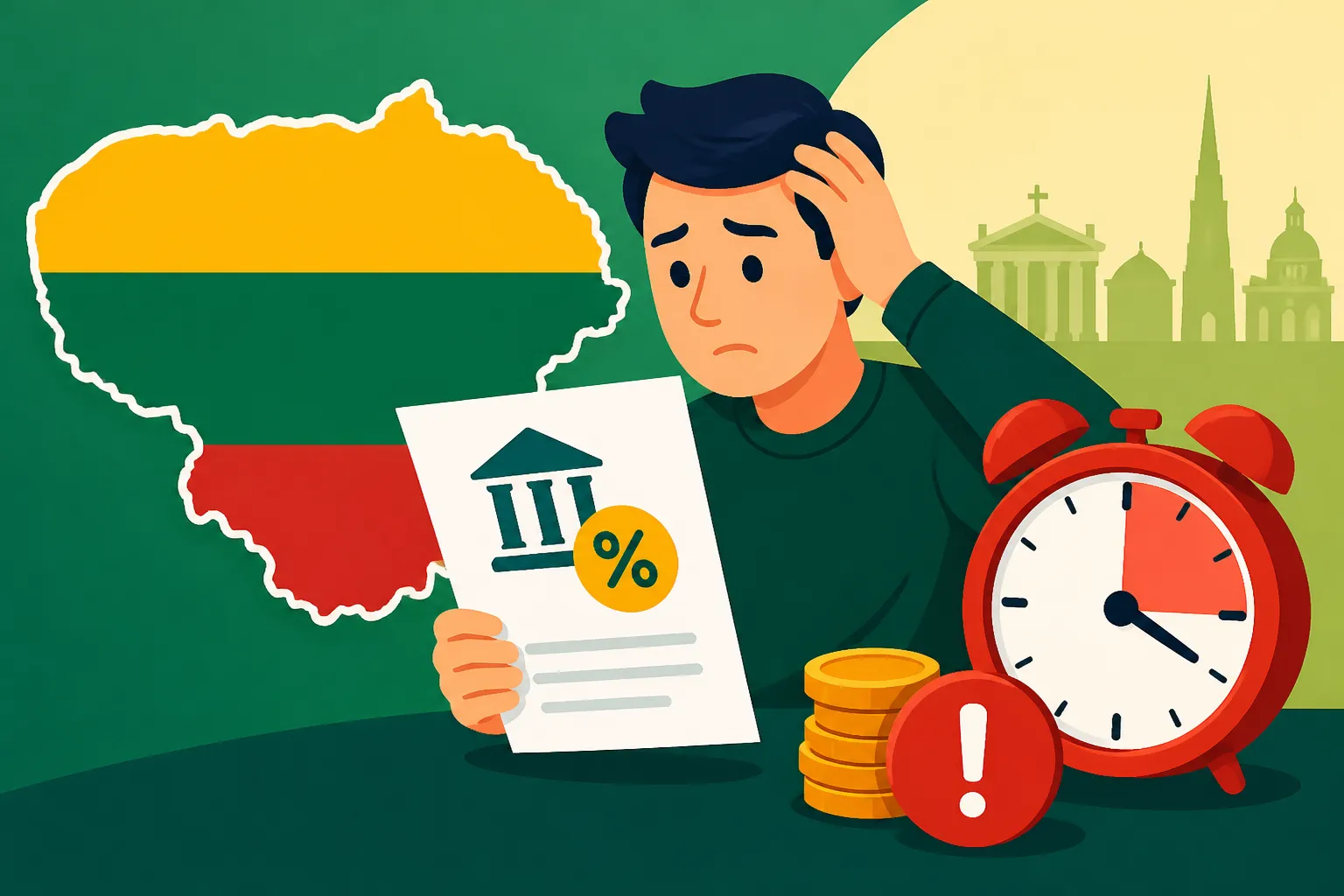
This is the most common and often the first penalty you'll encounter. If you don't pay your taxes on time, the VMI will start charging you delspinigiai, which means late payment interest. This interest is calculated daily on the overdue amount. Currently, the late payment interest rate in Lithuania is 0.03% per day. It might not sound like much, but it can quickly add up, especially on larger sums.
Let me give you a hypothetical example. Say you owed €1,000 in GPM and you missed the May 1st deadline. If you finally pay it on June 1st, that's 31 days late.
The calculation would be:
€1,000 (unpaid tax) * 0.03% (daily interest rate) * 31 days = €9.30 in interest.
Now, for €1,000, that might not seem too bad. But imagine if you owe €10,000 or €20,000 and the delay is several months. The numbers can escalate rapidly. This interest applies automatically from the day after the payment deadline until the day the payment is actually made. It's a constant tick-tock on your outstanding balance. Our guide to Understanding Income Tax (GPM) in Lithuania: The Full Expat Guide has more details on calculating your GPM.
Fines for Administrative Offenses (Baudos)
Beyond the daily interest, the VMI can also impose baudos (fines) for administrative offenses related to tax. These are more severe penalties and are typically levied for things like:
- Failure to file a tax declaration: If you were required to file and simply didn't, this can lead to a fine.
- Late filing of a tax declaration: Even if you eventually file, a significant delay can result in a fine.
- Filing an incorrect or incomplete declaration: If your declaration has serious errors, omissions, or deliberately false information, you could be fined.
- Failure to provide information: If the VMI requests documents or information and you don't provide them, or provide them late, that can also lead to a fine.
These fines are usually stipulated in the Code of Administrative Offenses and can range from tens to several thousands of euros, depending on the severity of the infraction, whether it's a first offense, and the amount of tax evaded or misrepresented. For example, a minor technical error might result in a small fine, but deliberately concealing income or submitting significantly false information could lead to much heavier penalties and even legal proceedings in extreme cases. It's important to understand that these fines are separate from the late payment interest. You could pay your taxes and the interest, but still be fined for the administrative offense of late filing.
Penalties for Late Sodra Contributions
Sodra, Lithuania's social insurance fund, operates a bit differently from the VMI, but they also have their own set of penalties for late contributions. This is particularly relevant for the self-employed, individual activity holders, and companies with employees. Understanding Sodra Social Insurance in Lithuania: The Full Guide delves into the intricacies of this system.
If you miss your monthly or quarterly Sodra payments, you will also incur late payment interest. Similar to the VMI, the current daily interest rate for overdue Sodra contributions is often 0.03% per day, though it's always wise to confirm the exact rate directly with Sodra or through a current legal resource. Just like with VMI taxes, this interest accrues daily on the unpaid amount until it's settled.
Additionally, Sodra can also impose administrative fines for repeated or serious non-compliance, such as:
- Failure to register with Sodra: If you start an activity that requires Sodra contributions and don't register within the stipulated timeframe.
- Failure to submit declarations: If you don't submit your income declarations to Sodra (e.g., for individual activity) on time.
- Incorrect reporting: Providing inaccurate information that leads to underpayment of contributions.
These penalties serve as a significant deterrent, emphasizing the importance of timely and accurate reporting to both the VMI and Sodra. Both institutions are interconnected, and a lapse in one area can often trigger scrutiny from the other.
Real-World Scenarios and How Penalties Apply
It's one thing to read about theoretical penalties, and another to imagine how they might apply in real life. Let's look at a few common scenarios that expats might face.
Missing the Annual Income Tax Deadline
Imagine it's the end of April. You've been busy, maybe travelling, or just procrastinating, and suddenly May 1st passes you by. You completely forget to file your annual GPM declaration and pay your taxes.
- Day 1 (May 2nd): The late payment interest clock starts ticking. Let's say you owe €500. From this day forward, 0.03% of that €500 will be added each day.
- A few weeks later: You get a polite (or not-so-polite) reminder from the VMI, often via your registered address or the EDS system. They inform you of your outstanding balance, plus the accrued interest.
- A month or two later: If you still haven't filed or paid, the VMI might impose an administrative fine for late filing, on top of the accumulated interest. This fine could be, for instance, anywhere from €50 to several hundred euros, depending on various factors including the amount of tax involved and whether this is your first time.
- Prolonged delay: If you ignore these notices, the VMI can escalate the situation, potentially leading to forced collection measures, such as freezing bank accounts or garnishing wages.
This is a scenario many expats dread. The key takeaway is that the penalties are not a one-time lump sum; they are dynamic and worsen with time. If you find yourself in this situation, our guide What Happens If I Miss the Tax Filing Deadline in Lithuania? offers practical steps on how to proceed.
Late Payments for Self-Employed Individuals
For those of us working for ourselves, managing taxes can be a continuous process, not just an annual event. Whether you're a freelancer, a consultant, or running a small business under individual activity, you're likely making regular Sodra and potentially GPM payments throughout the year.
Consider an expat who runs a small online business. They have individual activity registered and are supposed to make quarterly Sodra and GPM advance payments. They usually transfer funds from their home country via a service like Wise, but this quarter, a client paid late, and the transfer was delayed.
- Missed quarterly payment: If the payment for the first quarter (due by April 15th, for example) is late by 10 days, they would incur daily interest (0.03% per day) on both the overdue Sodra and GPM amounts for those 10 days.
- Repeated delays: If this becomes a pattern, or if the delay is significant, Sodra or the VMI might take a closer look. While an occasional minor delay might just incur interest, consistent non-compliance could lead to administrative fines or a more thorough audit.
This is where planning and good financial habits are crucial. Using financial tracking tools, setting up payment reminders, and ensuring you have sufficient funds available are key to avoiding these penalties. This is also where professional advice from services like Taxes for Expats can be invaluable, especially for navigating the specific nuances of self-employment tax obligations in Lithuania.
Correcting Errors and Underpayments
Penalties aren't just for completely missing deadlines. They can also apply if you file on time but later realize you made a mistake that led to an underpayment of tax. For instance, you might have forgotten to declare a small piece of foreign income or made an error in calculating your deductible expenses.
- Discovery of error: You review your records months after filing and realize you underpaid your GPM by €300.
- Correction and payment: When you submit a corrected declaration (patikslinta deklaracija) to the VMI, you'll need to pay the additional €300. Crucially, late payment interest (0.03% per day) will be calculated on that €300 from the original payment deadline until the date you make the corrective payment.
- Potential fine: If the error was substantial, resulted from negligence, or was deemed intentional, an administrative fine might also be applied. However, the VMI is generally more lenient if you self-correct promptly before they discover the error themselves.
The lesson here is diligence. Even small errors can lead to penalties, and the longer it takes to correct them, the more interest accrues. It's always better to be proactive in reviewing your declarations and rectifying any mistakes.
What to Do If You're Facing a Penalty
Finding out you've been slapped with a penalty can feel like a punch to the gut. The immediate instinct might be to panic or ignore it, but neither is a good strategy.
Act Promptly: Self-Correction and Communication
The best course of action is to address the situation immediately. The VMI, like most tax authorities, generally prefers taxpayers to be proactive. If you realize you've missed a deadline or made an error, don't wait for them to contact you.
- File/Correct Your Declaration: The very first step is to file the overdue declaration or submit a corrected one through the VMI's Electronic Declaration System (EDS). This stops the "late filing" clock and allows the VMI to calculate the correct tax due.
- Calculate and Pay the Overdue Amount (Plus Interest): The VMI system will usually calculate the interest (delspinigiai) for you once you file an overdue declaration. Pay the full outstanding amount, including the calculated interest, as soon as possible. The sooner you pay, the less interest accumulates.
- Communicate (If Necessary): For more complex situations or if you've received a formal notice, it might be beneficial to contact the VMI directly. You can often communicate through the EDS portal or visit a local VMI branch. Explaining your situation, especially if it's a genuine oversight and you're taking steps to rectify it, can sometimes lead to leniency regarding administrative fines, though interest is usually non-negotiable.
Remember, showing good faith goes a long way. The VMI has mechanisms for correcting mistakes, and using them promptly is key. If you're struggling with the language, seek assistance. Our guide on How Do I Get Help Filing My Lithuanian Tax Return in English? can point you in the right direction.
Appealing a Penalty
If you believe a penalty has been unfairly applied, or if there's a miscalculation on the VMI's part, you have the right to appeal.
- Understand the Grounds for Appeal: Appeals are generally successful if there's a factual error in the VMI's assessment, if you can demonstrate circumstances beyond your control prevented timely compliance (e.g., severe illness, natural disaster), or if the penalty itself is legally flawed. "I forgot" or "I didn't know" are rarely valid grounds.
- Gather Documentation: Collect all relevant documents that support your case. This could include medical certificates, correspondence, or proof of payment attempts.
- Submit a Formal Appeal: You'll need to submit a written appeal to the VMI within a specified timeframe (usually 30 days from the date of the penalty notice). The appeal should clearly state your reasons and provide supporting evidence. If the VMI denies your appeal, you may have further avenues for appeal through administrative courts, but this is a more involved and potentially costly process.
Appealing a penalty can be a complex process, often requiring a good understanding of Lithuanian tax law. For this reason, many expats choose to engage professional tax advisors from the start.
Seeking Professional Help
For expats, the tax landscape can be a minefield. Language barriers, unfamiliar systems, and different legal frameworks can make things incredibly difficult. This is where professional help becomes invaluable.
A tax consultant or an accountant specializing in expat taxes in Lithuania can:
- Ensure compliance: They can help you understand all your tax obligations, file accurate declarations on time, and minimize the risk of penalties.
- Assist with corrections: If you've made an error, they can guide you through the process of correcting declarations and negotiating with the VMI.
- Represent you: In case of an audit or dispute, a professional can represent you, communicate with the tax authorities on your behalf, and handle any appeals.
- Strategic planning: For those with more complex financial situations (e.g., self-employment, foreign income, investments), they can offer strategic advice to optimize your tax position legally.
While there's a cost involved, the peace of mind and the potential savings from avoiding penalties often outweigh the expense. Services like Taxes for Expats often specialize in helping foreigners navigate these complexities, offering tailored advice that considers your international income and residency status.
Strategies to Avoid Penalties (and Stress!)
Prevention is always better than cure, especially when it comes to taxes. There are several proactive steps you can take to minimize the chances of facing a late payment penalty in Lithuania.
Calendar Reminders and Automated Payments
It sounds simple, but a robust system of reminders can save you a world of headache.
- Set multiple reminders: Don't just rely on one alert. Put key tax deadlines (annual GPM, quarterly Sodra, etc.) in your digital calendar (Google Calendar, Outlook, etc.) with notifications set for a week, a few days, and the day before.
- Physical reminders: If you're old school, a wall calendar with deadlines prominently marked works too!
- Automated payments: Where possible, set up standing orders or direct debits for recurring payments like monthly Sodra contributions if your bank allows for it. This takes the human error out of the equation. Many Lithuanian banks (like Swedbank or Luminor) offer robust online banking platforms where you can schedule future payments. If you're transferring money from abroad, services like Wise can help you set up fast, reliable transfers to ensure funds arrive in time for your tax payments.
Using the VMI EDS System Effectively
The VMI's Electronic Declaration System (EDS) is your primary tool for managing taxes. Getting comfortable with it can significantly reduce your stress.
- Regularly check your EDS account: Even if you think you have everything sorted, log into your EDS account periodically. The VMI often communicates notices, reminders, and updates through this platform. It's also where you can see your tax liabilities and payment history.
- Utilize pre-filled declarations: For many employed individuals, the VMI offers pre-filled GPM declarations based on data from employers and other institutions. While you should always review these carefully for accuracy, they can be a huge time-saver and reduce the chance of missing income sources. Our guide on How Do I File My Income Tax Return Through the VMI EDS? offers a full walkthrough.
- Learn to navigate it: Take the time to understand where to find your tax history, submit declarations, and check your status. Don't wait until the last minute of a deadline to try and figure out the system.
Professional Assistance for Peace of Mind
For some expats, particularly those with complex financial situations, international income, or just a deep-seated aversion to tax forms, professional help is not a luxury; it's a necessity.
- Initial consultation: Even a single consultation with a tax advisor can clarify your specific obligations and set you on the right path. This is especially true if you're new to the country or if your tax residency in Lithuania is complex.
- Ongoing support: For peace of mind, consider engaging an accountant or tax specialist for annual filing or ongoing bookkeeping, particularly if you are self-employed or run a business. They can help you stay compliant with both VMI and Sodra requirements. These specialists, such as those at Taxes for Expats, are adept at handling foreign income declarations and navigating the intricacies of Lithuanian tax law for non-nationals, ensuring you comply with The Complete Guide to Taxes in Lithuania for Expats (2027).
- Understanding international tax treaties: Lithuania has double taxation agreements with many countries. A professional can help you understand how these apply to your situation, preventing you from paying tax twice on the same income. This is a critical aspect covered in our article Tax Residency in Lithuania: A Definitive Guide for Expats (2027) and How to Report Foreign Income to the Lithuanian Tax Authority.
Investing in professional tax advice can save you not only from penalties but also from countless hours of frustration and potential legal complications. It ensures that your focus remains on enjoying your expat life in Lithuania, rather than worrying about the intricacies of tax compliance.
Disclaimer
Please note that I am a veteran expat blogger, not a certified tax advisor or legal professional. The information provided in this article is for general informational purposes only and is based on my personal experience and general understanding of the Lithuanian tax system as of early 2026. Tax laws and regulations can change, and their application can vary greatly depending on individual circumstances. Therefore, it is highly recommended to consult with a qualified Lithuanian tax professional or the State Tax Inspectorate (VMI) directly for personalized advice regarding your specific tax obligations and any potential penalties. I cannot be held responsible for any decisions made based on the information in this article.