Understanding Health Insurance Waiting Periods for New Residents in Lithuania
Moving to Lithuania often feels like a whirlwind of beautiful cobblestone streets in Vilnius and endless paperwork at the Migration Department. One of the biggest shocks for many newcomers is realizing that healthcare coverage isn't a "flip of a switch" moment; there is often a confusing gap between your arrival and the activation of your public insurance. This guide explains exactly how health insurance waiting periods work in Lithuania and how you can ensure you are never left footing a massive medical bill while your residency is processing.
The Reality of Health Insurance Timelines in Lithuania
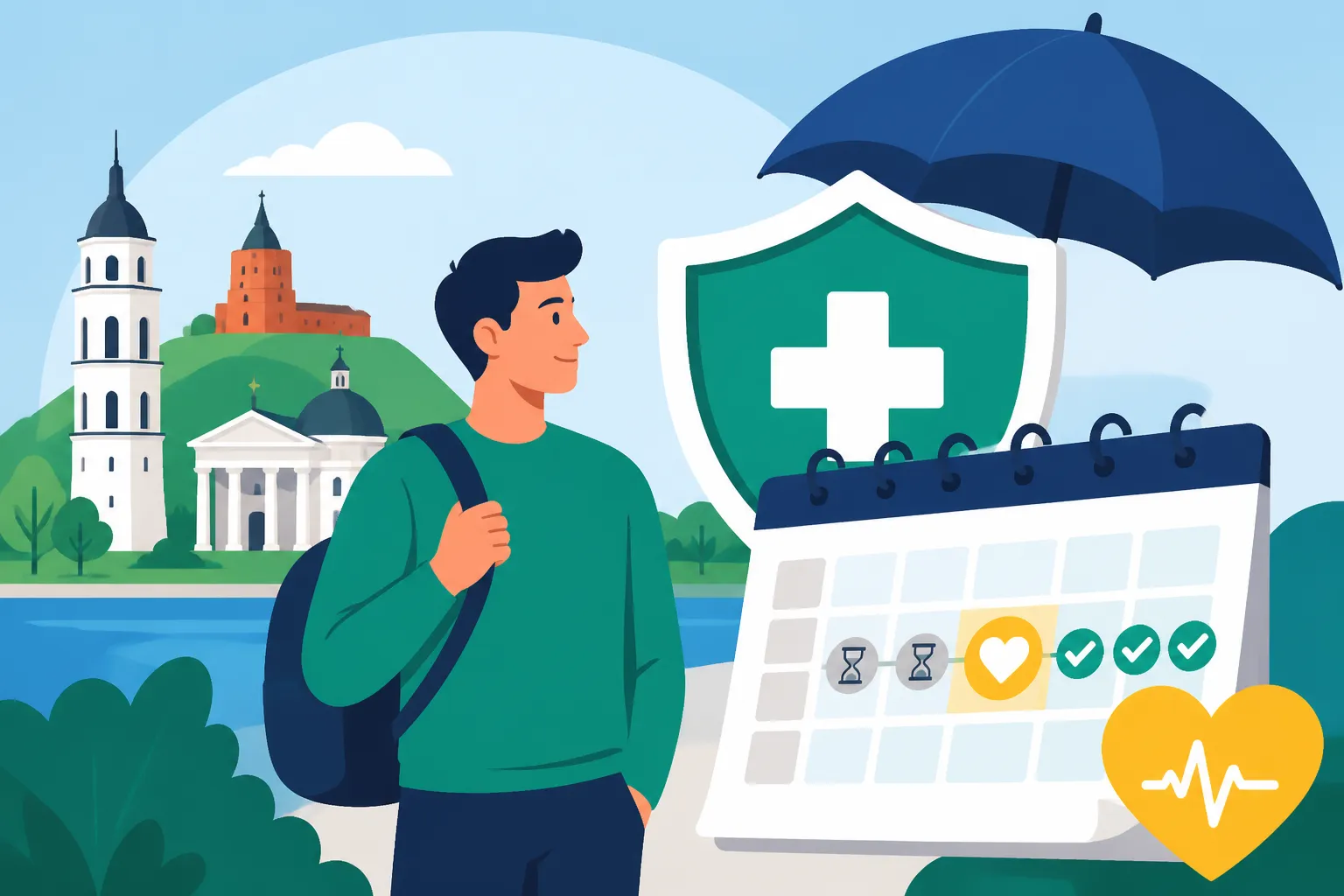
When you first land at Vilnius Airport, your mind is likely on finding an apartment or navigating the local bus system. However, the clock is already ticking on your healthcare status. In Lithuania, the public system is robust, but it is strictly tied to your legal residency status and your contributions to the Social Insurance Fund, known locally as Sodra. The "waiting period" isn't necessarily a formal cooling-off period mandated by law, but rather a bureaucratic lag that occurs while your documents are being verified and your first contributions are processed.
Why the Administrative Gap Exists
The primary reason for a delay in coverage is the synchronization between the Migration Department (MIGRIS) and the National Health Insurance Fund (VLK). For many, you cannot even begin the process of becoming "insured" until you have your Asmens Kodas (personal code). Even after you receive this code, if you are not immediately employed by a Lithuanian company, you must manually register and pay your own contributions. Many expats assume that simply having a residence permit means they are covered. This is a dangerous mistake. The system requires an active trigger—either a payroll report from an employer or a manual payment from you—to flip your status to "Active" in the electronic system.
Who is Most Affected by the Waiting Period
If you are moving here on a work visa, your employer usually handles the heavy lifting, but there is still a window of a few days or weeks where your status might be in limbo. The group that faces the most significant hurdle is those moving for family reunification, remote work, or self-employment. For these individuals, the wait can stretch from a few weeks to a couple of months. During this time, the public system views you as an "uninsured person," meaning you would have to pay full market rates for any medical service, including emergency room visits. This is where having a reliable bridge like SafetyWing becomes essential, as it provides that necessary cushion while the Lithuanian gears slowly turn.
The Impact of the "First Day" Rule
Lithuania operates on a monthly cycle for many of its social benefits. If you register for Compulsory Health Insurance (PSD) in the middle of the month, your full "insured" status often doesn't officially reflect in the Understanding the E-Sveikata (E-Health) System in Lithuania portal until the first day of the following month, provided your payment was received on time. This creates a "dead zone" of coverage that catches many people off guard. Understanding this cycle is the difference between a stress-free transition and an expensive trip to a private clinic.
Navigating the Compulsory Health Insurance (PSD) System
The cornerstone of Lithuanian healthcare is the Privalomasis Sveikatos Draudimas or PSD. This is the compulsory fund that every resident must contribute to. If you are an expat, understanding how this fund interacts with your residency status is the most important administrative task you will face after finding a home. It is not just about having the money to pay; it is about knowing exactly when the system recognizes you as a participant.
Registering for PSD as a New Resident
For most foreigners, the journey begins after you receive your residence permit. Once you have your permit, you are required to declare your place of residence. This declaration is a vital step because it signals to the government that you are now a permanent part of the local infrastructure. However, the How Do I Register for PSD After Moving to Vilnius? process isn't automatic for everyone. If you are not working under a standard employment contract, you must visit the VLK office or handle the registration through the Sodra portal. The waiting period here is often tied to how quickly you can navigate the Lithuanian-language interface of the government websites.
The Role of Sodra and the Health Insurance Fund
Sodra is the entity that collects the money, while the VLK (Valstybinė ligonių kasa) is the entity that manages the healthcare services. There is often a delay in communication between these two. For example, you might pay your PSD contribution on the 15th of the month, but the VLK system might not show you as "covered" for another 3 to 5 business days. During this specific window, if you were to visit a doctor, their computer might show your status as "Inactive." This is a classic "waiting period" frustration that veterans of the system know all too well. It’s always wise to keep digital receipts of your Sodra payments on your phone just in case.
Understanding PSD Contributions for the Self-Employed
If you decide to work as a freelancer, you will need to learn How to Register for PSD as a Self-Employed Person in Lithuania. For freelancers, the waiting period can be even more complex. You are required to pay a fixed monthly PSD contribution (which is around 64.50 EUR in 2024, though it adjusts annually). If you miss a payment, your insurance is suspended immediately. There is no grace period. When you eventually pay the debt, there is a reactivation lag. This "yo-yo" effect of coverage is why many self-employed expats choose to maintain a private policy like SafetyWing as a secondary backup to ensure they are never truly without protection.
Bridging the Gap with Private Insurance
Given the administrative delays we’ve discussed, relying solely on the public system from day one is a gamble. Most experienced expats will tell you that the first 90 days of your life in Lithuania should be covered by a flexible private policy. This isn't just about safety; it’s often a requirement for your initial visa or residence permit application.
Why You Need a Safety Net
The public system in Lithuania is great once you are in, but it is not designed for the "transient" phase of moving. If you fall ill during your first week, you will likely end up at a private clinic like Northway or Kardiolita. Without insurance, a simple consultation and blood test could cost you several hundred euros. A bridge policy like SafetyWing is specifically designed for this. It covers you globally and, more importantly, it covers you in Lithuania while you are waiting for your PSD to activate. Because it operates on a subscription model, you can cancel it the moment you confirm your status is "Active" in the Lithuanian system.
Comparing Short-term vs. Long-term Coverage
When looking for a bridge, you have to decide between "travel medical insurance" and "international health insurance." For the specific purpose of bridging the Lithuanian waiting period, a travel medical insurance policy is usually sufficient and much more cost-effective. These policies focus on unexpected illnesses and emergencies, which are the primary risks you face during your first month. Is Private Health Insurance Worth It for Expats in Lithuania? is a question many ask, and the answer is almost always "yes" for the transition period, even if you plan to rely entirely on the public system later.
Strategic Use of Private Clinics
Even after your PSD is active, you might find that waiting times for specialists in the public system are long. Many expats choose to use their private insurance to access specialists quickly while keeping their PSD for major hospitalizations or chronic care. Using SafetyWing during your initial move allows you to access these high-end private facilities immediately without worrying about the How Long Are Specialist Waiting Lists in the Lithuanian Public System? issues that plague the public polyclinics.
Special Cases: EU vs. Non-EU Citizens
The "waiting period" looks very different depending on what passport you hold. EU citizens have a significantly smoother path, but even they can fall into traps if they aren't careful about their documentation.
Using the EHIC (ESDK) Card
If you are an EU citizen, your European Health Insurance Card (EHIC) is your best friend during the waiting period. It allows you to access necessary medical care under the same conditions as Lithuanians. However, there is a catch: the EHIC is only intended for temporary stays. Once you register your residence in Lithuania, you are technically no longer a "visitor," and you should transition to the local PSD system. Many EU expats rely on their EHIC for the first few months while they figure out How to Declare Your Right of Residence as an EU Citizen in Lithuania. Just be aware that the EHIC does not cover private clinics—it only works at public institutions that have a contract with the VLK.
National Visa Holders and TRP Applicants
For non-EU citizens, the situation is stricter. When you apply for a National (D) Visa or a Temporary Residence Permit (TRP), you must provide proof of health insurance that meets specific Euro-denominated coverage requirements. This insurance must cover the entire period of your visa or the initial months of your residency. This is a "forced" waiting period solution. You are essentially paying for private coverage because the government won't let you into the public system until your permit is granted. Understanding Do Work Visa Holders Need Private Health Insurance in Lithuania? is critical here; the answer is yes, at least until your employment officially starts and your PSD is triggered.
Comparison of Coverage Activation Times
| Resident Category | PSD Activation Trigger | Estimated Waiting Gap | Recommended Action |
|---|---|---|---|
| Employed (Non-EU) | First day of work | 2–14 days | Short-term private bridge |
| Self-Employed | Manual registration/payment | 15–45 days | 2 months of private insurance |
| EU Citizen | Immediate (via EHIC) | 0 days (for emergencies) | None, but PSD registration needed |
| Family Member | Residence declaration | 30–60 days | Critical need for private cover |
Managing Medical Emergencies During the Transition
The biggest fear for any expat is: "What happens if I have an accident before my insurance is ready?" This is a valid concern in a country where medical terminology can be difficult to navigate in a high-stress situation.
What Happens If You Get Sick Before Registration?
If you end up in an emergency room before your PSD is active, the hospital will treat you—Lithuanian doctors are professionals and will not leave you in danger. However, once you are stabilized, the billing department will come calling. Without an active PSD status or a private policy like SafetyWing, you will be billed as a "private patient." You can find more detail on this in our guide on What Happens If I Get Sick Before My PSD Registration Is Complete? to prepare for the potential costs. Emergency care is not "free" for residents; it is "pre-paid" through taxes. If you haven't paid into the system yet, you haven't pre-paid for the care.
Out-of-Pocket Costs at Polyclinics
If you need a non-emergency visit—say, for a sinus infection or a minor injury—you will likely visit a Poliklinika. If your status is "Inactive," you will have to pay at the registration desk before seeing the doctor. These costs are generally lower than in the US or UK (usually 30–60 EUR for a consultation), but the costs of diagnostic tests, x-rays, and prescriptions add up quickly. This is another reason to ensure your Registering for Compulsory Health Insurance (PSD) in Lithuania (2027) is handled as a priority the moment you get your residence permit.
Navigating the E-Health Portal
Lithuania is highly digitized. Most of your health records, including your insurance status, are managed through the E-Sveikata portal. As a newcomer, it may take some time for your data to propagate through the various government servers. It is not uncommon for a person to be legally "insured" but for the E-Sveikata portal to still show them as "uninsured" for a few days. During this specific waiting period, you might have trouble getting a subsidized Electronic Prescription (E-Receptas) System in Lithuania to work at the pharmacy. Always keep a paper copy of your insurance confirmation during your first month.
Long-term Planning and Maintenance
Once you have survived the initial waiting period and your PSD is active, the battle isn't quite over. You must maintain your status to avoid falling back into a waiting period later.
Keeping Your PSD Status "Active"
For employees, this is easy—as long as you have a job, your employer pays the tax. But if you change jobs, there can be a gap. If you leave one job on the 15th and start another on the 20th, you are generally covered for the whole month. However, if you take a month off between jobs, you must manually pay the PSD contribution for that month to Sodra. If you forget, your status will turn "Inactive," and you may face a new waiting period or "penalty" payments when you try to reactivate it. This is a common pitfall for those trying to figure out How to Keep Health Coverage Between Jobs in Lithuania.
The Importance of the Asmens Kodas
Everything in the Lithuanian health system revolves around your Asmens Kodas. This 11-digit number is your key to healthcare, banking, and taxes. If there is a typo in your code in the Sodra system, your insurance will not activate. It is wise for new residents to double-check their code on their residence card against the code listed on their employment contract. Any discrepancy will result in an indefinite waiting period that won't resolve itself until you physically go to a government office to fix it. Knowing What Documents Do I Need to Get an Asmens Kodas in Lithuania? early on will save you weeks of headaches.
Annual Reviews and Renewals
Every year in May, Lithuania has a tax declaration season. This is often when people discover "holes" in their insurance history from the previous year. If the system finds that you were a resident but didn't pay PSD for a certain month, they will bill you for it. Ensuring you have consistent coverage—whether through the state or a bridge like SafetyWing during transitions—is the only way to avoid these surprise bills. For those who are self-employed, understanding How to File Your Annual Income Tax Return (GPM) in Lithuania is an essential part of maintaining your long-term health coverage health.
Summary of Action Steps for New Arrivals
To avoid the stress of health insurance waiting periods, follow this checklist the moment you arrive in Lithuania:
- Immediate Private Cover: Ensure you have a flexible policy like SafetyWing active before you even board your flight.
- Residence Declaration: Declare your residence the same day you pick up your permit.
- Check Sodra: If you are not employed, log into the Sodra portal (you will need a Lithuanian bank account or Mobile-ID for this) to check your PSD status.
- Manual Payment: If you are in the "gap," make your first PSD payment manually to trigger the system.
- Verify with VLK: Call the VLK or visit their office in Vilnius (on Europos aikštė) to confirm you are in the database.
- Register with a Doctor: Don't wait until you are sick. Use our guide on How to Choose and Register with a Family Doctor (Šeimos Gydytojas) in Lithuania to find a clinic once your PSD is active.
Disclaimer
The information provided in this guide is for general informational purposes only and does not constitute legal or professional medical advice. Lithuanian laws and immigration regulations regarding healthcare and insurance contributions are subject to frequent changes. While we strive to keep this information up to date, you should always consult with the National Health Insurance Fund (VLK), Sodra, or a qualified legal professional to confirm your specific insurance status and requirements. We are not responsible for any costs incurred due to reliance on this information.