Can I Drive in Lithuania with a Foreign Licence?
Navigating the rules of the road in a new country can feel like a labyrinth, and when you first land in Lithuania, one of the biggest questions often looming in your mind (right after "Where's the best cepelinai?") is whether your trusty foreign driving licence will still cut it. Trust me, I’ve been there, clutching my international licence, wondering if I’d have to start from scratch. The short answer is, it depends on where your licence comes from and how long you plan to stay. This guide will break down everything you need to know about driving in Lithuania with your existing licence, and when it’s time to make the switch.
The Initial Grace Period and What It Means for You
When you first arrive in Lithuania, especially if you're fresh off the plane and still finding your feet, understanding the immediate rules around driving is essential. It's not a one-size-fits-all situation, and the duration your foreign licence is valid often depends on your country of origin and your residence status. It's like a temporary welcome mat for your driving privileges, but that mat eventually rolls up.
Non-EU/EEA Licences and International Driving Permits
If your driving licence was issued by a country outside the European Union (EU) or European Economic Area (EEA), you're typically granted a grace period. For tourists or those without a permanent residence status, you can usually drive in Lithuania for up to 90 days within a 180-day period. This mirrors the standard Schengen visa rules. During this time, it's not just enough to have your home country's licence; you absolutely need to carry an International Driving Permit (IDP) alongside it.
The IDP isn't a licence itself; think of it as an official, multi-language translation of your existing driving licence. It confirms that you are indeed qualified to drive various vehicle categories. Without it, your foreign licence might not be understood or accepted by local authorities, potentially leading to fines or serious complications if you're involved in an accident. Many new arrivals, excited about exploring, forget this crucial detail until they encounter a roadside check. Getting pulled over and trying to explain your local licence to a police officer who doesn't speak English can be an unnecessarily stressful experience. So, before you even consider hitting the Lithuanian roads, make sure that IDP is sorted and tucked away with your original licence. This initial 90-day window is great for those who are still figuring out The Complete Guide to Moving to Lithuania: Your First 90 Days (2027), allowing you to remain mobile while handling other administrative tasks.
EU/EEA Licences: Business as Usual, Mostly
For those holding a driving licence issued by an EU or EEA member state, the rules are much more relaxed – bless the European integration! You can use your existing EU/EEA driving licence in Lithuania indefinitely. There's no mandatory requirement to exchange it for a Lithuanian one, regardless of how long you reside here. This means you can cruise around Vilnius, explore the Curonian Spit, or commute to work in Kaunas with the same piece of plastic you've always used.
However, while not legally required, exchanging your EU/EEA licence for a Lithuanian one can be a smart move for practical reasons. For instance, if you get a Lithuanian licence, it might be easier for local authorities (police, car rental agencies) to verify your details, especially if your original licence is from a country with a different script or format. Plus, a Lithuanian driving licence can sometimes serve as an additional form of local identification, which can be useful when you're trying to prove your address or open bank accounts. It's not uncommon for administrative processes to run smoother when all your documents are local. You'll definitely appreciate having fewer hurdles when you're trying to sort out mundane tasks, like updating your address at Registrų Centras after Declaring Your Place of Residence in Lithuania: The Complete Guide.
When and How to Exchange Your Foreign Driving Licence
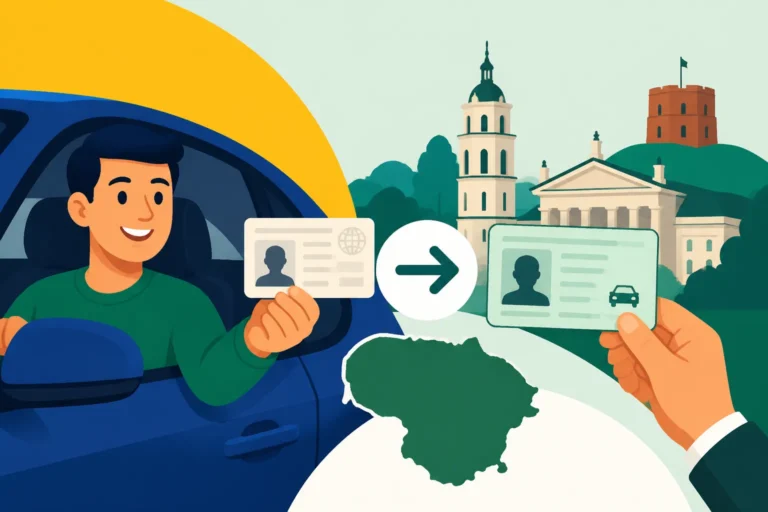
The big question isn't if you can drive with your foreign licence, but when you need to exchange it, and what that process actually entails. This is where things can get a bit more involved, particularly for those from outside the EU/EEA. The process is handled by Regitra, Lithuania's state enterprise responsible for vehicle registration and driver's licences.
Requirements for EU/EEA Licence Exchange
Even though it’s optional, if you decide to exchange your EU/EEA licence, the process is relatively straightforward. You'll need to head to a Regitra branch. Here’s a general idea of what they’ll ask for:
- Your existing EU/EEA driving licence: This is a given, as they'll take this one and issue you a new Lithuanian one.
- Proof of identity: Your passport or Lithuanian ID card.
- Proof of residency in Lithuania: This could be your temporary or permanent residence permit, or a certificate of declared place of residence.
- A valid health certificate (Sveikatos Pažyma): This is a mandatory medical examination for all drivers in Lithuania. It certifies that you are medically fit to drive. More on this crucial document later.
- Your Asmens Kodas (Personal Code): This unique identification number is essential for almost any administrative task in Lithuania, including getting your licence. If you don't have one yet, you'll need to sort that out first. You can learn more about How to Get Your Asmens Kodas (Personal Code) and Why It Matters for Healthcare.
The process for EU/EEA licence exchange is generally hassle-free. You pay a fee, submit your documents, and they'll usually issue a temporary permit while your new Lithuanian licence is being printed. This is often the path of least resistance for expats looking to fully integrate their driving credentials. For a more detailed walkthrough, check out How to Exchange Your Foreign Driving Licence in Lithuania.
The Mandatory Exchange for Non-EU/EEA Licences
This is where things can get a bit tricky for non-EU/EEA residents. If you hold a residence permit in Lithuania (meaning you're no longer just a tourist), your foreign licence is typically valid for one year from the date your residence permit was issued. After this period, you must exchange it for a Lithuanian driving licence. There's no escaping this.
The key factor here is whether your home country has a bilateral agreement with Lithuania for driving licence recognition.
- If there’s an agreement: Great news! You might be able to exchange your licence without taking any tests. This usually involves presenting your original licence, health certificate, proof of residency, and Asmens Kodas, much like the EU/EEA process. Currently, countries like Ukraine, Turkey, and several others have such agreements. It’s always best to check the latest list on Regitra’s website or your local embassy.
- If there’s NO agreement: This is the less favourable scenario, and it's a common source of expat frustration. If your country doesn't have an agreement, you will be required to pass both the theoretical and practical driving tests in Lithuania. Yes, even if you’ve been driving for decades with a clean record in your home country, you might have to re-sit the tests. This applies to citizens from countries like the USA, Canada, Australia, India, and many others. It means studying the Lithuanian road rules (which you can often do in English) and booking practical lessons, possibly with an instructor who speaks English, before taking the final practical examination. This transition is a direct consequence of your The Complete Guide to Lithuanian Residence Permits for Expats (2027), tying your long-term stay to local driving rules.
The medical certificate is still a requirement here, just as it is for EU/EEA exchanges. This mandatory exchange or re-testing can feel like a significant hurdle, but it’s a non-negotiable step to legally drive long-term in Lithuania.
The Dreaded Driving Test: What to Expect
If you find yourself in the position of needing to retake the driving tests, it's understandable to feel a bit daunted. It's not just about knowing the rules; it's about adapting to local expectations and driving culture, which can be subtly different from what you're used to.
- Theoretical Test: This is a computer-based exam covering Lithuanian traffic laws, road signs, and safe driving practices. You can usually choose to take it in English. Regitra provides online resources, including test simulations, which are incredibly helpful. Dedicate time to studying these, as some nuances of Lithuanian road law might differ from your home country. For example, understanding specific rules regarding tram priority or right-hand turns at red lights (where permitted) is crucial.
- Practical Test: This is the one that often causes the most anxiety. It involves driving with a Regitra examiner who assesses your ability to safely operate a vehicle, follow traffic rules, and perform specific manoeuvres (parking, starting on an incline, etc.). The test is done in a car provided by Regitra or a driving school. Many expats opt for a few lessons with a local driving instructor to familiarise themselves with the test routes and the examiner's expectations. Be prepared for a thorough assessment; they're not just looking for technical skills but also for safe and confident driving in various traffic conditions. This whole process is covered in more detail in our comprehensive guide to Driving in Lithuania: Licences, Registration and Rules for Expats (2027).
Remember, failing a test means you have to rebook and pay again. It's a test of patience and adaptability, but entirely achievable with preparation.
| Licence Origin | Initial Validity (Tourists/Short Stay) | Validity (Residents, with Permit) | Exchange Required? | Tests Required for Exchange? | Key Document |
|---|---|---|---|---|---|
| EU/EEA | Indefinite | Indefinite | No (Optional) | No | Original EU/EEA Licence |
| Non-EU/EEA | 90 days (with IDP) within 180-day period | 1 year from Residence Permit issue date | Yes, after 1 year | Yes, unless bilateral agreement exists | Original Licence + IDP (initially) |
Practical Considerations and Common Pitfalls
Beyond the official requirements, there are several practical aspects and potential pitfalls that expats often encounter when dealing with driving licences in Lithuania. Being prepared for these can save you a lot of headaches and unnecessary stress.
The All-Important Medical Certificate (Sveikatos Pažyma)
Ah, the "Sveikatos Pažyma" – this little piece of paper often catches new expats off guard. It's a mandatory medical certificate confirming your fitness to drive, and you'll need it not only for exchanging your licence but also for obtaining a new Lithuanian one, or even renewing an existing one further down the line. It's a cornerstone of the Lithuanian driving system.
To get one, you'll need to visit a general practitioner, often at a local poliklinika (polyclinic) or a private clinic. The examination typically includes:
- General Health Check: The doctor will review your medical history, check your blood pressure, and ensure you don't have any conditions that would impair your driving.
- Eye Test: A standard vision test to ensure your eyesight meets the required standards. If you wear glasses or contact lenses, make sure to bring them.
- Hearing Test: A basic check of your hearing.
- Psychological Evaluation (sometimes): While not always a full psychological assessment, some clinics may include a brief evaluation or questionnaire to ensure mental fitness for driving.
Finding an English-speaking doctor for this can be a challenge outside of major cities like Vilnius or Kaunas, but it’s becoming increasingly common. Many private clinics, such as those found at the Affidea or MediCa group clinics, are well-versed in expat needs and may have staff who speak English. It’s definitely worth calling ahead to confirm language availability. You can also consult our guide on The Expat Guide to Finding a Family Doctor (Šeimos Gydytojas) in Lithuania or specifically How to Find an English-Speaking Doctor in Lithuania for recommendations. Without this certificate, Regitra simply won't process your licence application, so make it a priority.
Insurance and Vehicle Registration Implications
Your driving licence status has direct implications for vehicle ownership and insurance in Lithuania. If you plan to buy a car here, you'll need to register it with Regitra, and your licence will be a key piece of documentation. Our guide on How to Register a Vehicle with Regitra in Lithuania covers this process in depth.
More importantly, your insurance premiums can be affected. Insurers in Lithuania generally prefer a Lithuanian driving licence, or at least a licence from an EU/EEA country. If you're driving with a non-EU licence that requires exchange after a year, some insurance companies might offer policies for that initial period, but they may become void or significantly more expensive if you haven't completed the exchange or re-testing by the deadline. It's always best to be transparent with your insurance provider about your licence status to avoid any nasty surprises should you need to make a claim. Getting your local licence sorted makes everything smoother when it comes to kasko (comprehensive) or compulsory civilinės atsakomybės draudimas (third-party liability) insurance.
Don't Get Caught Off Guard: Police and Legalities
Driving in Lithuania with an invalid or improperly documented foreign licence can lead to serious consequences. The Lithuanian police are generally fair but strict when it comes to road safety and administrative compliance.
- Fines: Driving without a valid licence, or without an IDP when required, will result in significant fines. These aren't minor parking tickets; they can be substantial and hit your wallet hard.
- Vehicle Impoundment: In severe cases, particularly if you're found driving without any legal right to do so (e.g., after your grace period or mandatory exchange deadline has passed without action), your vehicle could be impounded. This is a nightmare to sort out and incredibly costly.
- Insurance Voided: As mentioned, driving illegally can void your car insurance, leaving you personally liable for any damages in an accident, which can be financially ruinous.
Always carry your valid driving licence (original, not just a copy), vehicle registration documents, and proof of insurance when driving. It's also a good idea to have your ID card or passport on you. While technology helps, it's not always reliable on the spot. Having important documents digitally accessible on your phone can be a lifesaver. Using a local eSIM provider like Airalo can ensure you always have data to quickly access documents or navigation if needed, especially when out in less familiar areas.
Finally, for general advice on moving to Lithuania and ensuring you have all your ducks in a row for documentation, services like Sirelo can be an excellent resource, helping you coordinate your relocation and understand essential administrative steps, including driving permits. Familiarising yourself with the Understanding the E-Government Gateway (Elektroniniai Valdžios Vartai) in Lithuania can also make dealing with administrative tasks much simpler down the line.
Disclaimer
The information provided in this guide is intended for general informational purposes only and does not constitute legal advice. While we strive to provide accurate and up-to-date information, rules and regulations regarding driving licences and residency in Lithuania can change. It is always recommended to consult official sources such as the Lithuanian Migration Department (MIGRIS), Regitra, and/or a legal professional for the most current and specific advice pertaining to your individual circumstances.