How Do I Find a Pharmacy (Vaistinė) Near Me in Šiauliai?
There's nothing quite like the sudden panic of needing medicine in a new country, especially when you're in a city like Šiauliai and the local language feels like a beautiful but impenetrable mystery. You've got a headache, a persistent cough, or maybe something more serious, and all you know is you need a vaistinė. This guide is here to cut through the confusion and give you the down-low on how to find a pharmacy in Šiauliai, what to expect, and how to make sure you get the care you need.
Navigating the Vaistinė Landscape in Lithuania (and Šiauliai)
First things first, let's get comfortable with the term vaistinė. This is your Lithuanian word for pharmacy or chemist, and you'll see it emblazoned on signs all over town, usually with a green cross. Unlike some countries where pharmacies might just be a section of a larger supermarket, in Lithuania, a vaistinė is typically a dedicated shop, staffed by licensed pharmacists who are ready to assist.
What is a Vaistinė? More Than Just Pills
When you step into a Lithuanian vaistinė, you'll quickly realize it's more than just a place to pick up prescriptions. These places are treasure troves of general health and wellness products. You'll find a range of over-the-counter medications for common ailments like colds, flu, allergies, and minor aches. Beyond that, expect to see a vast selection of vitamins and dietary supplements, specialized skincare products (often dermocosmetics from brands like Vichy, La Roche-Posay, Eucerin), baby care items, herbal remedies, and even some basic medical supplies like bandages or thermometers.
The pharmacists themselves are highly knowledgeable. They're not just there to hand you a box; they're trained to offer advice, explain dosages, and even suggest appropriate over-the-counter alternatives if you can't get a prescription. Don't be shy about asking questions, even if it takes a bit of charades or a translation app to get your point across.
Common Pharmacy Chains in Šiauliai
Šiauliai, being a significant regional center, has a good network of pharmacies, mainly dominated by a few large chains you'll quickly recognize. These chains ensure a consistent level of service and a wide range of products across their various locations.
Here are the big players you'll frequently encounter in Šiauliai:
- Eurovaistinė: This is arguably the largest chain in Lithuania, and you'll find multiple Eurovaistinė branches strategically located throughout Šiauliai, often near major shopping centers like Akropolis or Eifelis, and in the city center. They usually have longer opening hours, and some larger branches might even have an English-speaking pharmacist, though it's not guaranteed.
- Camelia: Another very popular chain, Camelia pharmacies are widespread. They often have competitive pricing on certain items and are known for their promotions. Look for their green and white signs.
- Gintarinė Vaistinė: Also a prominent chain, Gintarinė Vaistinė offers a similar range of products and services. You'll find their locations in various neighborhoods, often in smaller shopping complexes or standalone buildings.
- Benu Vaistinė: Benu is part of a larger European network and has a strong presence, particularly in larger towns. Their stores are generally modern and well-stocked.
These major chains are usually reliable, well-stocked, and maintain professional standards. If you're staying in Šiauliai, it's worth noting down the nearest Eurovaistinė or Camelia to your accommodation.
Standard Operating Hours and Finding Out-of-Hours Options
Most pharmacies in Šiauliai operate within standard business hours, typically from around 9 AM to 7 PM or 8 PM on weekdays. On Saturdays, they might close a bit earlier, say 3 PM or 4 PM, and many will have reduced hours or be closed on Sundays and public holidays. This can be a real pain if you suddenly need something late at night or over a long weekend.
However, almost every sizable Lithuanian city, including Šiauliai, will have at least one 24-hour pharmacy or a rotating schedule for "on-call" pharmacies (budinti vaistinė) that cater to urgent after-hours needs. These are often larger branches of the main chains, usually centrally located or near a hospital.
To find an out-of-hours pharmacy in Šiauliai:
- Check Google Maps: This is your best friend. Search for "vaistinė Šiauliai" and then filter by "Open now" or check the opening hours listed for each location. Google Maps is generally quite accurate for this.
- Look for "Budinti Vaistinė": If you're out and about, look for signs that might say "Budinti Vaistinė" which means "on-call pharmacy" or "duty pharmacy." These will have extended or 24/7 hours.
- Ask at your accommodation: Hotel staff, landlords, or local friends can often point you to the nearest 24-hour option.
- Use specific pharmacy chain websites: For example, Eurovaistinė or Camelia often have store locators on their websites where you can filter by opening hours.
It's a good idea to identify an emergency pharmacy location when you first arrive, especially if you have chronic health conditions or are traveling with family. While your travel insurance like SafetyWing might cover medical emergencies, getting a prescription filled quickly can prevent a small issue from becoming a big one.
The Quest for Your Medications: Prescriptions, Language, and Local Quirks
Getting your hands on the right medication can sometimes feel like an odyssey, especially when you're dealing with different systems and language barriers. Lithuania has made great strides in digitalizing its healthcare, which generally simplifies things, but there are still nuances.
Understanding the E-Receptas System
Lithuania operates on a highly efficient electronic prescription system called "e-receptas." This means that after your doctor prescribes medication, the prescription isn't a paper slip you carry; it's electronically uploaded to the national e-health system, E-Sveikata. When you go to a pharmacy, all you need is your personal code (asmens kodas) or your ID, and the pharmacist can access your prescriptions directly from the system. This system is a huge convenience, as it reduces errors and the risk of losing prescriptions.
If you've just seen a family doctor (šeimos gydytojas) in Šiauliai, your prescription should be available almost immediately in the system. When you approach the counter, simply present your ID or tell the pharmacist your asmens kodas. They will then see any active prescriptions under your name. If you're still figuring out your way around the healthcare system, our guide on Understanding the Electronic Prescription (E-Receptas) System in Lithuania might be helpful.
Navigating Language Barriers at the Pharmacy Counter
This is often the biggest hurdle for expats, particularly outside of Vilnius or Kaunas. While many younger pharmacists, especially in larger chain branches, may have some English proficiency, it's not something you can always count on in Šiaiauli.
Here are some strategies to help you communicate:
- Write it down: If you know the exact name of the medication (the active ingredient or brand name), write it down clearly. This avoids mispronunciations.
- Use a translation app: Google Translate or similar apps are lifesavers. You can type in your symptoms or the medication you need.
- Show your doctor's note: If you have a physical note from a doctor (even if the prescription is electronic), showing it can help the pharmacist understand your needs.
- Be patient: Lithuanians are generally very helpful, and pharmacists will do their best to understand you, even if it takes a bit longer.
- Learn a few key phrases: "Vaistas nuo skausmo" (pain medicine), "vaistas nuo peršalimo" (cold medicine), "ar galite patikrinti e-receptą?" (can you check e-prescription?). Even a few words can go a long way.
If you've managed to find an English-speaking doctor in Šiauliai, they can often write down the medication names for you or even call the pharmacy if there's a specific concern.
Over-the-Counter vs. Prescription Medications
The line between what you can buy off the shelf and what needs a prescription can differ significantly from your home country. Many medications that might be readily available over-the-counter elsewhere, such as stronger pain relievers, certain antibiotics (which are almost always prescription-only here), or specific allergy medications, may require an e-receptas in Lithuania.
Generally, for common issues, you'll find:
- Over-the-counter (OTC): Mild pain relievers (like Ibuprofen or Paracetamol), cough syrups, throat lozenges, basic cold and flu remedies, some antihistamines, antiseptic creams, and vitamins are widely available. You can simply pick these up.
- Prescription-only: Anything stronger, chronic medications, or antibiotics will definitely require an e-receptas.
It's always best to err on the side of caution. If you suspect you might need something beyond a basic OTC remedy, try to consult a doctor first. Our guide on Prescription Medications and Pharmacies in Lithuania: The Complete Guide provides a broader overview of the system.
Practical Tips for Expats in Šiauliai
Living in a new place means adapting to new ways of doing things, and finding your stride with the local pharmacy system is a crucial part of that. Here are some actionable tips specific to Šiauliai that can save you time and stress.
Using Online Tools and Apps to Locate Pharmacies
In today's digital age, your smartphone is your most powerful tool for finding a vaistinė in Šiauliai.
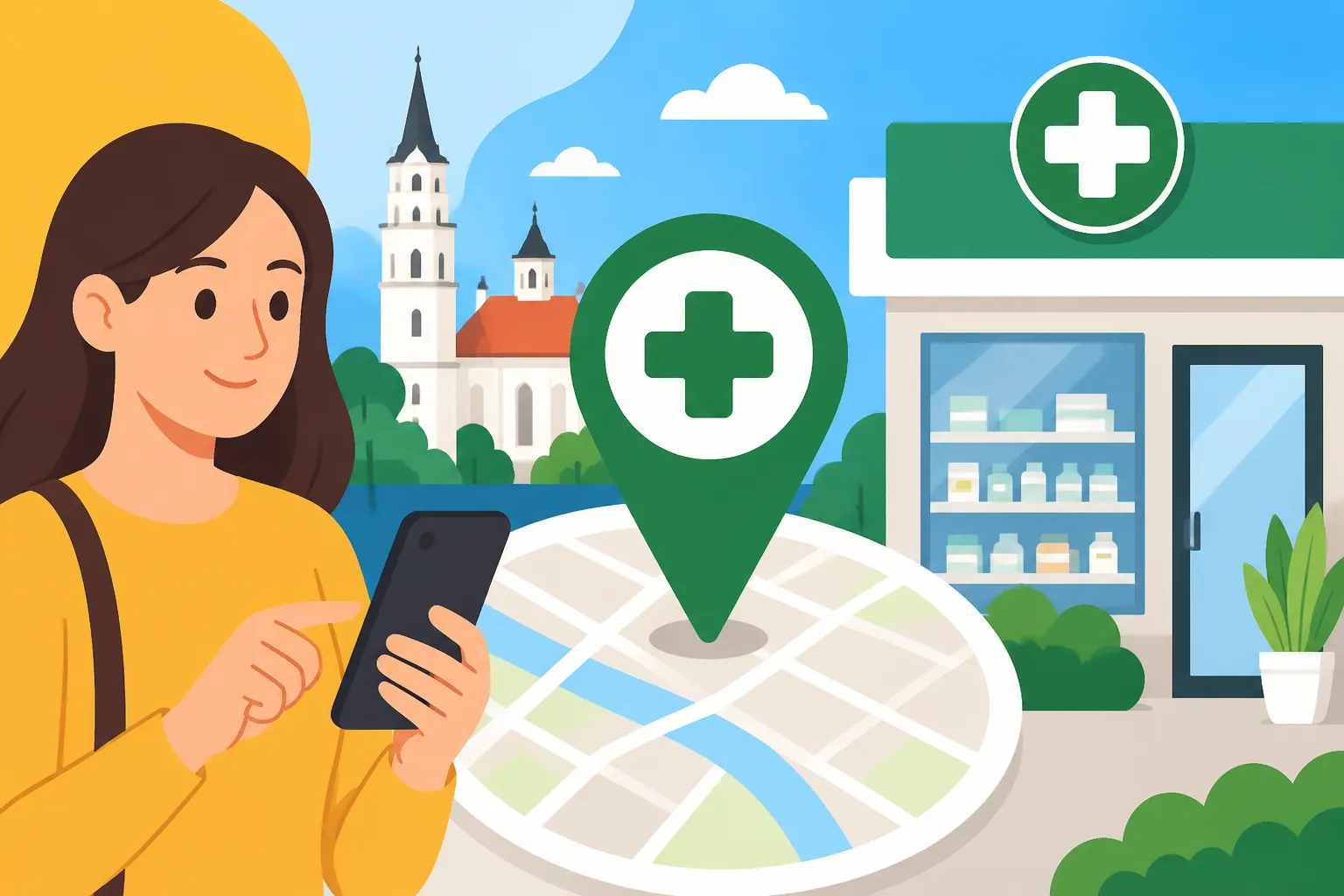
- Google Maps: As mentioned, this is number one. Open Google Maps, type "vaistinė Šiauliai," and you'll see a scatter plot of green crosses. Click on each one to see opening hours, addresses, and sometimes even phone numbers. You can also get directions directly from your current location.
- Pharmacy Chain Websites/Apps: The major chains like Eurovaistinė, Camelia, and Gintarinė Vaistinė all have websites, and some even have dedicated apps. These often feature store locators, allowing you to search by city (Šiauliai) and filter by specific criteria like "24/7" or "open now."
- E-Sveikata Portal: While primarily for managing your health records and e-prescriptions, the E-Sveikata portal can sometimes provide information on service points, including pharmacies. You'll need your electronic signature or mobile signature to log in, but once you do, it offers a comprehensive overview of your health information. If you're curious about this system, check out Understanding the E-Sveikata (E-Health) System in Lithuania.
Before heading out, a quick check on one of these platforms can confirm if a pharmacy is open and save you a wasted trip.
What to Do in a Pharmacy Emergency
Emergencies can strike anytime, anywhere. If you find yourself in Šiauliai needing urgent medication or advice outside of normal hours, here’s your game plan:
- Identify a 24-hour Pharmacy: Prioritize finding the nearest "Budinti Vaistinė." These are designed for such situations. For example, Eurovaistinė at Tilžės g. 109, inside the Akropolis shopping center, sometimes has extended hours, but you should always verify the exact 24/7 locations via Google Maps or the pharmacy's official site for real-time information.
- Contact 112 for Medical Emergencies: If your need for medication is part of a broader medical emergency, don't hesitate to call 112 (the general emergency number in Lithuania). They can dispatch an ambulance or guide you to the nearest emergency medical facility. For more on this, see Emergency Medical Care in Lithuania: What Every Expat Needs to Know.
- Go to an Urgency Room (Priėmimo-skubiosios pagalbos skyrius): If you can't get a prescription filled and your condition is worsening, heading to the urgency room of Šiauliai Hospital (Šiaulių Respublikinės Ligoninės) at V. Kudirkos g. 99, will allow a doctor to assess you and issue an emergency e-receptas if necessary. This isn't for minor issues, but for true urgent needs.
- Have Your Asmens Kodas Ready: In any medical or pharmacy emergency, your personal code is critical for identifying you within the Lithuanian healthcare system. If you haven't sorted this out yet, understanding How to Get Your Asmens Kodas (Personal Code) and Why It Matters for Healthcare is vital.
Being prepared with this knowledge can make a scary situation much more manageable.
Dealing with Foreign Prescriptions and Specific Needs
So, you've arrived in Šiauliai with a prescription from your home country, or maybe you need a very specific medication. This is where things can get a little tricky, but not impossible.
- Foreign Prescriptions: Generally, a prescription from outside the EU/EEA will not be honored directly by a Lithuanian pharmacy. You will need to consult a local doctor to get a Lithuanian e-receptas. Even EU prescriptions can sometimes pose challenges if pharmacists aren't familiar with the format or if specific details are missing. Our article Can I Use a Foreign Prescription at a Lithuanian Pharmacy? delves into this topic more thoroughly.
- Seeing a Local Doctor: Your best bet is to schedule an appointment with a family doctor in Šiauliai. They can review your condition and your foreign prescription and then issue an appropriate Lithuanian e-receptas. You might need to pay for this consultation if you're not yet integrated into the public healthcare system or if you have a private insurance plan like SafetyWing that covers such visits. Finding an English-speaking doctor can greatly simplify this process. Look up How to Find an English-Speaking Doctor in Lithuania for tips.
- Medication Availability: Be aware that not all medications available in your home country will be available under the exact same brand name, or sometimes at all, in Lithuania. Pharmacists are usually very good at finding equivalent generic medications (if available) or suggesting alternatives. Having the active ingredient name rather than just the brand name can be very helpful.
Always carry a list of your current medications (generic names preferably), dosages, and any allergies. This information is invaluable to any healthcare professional you consult.
Beyond the Counter: Ensuring Your Health Safety
Navigating pharmacies is just one piece of the puzzle when it comes to maintaining your health in a new country. It’s about building a holistic approach to your well-being.
The Importance of Your Family Doctor
In Lithuania, your family doctor (šeimos gydytojas) is the cornerstone of your healthcare. They are your first point of contact for almost all medical issues, including getting prescriptions for anything beyond basic over-the-counter remedies. Without being registered with a family doctor, accessing specialist care or even routine medication can be a bureaucratic nightmare.
Once you’re registered with a family doctor in Šiauliai (or anywhere else in Lithuania), they will be the one uploading your e-receptas into the E-Sveikata system, making your pharmacy visits smooth. They can also advise on local medication availability and help you manage chronic conditions. If you're just getting started, our guide on The Expat Guide to Finding a Family Doctor (Šeimos Gydytojas) in Lithuania is a must-read. Don't underestimate this step; it's fundamental to integrated healthcare here.
Health Insurance and Pharmacy Costs
While the Lithuanian public health insurance (PSD) covers the cost of many prescription medications, often with a co-payment, it's crucial to understand how this works, especially as a new expat. If you're not yet covered by PSD, or if you're awaiting its activation, you'll be responsible for the full cost of prescriptions. Private health insurance can sometimes bridge this gap or cover medications not fully reimbursed by the public system.
Many expats opt for additional private health insurance to ensure comprehensive coverage and access to private clinics, which can sometimes mean quicker appointments. Some travelers or short-term residents also rely on international travel medical insurance like SafetyWing to cover unforeseen medical expenses, including urgent prescriptions. It's always a good idea to check your policy's specifics regarding outpatient pharmacy benefits. Understanding the nuances of Public vs Private Healthcare in Lithuania: Which Should Expats Choose? will shed more light on your options.
Here's a quick overview of potential costs at a pharmacy:
| Item/Service | Publicly Insured (with PSD) | Privately Insured/Uninsured |
|---|---|---|
| Prescription Medication | Partial co-payment (depends on medication) | Full cost |
| Over-the-Counter Medication | Full cost | Full cost |
| Vitamins/Supplements/Cosmetics | Full cost | Full cost |
| Pharmacist Consultation/Advice | Free | Free |
| Medical Supplies (e.g., bandages) | Full cost (unless specific medical need) | Full cost (unless specific medical need) |
This table provides a general idea, but medication prices can vary, and co-payments are based on the specific drug and its inclusion on the Compensated Medicines List.
Finding a pharmacy in Šiauliai doesn't have to be a daunting task. With a bit of preparation, understanding the local system, and leveraging modern tools, you can ensure you always have access to the medications and health products you need. Stay informed, stay healthy, and enjoy your time in Lithuania!
Disclaimer
The information provided in this guide is intended for general informational purposes only and does not constitute medical, legal, or professional advice. While we strive to keep the information accurate and up-to-date, healthcare regulations, pharmacy locations, and specific services can change. Always consult with a qualified healthcare professional, local authorities, or legal experts for advice tailored to your individual situation. Reliance on any information in this guide is solely at your own risk.