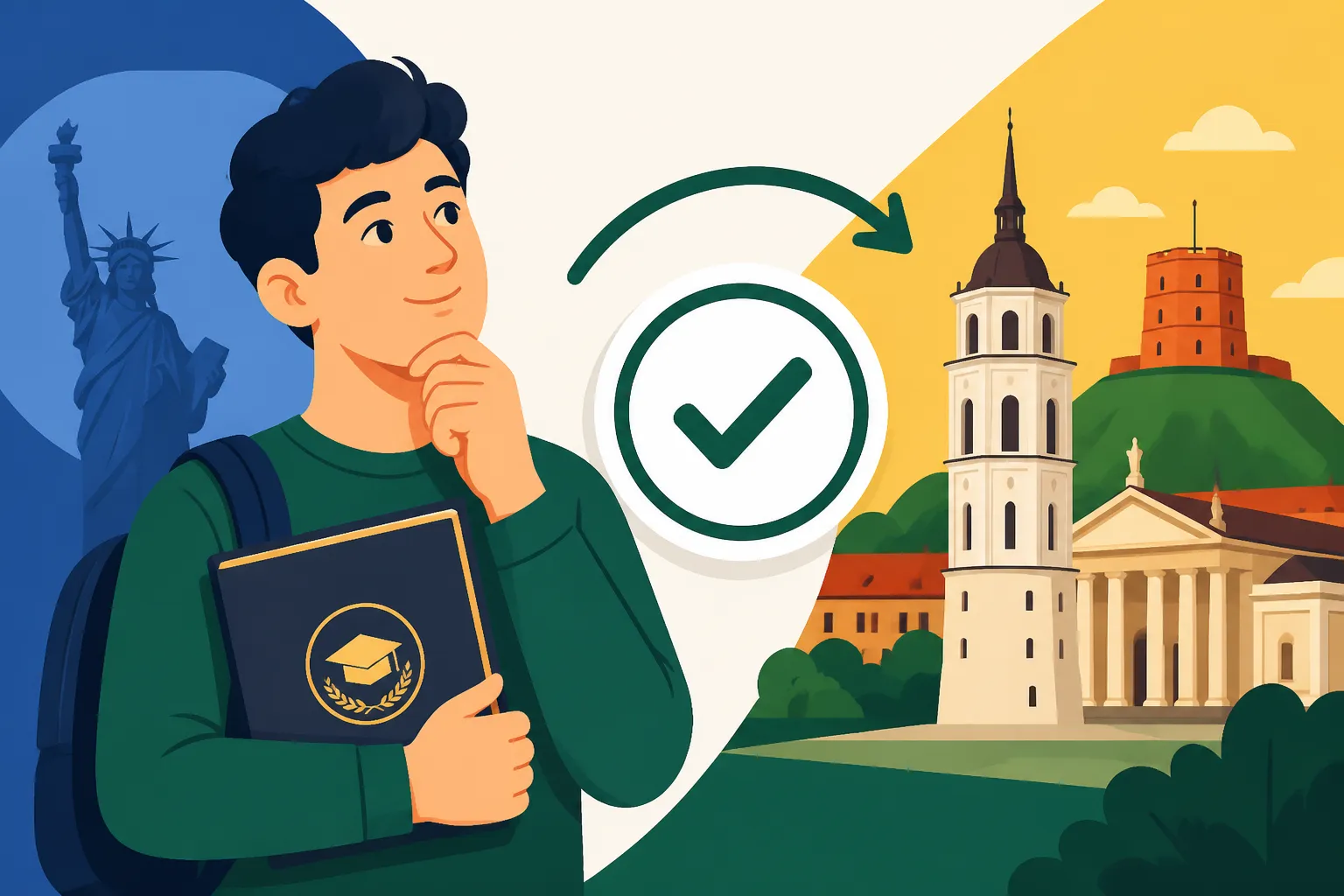
How Do I Get My US Degree Recognised in Lithuania?
Moving to a new country like Lithuania is exhilarating, but trying to navigate the bureaucracy, especially when it comes to something as fundamental as your education, can feel like you've landed on another planet. Many of us arrive with degrees from back home, expecting them to open doors, only to discover a whole new set of hoops to jump through. This guide is here to unravel the mystery of getting your US degree recognized in Lithuania, helping you understand the process, anticipate the challenges, and ultimately, succeed in your new life here.
Understanding the SKVC: Your Gateway to Recognition in Lithuania
So, you’ve landed in Lithuania, perhaps with a job offer, or maybe you’re dreaming of continuing your studies or even just making sure your qualifications are valid for future endeavors. The first thing you'll encounter is the need for your degree to be recognized by the Lithuanian Centre for Quality Assessment in Higher Education, affectionately known as SKVC (Studijų kokybės vertinimo centras). Trust me, this isn't just a formality; it's a crucial step that can impact your entire professional and academic journey here. I remember the headache of gathering documents, wondering if my perfectly valid degree would be seen the same way across an ocean. It’s a common expat experience.
Why Degree Recognition Matters and Who Needs It
Let's be clear: not every single degree needs official SKVC recognition in Lithuania. If you're planning to work for an international company that doesn't strictly adhere to local qualification requirements, or if your role is outside of a regulated profession, you might not immediately need it. However, for the vast majority of expats aiming for long-term integration, it becomes essential.
For instance, if you're looking to work in a regulated profession such as medicine, law, engineering, or teaching, official recognition isn't just helpful, it's mandatory. The Lithuanian state meticulously regulates these fields to ensure public safety and professional standards. Without a recognized degree, you simply won't be able to practice. Imagine getting a fantastic job offer, only to realize you can't start because your qualifications aren't officially approved. That's a nightmare many have faced.
Beyond regulated professions, many Lithuanian employers, especially those in the public sector or larger national companies, will require an SKVC statement to verify your qualifications. They want to know that your shiny US Bachelor's or Master's degree is equivalent to what someone with a Lithuanian degree would hold. It's about ensuring fairness and meeting national standards. Plus, if you ever plan to pursue further education at a Lithuanian university – say, a Master's or a PhD – your previous degree must be recognized by the SKVC for admission purposes. Don't underestimate the long-term benefits; it's an investment in your future here. For more insights into working in this country, check out The Complete Guide to Working in Lithuania as a Foreigner (2027).
The SKVC Process Overview for US Degrees
The SKVC process, while sometimes feeling like a bureaucratic maze, is designed to evaluate your foreign qualification against the Lithuanian higher education system. It's about academic recognition, not professional licensure (though academic recognition is often a prerequisite for professional licensure). For US degrees, the SKVC looks at several factors: the accreditation of your institution, the duration of your studies, the content and workload of your program, and the learning outcomes.
They want to ensure that your US degree, for example, a four-year Bachelor of Arts, aligns with a corresponding Lithuanian Bachelor's degree in terms of scope and depth. The good news is that US degrees from accredited institutions are generally well-regarded globally, and Lithuania is no exception. However, don't expect it to be a simple rubber stamp. The SKVC will meticulously review your documentation.
The process typically involves an online application, submitting a mountain of documents, and then a waiting period while their experts assess everything. This assessment can lead to a few outcomes: full recognition, partial recognition (meaning some additional studies might be required), or, in rare cases, non-recognition. The most common scenario for well-established US degrees from reputable universities is full recognition, but getting there requires diligence and attention to detail during the application phase. Knowing the steps in advance can save you a lot of grief. To get a head start, you might find our guide on How to Get Your Foreign Degree Recognised (SKVC) in Lithuania incredibly useful.
Step-by-Step Guide to Applying for SKVC Recognition from the US
Alright, let's get down to brass tacks. Applying for SKVC recognition can feel daunting, especially when you're dealing with documents from a different country and navigating a new administrative system. But don't worry, I've been there, and with a structured approach, it's entirely manageable. The key is preparation and understanding each step.
Gathering Your Essential Documents
This is where the real work begins. The SKVC requires a comprehensive set of documents to properly evaluate your US degree. Think of it like building a legal case for your education – every piece of evidence matters. Here’s a breakdown of what you’ll likely need:
- Original Diploma or Degree Certificate: You'll need a scanned copy of the original document. Crucially, for US documents to be legally recognized in Lithuania, they often require an apostille. This is a certification issued by your US Secretary of State (usually the state where your university is located) that authenticates the signatures and seals on your document. Do not skip this step. Without an apostille, your document might not be accepted. You'll need to contact the relevant state authority in the US to get this done before you leave, or arrange for someone to do it for you if you're already here.
- Official Academic Transcripts: These are detailed records of all courses you took, grades received, and credits earned. The SKVC needs these to understand the scope and depth of your studies. They typically prefer transcripts sent directly from your US institution to the SKVC, or submitted in a sealed, untampered envelope.
- Course Descriptions/Syllabus: This is often overlooked but incredibly important for US degrees. The SKVC wants to know what you actually learned in each course. Providing detailed course descriptions or a syllabus for relevant subjects helps them match your curriculum to Lithuanian standards. If you don't have these readily available, you'll need to contact your university's department or registrar's office.
- Proof of Change of Name (if applicable): If the name on your diploma or transcripts differs from your current legal name (e.g., due to marriage), you'll need to provide an official document like a marriage certificate.
- Proof of Payment: There's a fee for the SKVC evaluation. Make sure you have proof of this transaction.
- Copy of Your Passport or ID: Standard identification.
- Translations: Any documents not originally in English or Lithuanian (which is unlikely for a US degree, but still good to note) must be translated by a sworn translator. Even for English documents, sometimes the SKVC might request specific translations, although usually, English documents are fine as is. Always double-check their latest requirements.
It’s a tedious process, but gathering everything meticulously from the start will prevent frustrating delays.
Navigating the SKVC Online System
Once you have your documents in order, it's time to hit the digital highway. The SKVC utilizes an online application portal, making it relatively convenient to submit everything from anywhere in the world.
- Register an Account: Head to the official SKVC website and register for a new account. You'll typically need to provide an email and create a password.
- Choose Your Application Type: Select the option for academic recognition of foreign qualifications.
- Fill in Personal Details: Provide all your personal information accurately, including your full name, contact details, and current address. This is also where your How to Get Your Asmens Kodas (Personal Code) and Why It Matters for Healthcare comes in handy if you already have it.
- Upload Documents: Carefully upload the scanned copies of all your prepared documents. Ensure they are clear, legible, and meet any specified file size or format requirements. This is where those apostilled documents and official transcripts come into play.
- Pay the Fee: The application fee is usually paid online through the portal. Keep the receipt!
- Submit the Application: Once all fields are completed and documents uploaded, you'll finalize and submit your application.
After submission, you'll receive a confirmation, usually with a case number. This is your lifeline for tracking your application. The SKVC system is reasonably user-friendly, but remember to take your time and review everything before clicking that final "submit" button. A small error can lead to significant delays.
What Happens After You Submit: The Evaluation Phase
The waiting game begins! Once your application is submitted, the SKVC team of experts gets to work. They will:
- Verify Authenticity: They'll confirm the authenticity of your degree and the accreditation of your US institution. This might involve contacting your university directly, so ensure your university is prepared to respond to such inquiries.
- Assess Equivalence: This is the core of the process. They'll compare your curriculum, study duration, and learning outcomes with comparable Lithuanian higher education programs. They want to ensure your US Bachelor's is truly a Bachelor's by Lithuanian standards, and so on.
- Request Additional Information: It's not uncommon for the SKVC to request further clarification or additional documents during this phase. Don't panic if this happens! Respond promptly and provide whatever they ask for. This could be anything from a more detailed course description to proof of practical experience if your degree had a professional component.
- Issue the Decision: After their assessment, the SKVC will issue a formal statement of academic recognition. This statement will indicate the level of your recognized qualification (e.g., "The Bachelor's degree from [Your University] is recognized as equivalent to a Lithuanian Bachelor's degree").
The processing time can vary significantly. Generally, it can take anywhere from a few weeks to several months, depending on the complexity of your degree, the completeness of your application, and the current workload at the SKVC. It's always best to apply as early as possible. You can find more specific timelines in resources like How Long Does Degree Recognition Through SKVC Take?.
Common Challenges and Tips for US Expats
Many expats struggle with administrative processes, and degree recognition is no exception. It's never as straightforward as you'd hope, but knowing the potential pitfalls can help you navigate them more smoothly.
Addressing Discrepancies and Appeals
Sometimes, despite your best efforts, the SKVC decision might not be what you expected. Perhaps your four-year US Bachelor's is only recognized as equivalent to a Lithuanian professional Bachelor's (which is typically a shorter, more vocationally focused degree), or maybe there's a requirement for supplementary studies. This can be incredibly frustrating, especially when you know the rigor of your US education.
What to do if there's a discrepancy:
- Understand the Reason: The SKVC statement should clearly outline the reasons for any partial recognition or additional requirements. Read it carefully. Often, it comes down to differences in credit systems, program duration, or specific curriculum requirements that don't perfectly align with Lithuanian standards.
- Seek Clarification: If you don't understand the reasoning, contact the SKVC directly. They usually have designated staff who can explain the decision. Be polite but firm in seeking comprehensive answers.
- Consider an Appeal: The SKVC process typically includes an appeal mechanism. If you believe there has been an error in their assessment or if you can provide additional, compelling evidence that was not considered, you have the right to appeal. This usually involves submitting a formal letter of appeal within a specified timeframe, along with any new supporting documentation. For example, if they didn't fully grasp the depth of a particular course, providing the full course syllabus and a letter from your former professor explaining its academic weight could be beneficial.
- Consult an Expert: For complex cases, consider consulting a local legal professional or an education consultant specializing in international qualifications. They can offer guidance on the appeal process and help you strengthen your case.
Remember, a discrepancy isn't necessarily a dead end. It just means you might need to put in a little more effort to ensure your degree gets the recognition it deserves.
Language Barriers and Support
While the SKVC application process and most of their communication can be handled in English, living and working in Lithuania will inevitably expose you to the Lithuanian language. And let's be honest, Lithuanian is not for the faint of heart! Even if the official process is in English, understanding nuances, asking clarifying questions, or dealing with ancillary services (like finding a sworn translator) can be challenging without some local language skills.
- Online Translators: Tools like Google Translate can be helpful for quick understanding, but never rely on them for official documents or complex communications.
- Friends or Colleagues: If you have Lithuanian friends or colleagues, don't be shy about asking for help with interpreting something tricky. Most Lithuanians are happy to assist.
- Language Learning: Seriously consider investing some time in learning Lithuanian. Even basic phrases can make a huge difference in your daily life and administrative interactions. Platforms like iTalki offer personalized language lessons with native speakers, which can be incredibly useful for picking up practical conversational skills. The better you understand the language, the more confidently you can navigate the system. It also helps with integration and finding local employment opportunities. For a more structured approach, you can explore resources like Learning Lithuanian: A Complete Guide to Language Courses and Levels.
- Professional Assistance: For critical situations where precise understanding is paramount, hire a professional interpreter or a local administrative assistant.
| Document Type | Requirement for US Degrees | Notes |
|---|---|---|
| Diploma/Degree Certificate | Scanned original, Apostilled | Apostille usually obtained from the Secretary of State in the US state where the university is located. Crucial for legal validity in Lithuania. |
| Official Academic Transcripts | Scanned original, often preferred from institution direct | Must be comprehensive. If sent by you, ensure they are in a sealed, untampered envelope from the university. |
| Course Descriptions/Syllabus | Highly recommended, especially for specific programs | Detailed outlines of courses help SKVC assess content equivalence. Contact your university's department or registrar. |
| Passport/ID | Scanned copy | For identification purposes. |
| Proof of Name Change | Scanned official document (e.g., marriage certificate) | If names on documents differ. |
| Translation | Generally not needed for English, but be prepared | SKVC typically accepts English documents. For any other language, a sworn translation into Lithuanian or English is required. |
| Application Fee Proof | Confirmation of payment | Keep your receipt from the online application. |
Professional Licensure vs. Academic Recognition
This is a critical distinction that often confuses expats. The SKVC is primarily responsible for academic recognition. This means they assess whether your US degree is academically equivalent to a Lithuanian higher education qualification. This recognition is generally sufficient for general employment or further studies.
However, if you intend to work in a regulated profession (e.g., doctor, nurse, architect, lawyer, teacher), academic recognition by the SKVC is usually just the first step. After obtaining your SKVC statement, you will likely need to apply to a separate professional body in Lithuania for professional licensure. These bodies have their own set of requirements, which might include:
- Clinical practice hours: For medical professions.
- Internships or apprenticeships: For fields like law or architecture.
- Language proficiency exams: Often mandatory for direct interaction with the public, especially in healthcare or teaching. For instance, you might pass your SKVC, but then need to demonstrate a C1 level of Lithuanian to practice medicine.
- Specific local training or exams: To ensure you understand Lithuanian laws, regulations, or practices pertinent to your field.
For example, a US-trained doctor would get their medical degree recognized by the SKVC, but then need to apply to the Lithuanian Ministry of Health or the relevant medical chamber for a license to practice. The requirements can be extensive and specific to each profession. It's vital to research the specific professional body for your field in Lithuania early on to understand all the steps involved. Don't wait until your SKVC recognition is complete, only to discover another year of requirements. This is part of the broader administrative challenge expats face, much like navigating The Complete Guide to Lithuanian Residence Permits for Expats (2027).
Making sure your degree is officially recognized is just one piece of the expat puzzle in Lithuania. Once you're cleared to work or study, you'll also be thinking about things like your employment contract and worker rights, and of course, your The Complete Guide to Taxes in Lithuania for Expats (2027). Each step requires a bit of research and a lot of patience, but it's all part of building your life here.
Getting your US degree recognized in Lithuania might feel like an arduous journey, but it's a worthwhile one. It's the key to unlocking many professional and academic opportunities and fully integrating into your new home. By understanding the SKVC's role, meticulously preparing your documents, and being ready to address any challenges, you can navigate this process successfully. Remember, countless expats have walked this path before you, and you're not alone in facing these administrative hurdles. Embrace the challenge, stay organized, and before you know it, your US qualifications will be officially recognized and valued in Lithuania.
Disclaimer
This article is for general informational purposes only and does not constitute professional advice. Laws, prices and regulations vary by location and change over time. Consult a qualified professional for guidance on your specific situation.