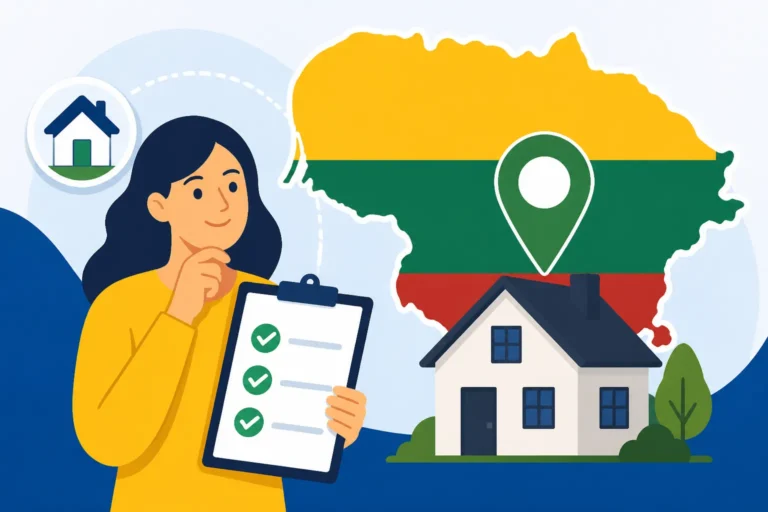
How to Declare Your Place of Residence (Gyvenamoji Vieta) in Lithuania
Oh, the sheer joy (and occasional headache) of settling into a new country! One of the first, and often most bewildering, tasks you’ll face in Lithuania is declaring your place of residence, or as the locals call it, Gyvenamoji Vieta. It sounds straightforward enough, but trust me, navigating the bureaucracy can feel like a labyrinth, especially when you’re still getting your bearings. This isn't just a formality; it's a fundamental step that unlocks everything else, from getting your local ID to accessing healthcare. This guide will walk you through every twist and turn, demystifying the process so you can get this essential task done with minimal fuss and maximum understanding.
Why Declaring Your Residence (Gyvenamoji Vieta) Is Non-Negotiable
When you first arrive in Lithuania, you're probably eager to explore the cobbled streets of Vilnius, perhaps taste some šaltibarščiai, and maybe even figure out how the buses work. But tucked away amidst the excitement is a critical administrative step: declaring your Gyvenamoji Vieta. This isn't just Lithuanian officialdom being picky; it's the bedrock upon which your entire life as a resident here will be built. Skipping it, or delaying it, can lead to a whole heap of problems down the line, this is a common outcome.
The Legal Obligation and Its Importance
Lithuanian law is pretty clear on this: if you plan to live in the country for more than six months, or if you're an EU/EEA citizen staying for more than three months, you absolutely must declare your place of residence. This legal requirement applies to everyone, regardless of your nationality or the reason for your stay. It's how the state keeps track of its residents for various administrative, social, and economic purposes. Think of it as officially telling the country, "Hey, I'm here now, and I'm putting down roots." Without this declaration, you're essentially invisible to the system in many crucial ways.
The significance goes beyond just ticking a box. Your declared residence is directly linked to your Asmens Kodas, or personal code, which is your unique identifier here. Without a valid Gyvenamoji Vieta, you might struggle with everything from getting your proper tax residency sorted to simply proving you live here when dealing with banks or utility companies. It’s the foundational piece of your administrative puzzle. For those coming from outside the EU, this often goes hand-in-hand with your residence permit application process, making it even more intertwined and time-sensitive.
Unlocking Essential Services and Rights
Declaring your Gyvenamoji Vieta is the key that unlocks a myriad of essential services and rights that you'll need as an expat. Imagine trying to open a bank account, register for local healthcare, or even get a library card without a proper address on file – it's often impossible. Your declared residence is the formal proof of your address, and almost every institution in Lithuania will ask for it. It's not just about proving where you sleep; it's about proving you're a legitimate resident with access to public services.
For instance, once your residence is declared, you can then proceed with things like registering for compulsory health insurance (PSD) through Sodra, ensuring you have access to the public healthcare system. This also affects your ability to enroll children in local schools or kindergartens, as residence within a certain catchment area is often a prerequisite. Even mundane tasks like getting your mail delivered correctly become smoother once you're officially on the grid. So, while it might seem like just another bureaucratic hurdle, it's actually your passport to truly integrating and enjoying life in Lithuania.
Who Needs to Declare Their Residence and When
Understanding who needs to declare their residence and the timeline for doing so is crucial to avoiding any unnecessary stress or penalties. The rules can vary slightly depending on your citizenship and the duration of your stay, so let's break it down to ensure you're always on the right side of Lithuanian law.
EU/EEA Citizens vs. Third-Country Nationals
The requirements for declaring residence differ slightly based on your nationality.
-
For EU/EEA Citizens: If you're a citizen of an EU or EEA country and plan to stay in Lithuania for longer than three months, you are legally obliged to declare your place of residence. This is part of exercising your right of free movement but still requires a formal notification to the Lithuanian authorities. While you don't typically need a separate residence permit (like non-EU citizens), this residence declaration is still mandatory. It confirms your presence and allows you to access various social rights and services on par with Lithuanian citizens. Think of it as a crucial step for becoming a proper resident, not just a long-term visitor. You'll likely also need to formally Declare Your Right of Residence as an EU Citizen in Lithuania which runs in parallel with the Gyvenamoji Vieta process.
-
For Third-Country Nationals (Non-EU/EEA): If you're coming from outside the EU/EEA, declaring your place of residence is an integral part of your overall immigration process. It's almost always a prerequisite for obtaining or maintaining your The Complete Guide to Lithuanian Residence Permits for Expats (2027). Whether you're here on a work visa, a student visa, or for family reunification, you'll need a valid declared address. In many cases, you'll have to provide proof of accommodation (like a rental contract) even before your residence permit is issued, and then declare your actual residence once you arrive and settle into that accommodation. The process is often more tightly integrated with the Migration Department (MIGRIS) procedures.
The Crucial 30-Day Window (or sooner!)
Regardless of whether you're an EU/EEA citizen or a third-country national, there's a critical timeframe you need to be aware of. Generally, you are required to declare your place of residence within 30 days of your arrival in Lithuania or within 30 days of changing your permanent address within Lithuania. This 30-day clock starts ticking from the moment you establish your actual place of abode.
For non-EU citizens, this often means the clock starts ticking from the date your temporary residence permit (TRP) or national D visa becomes active and you physically move into your long-term accommodation. For EU citizens, it's 30 days from when you establish your presence beyond the initial three-month tourist period. Missing this deadline can lead to complications and, in some cases, even minor fines, though authorities are usually more concerned with getting you registered than penalizing immediately. It's always best to get this done as soon as you have your long-term accommodation secured and your other initial paperwork (like your Asmens Kodas) in progress. Don't wait until the last minute – dealing with bureaucracy is rarely a quick dash!
The Step-by-Step Process for Your Gyvenamoji Vieta
Okay, now that we understand why and when to declare, let's dive into the nitty-gritty of how. This process largely happens through the Registrų Centras (Registry Centre), which is the official body responsible for maintaining property and population records in Lithuania. You have a couple of options for getting this done, but regardless of your chosen method, preparation is key.
Gathering Your Arsenal of Documents
Before you even think about stepping into an office or logging onto a portal, make sure you have all your ducks in a row. The documents required aren't overly complex, but missing even one piece can send you back to square one, which is always frustrating.
Here's a typical checklist of what you'll need:
- Valid Identification Document:
- For EU/EEA citizens: Your national ID card or passport.
- For third-country nationals: Your passport and your temporary residence permit (TRP) card or national D visa.
- Proof of Right to Occupy the Premises: This is the most crucial document related to your actual address.
- If you're renting: Your valid rental contract (Nuomos sutartis). Make sure it's properly signed by both you and the landlord. Ideally, the landlord will have registered this contract with Registrų Centras, but even if not, your signed copy is usually sufficient for your declaration. It’s also wise to understand How to Sign a Rental Contract (Nuomos Sutartis) in Lithuania properly to protect yourself.
- If you own property: Documents proving ownership, such as the notarised purchase agreement or an extract from the Understanding the Real Property Register (Registrų Centras) in Lithuania.
- If you're staying with friends/family: A consent form (Sutikimas) from the property owner(s) allowing you to declare residence at their address. This form usually needs to be signed in front of a notary or, if the owner logs in through the E-Government Gateway, they can provide digital consent.
- Application Form: You'll need to fill out a specific application form for residence declaration (Prašymas įregistruoti gyvenamąją vietą). This can often be found on the Registrų Centras website or provided at their offices.
- Asmens Kodas (Personal Code): While you might not always need it for the initial application, having your Lithuanian personal code beforehand makes the entire process infinitely smoother. It's often required for the online services and links all your official records. If you haven't got one yet, you'll need to sort out How to Get Your Asmens Kodas (Personal Code) and Why It Matters for Healthcare – it's fundamental for almost everything here.
It’s always a good idea to bring originals and a few photocopies of everything. Sometimes, they ask for copies, sometimes they scan the originals. Better safe than sorry!
Navigating the Registrų Centras (Registry Centre)
This is the traditional, in-person method, and for many expats, especially those less comfortable with Lithuanian or digital systems, it can feel more reassuring. Registrų Centras has client service offices in major cities like Vilnius, Kaunas, and Klaipėda.
Here’s what to expect:
- Book an Appointment: While you might be able to walk in, booking an appointment online through the Registrų Centras website is highly recommended. This saves you from potentially long waiting times. Navigate to their "Užsakyti vizitą" section and choose the service related to "Gyvenamosios vietos deklaravimas."
- Attend Your Appointment: On the day, arrive a little early. Take a number if there’s a queue system, even with an appointment. When your number is called, present your documents to the specialist.
- Language Barrier: Be prepared for a potential language barrier. While some staff may speak English, it's not guaranteed. Having a Lithuanian-speaking friend with you or using a translation app can be a lifesaver. Keep your documents organised and clearly presented, as this can help bridge communication gaps.
- Processing Time: The declaration is often processed on the spot, and you might receive an immediate confirmation or a printout. Sometimes, they might tell you it will be processed within a few days. Don't forget to eventually request How to Get Proof of Address (Pažyma) from Registrų Centras in Lithuania if you need a formal certificate for other administrative purposes. This document is often crucial for banks or other official bodies that require proof of your current residency.
The Online Declaration via E-Government Gateway
For those who are tech-savvy and have their Lithuanian electronic signature (e.g., mobile signature or ID card with chip reader) or online banking access for identification, declaring your residence online is often the quickest and most convenient option. This is done through the official Understanding the E-Government Gateway (Elektroniniai Valdžios Vartai) in Lithuania.
Here’s how to do it:
- Access the Portal: Go to the E-Government Gateway (www.epaslaugos.lt).
- Log In: You’ll need to log in using one of the available electronic identification methods. For most expats, this will be through your Lithuanian online banking credentials (Swedbank, SEB, Luminor, etc.) or a mobile signature. This ensures that your identity is verified securely.
- Find the Service: Search for "Gyvenamosios vietos deklaravimas" or "Declaration of place of residence." The interface might be in Lithuanian, so a browser translator can be useful, or having someone guide you the first time.
- Fill Out the Form: The online form will prompt you to enter details about your new address, your personal information, and the basis for your right to occupy the premises (e.g., rental contract number, property ownership details).
- Attach Documents (if necessary): Depending on the situation (e.g., needing to upload a scanned consent form from an owner), you might be asked to attach digital copies of your supporting documents. If your landlord is also registered online, they might be able to provide digital consent for you to declare at their property, which simplifies things immensely.
- Submit and Confirm: Review all the information carefully before submitting. You should receive an electronic confirmation once the declaration is successfully registered. The system is pretty robust, so once confirmed, you're usually good to go.
The online method truly streamlines the process, but it does require you to be a bit further along in your administrative setup, particularly with having access to Lithuanian online banking or an electronic signature. For those just landing, and perhaps using international eSIMs like Airalo for initial connectivity, the online declaration might be a step or two down the road.
Common Pitfalls and Troubleshooting for Expats
Even with the best intentions and all documents in hand, the path to Gyvenamoji Vieta can have its bumps. Anticipating these common issues can save you a lot of grief.
Language Barriers and What to Do
One of the most frequent hurdles expats face in Lithuania, especially outside the bustling international hubs of Vilnius or Kaunas, is the language barrier. While many younger Lithuanians speak excellent English, not all civil servants, particularly in smaller towns or older generations, might be fluent. This can turn a simple administrative task into a frustrating pantomime.
- Bring a Friend: The easiest solution is to bring a Lithuanian-speaking friend or colleague along to your Registrų Centras appointment. Their assistance can be invaluable for understanding questions, clarifying information, and ensuring everything is communicated correctly.
- Use Translation Apps: If a friend isn't available, don't underestimate the power of Google Translate or similar apps. While not perfect, they can certainly help with basic communication. Type out your key phrases in advance (e.g., "I want to declare my residence," "Here is my rental contract," "I need proof of address").
- Prepare Key Phrases: Even if you don't speak Lithuanian, memorizing a few polite phrases can go a long way. "Laba diena" (Good day), "Ačiū" (Thank you), and "Aš noriu deklaruoti gyvenamąją vietą" (I want to declare my place of residence) are good starters.
- Be Patient and Polite: Remember, civil servants are just doing their jobs. Frustration won't speed things up. A smile and a polite demeanor, even if you're struggling to understand each other, can make a huge difference in their willingness to help.
When Your Landlord Isn't Cooperating
This is a particularly thorny issue that pops up more often than you'd think. Declaring your residence legally requires the property owner's consent or a valid rental agreement. What happens if your landlord is hesitant, or flat-out refuses, to cooperate? This is where understanding your rights and the legal framework is crucial.
- Unregistered Contracts: Some landlords might rent properties without officially registering the rental agreement or declaring the rental income. In such cases, they might be reluctant to provide consent for your Gyvenamoji Vieta declaration because it puts them on the official radar. This is a big red flag, not just for your residence declaration but for your overall legal protection as a tenant. A properly drafted and signed How to Sign a Rental Contract (Nuomos Sutartis) in Lithuania is your first line of defense.
- Insist on a Proper Contract: When looking for a place to rent, always insist on a formal, written rental contract. This document is your primary proof of your right to reside at the property. Without it, declaring your residence becomes incredibly difficult, if not impossible. Be wary of landlords who only want "handshake agreements" or informal arrangements – it leaves you vulnerable. For comprehensive guidance on rental agreements, refer to The Complete Guide to Renting an Apartment in Lithuania (2027).
- Inform Your Landlord: Make sure your landlord understands that declaring your residence is a legal requirement for you. Explain that it benefits you, not them, directly (though indirectly, it ensures legal tenancy). Some landlords are simply uninformed about the process for expats.
- Legal Recourse (Last Resort): If you have a valid, signed rental contract but the landlord still refuses to provide the necessary consent (if required, e.g., for non-contractual stays or when the contract itself isn't sufficient for the online portal), you might need to seek legal advice. In some extreme cases, a tenant can declare residence through court order, but this is a lengthy and costly process that you absolutely want to avoid. This highlights why thorough vetting of landlords and properties is so important when moving abroad, perhaps with the help of international moving services like Sirelo that also offer advice on local property laws.
Special Cases: Owning Property or Short-Term Rentals
The general rules cover most situations, but there are always nuances.
-
Owning Property: If you've gone through the process of How to Buy Property in Lithuania as a Foreigner: The Full Guide (2027), declaring your residence is quite straightforward. You will use your property ownership documents (e.g., notarised sales contract, extract from Registrų Centras) as proof of your right to occupy the premises. In this case, you are the owner, so no third-party consent is needed. This is often the most hassle-free scenario. Just remember that owning property also comes with obligations like Understanding Real Estate Tax (NTM) for Homeowners in Lithuania.
-
Short-Term Rentals/Temporary Stays: This is where it gets tricky. If you're staying in a hotel, Airbnb, or very short-term rental (e.g., less than 3 months for EU citizens or before your TRP is issued for non-EU citizens), you generally cannot declare that as your permanent Gyvenamoji Vieta. The system is designed for long-term residency. If you are waiting for a permanent place, you might be in a bit of a limbo. In such situations, your temporary address might be sufficient for initial permit applications, but you will need to update it once you secure a long-term home. It's important to understand that your declared residence must reflect your actual long-term place of abode. Do not try to declare residence at a temporary or non-existent address, as this can lead to serious legal issues.
What Happens After You Declare Your Residence
Congratulations, you've done it! You've navigated the bureaucratic maze and officially declared your Gyvenamoji Vieta. But the journey doesn't quite end there. This crucial step has implications for several other aspects of your life in Lithuania, and it's good to be prepared for what comes next.
Receiving Your Proof of Address
Once your residence declaration is successfully processed, whether in person or online, you'll want to ensure you have an official document proving it. This is typically a "Pažyma apie deklaruotą gyvenamąją vietą" (Certificate of Declared Place of Residence).
- Online Confirmation: If you declared online, you can usually download or print this certificate directly from the E-Government Gateway or the Registrų Centras e-services portal. It will be an official document, often with a QR code or digital signature for verification.
- In-Person Collection: If you declared in person at Registrų Centras, they might provide a printout on the spot, or inform you that it's available for collection after a few days. Always confirm how and when you can get this physical proof.
- Why You Need It: This certificate will be requested by various institutions for myriad reasons: opening a bank account, registering with a family doctor (šeimos gydytojas) at a local polyclinic, enrolling children in school, and even some visa or residence permit renewals. Consider it an essential document to keep safe with your other important papers.
Updating Other Registries and Services
Declaring your Gyvenamoji Vieta is often the trigger for updating your information in other important registries and with service providers. While some systems are interconnected, don't assume that a change in one place automatically updates everything. It's better to be proactive.
- MIGRIS (Migration Department): If you are a non-EU citizen and your residence permit is tied to your address, you might need to notify MIGRIS of your new declared address, especially if it changed during your permit's validity period or if you move between different cities. They need to know where you officially reside.
- Sodra: Your social insurance contributions and benefits are linked to your declared residence. While your Asmens Kodas is the primary identifier, having an up-to-date address ensures smooth communication and accurate records, especially for things like Understanding PSD Contributions Through Sodra in Lithuania or any social benefits.
- Banks: Most banks will require proof of your current address. If you declared residence after opening your initial bank account (perhaps with a temporary address), make sure to update it with your bank. This is crucial for receiving official correspondence and ensuring smooth transactions.
- Utilities: When setting up services like electricity, water, heating, and internet, your declared residence will be the address associated with your accounts. If you moved, ensure you've formally transferred or set up How to Set Up Electricity (ESO) in Your Lithuanian Home and other Understanding Utility and Communal Costs (Komunaliniai Mokesčiai) in Lithuania in your name at your new declared address.
- Tax Authority (VMI): While your tax residency is determined by various factors, having your current declared Gyvenamoji Vieta on record with the Lithuanian Tax Authority (VMI) is important for any tax-related correspondence or claims, such as filing your annual income tax return.
Understanding Future Residence Updates
Life as an expat often involves moving around, whether within Lithuania or internationally. Your Gyvenamoji Vieta declaration isn't a one-and-done deal if your circumstances change.
- Changing Address Within Lithuania: If you move to a new apartment or house within Lithuania, you are legally obliged to declare your new place of residence within 30 days. The process is identical to your initial declaration, requiring proof of your right to occupy the new premises. Don't neglect this step, as having an outdated declared address can cause issues with mail, official notices, and service providers.
- Leaving Lithuania Permanently: If you decide to leave Lithuania for good, you should also declare your departure from the country. This involves submitting a declaration of departure (Deklaravimas apie išvykimą) to Registrų Centras. This is important for tax purposes, social insurance, and ensuring your administrative ties to Lithuania are properly severed. It prevents you from being considered a resident for certain obligations once you've truly moved on. While it might seem like a small detail in the chaos of moving, it's an important final administrative step to wrap up your life in Lithuania cleanly.
It might feel like a never-ending paper trail, but tackling each step methodically, like declaring your Gyvenamoji Vieta, makes the whole expat experience much smoother. Good luck, and welcome to the official resident club!
Disclaimer
Please note that the information provided in this guide is intended for general informational purposes only and does not constitute legal, financial, or immigration advice. While every effort has been made to ensure accuracy and up-to-date information, laws and procedures in Lithuania can change. It is always recommended to consult with official government sources (such as the Migration Department, Registrų Centras, or Sodra), legal professionals, or immigration specialists for advice tailored to your specific situation. Reliance on any information provided in this article is solely at your own risk.